MSI Debuts MEG Vision X2 AI+ Desktop Featuring ‘Holographic’ AI Companion
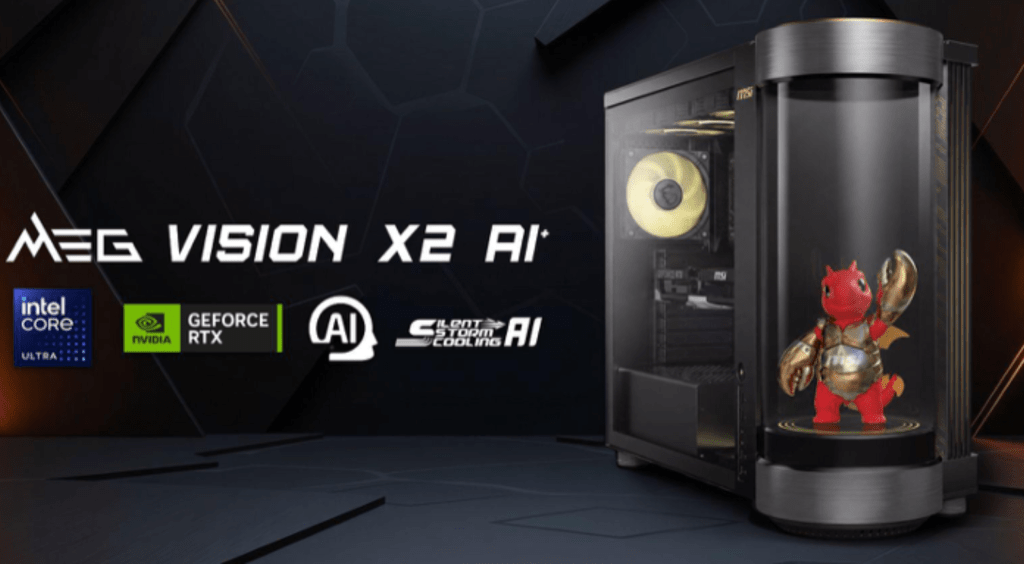
Table of Contents
The Integration of Agentic AI into Desktop Hardware
At Computex, MSI unveiled the MEG Vision X2 AI+, a high-end gaming desktop that attempts to move AI beyond the software layer and into the physical chassis of the machine. The standout feature is not the raw processing power, but the “AI Holostage”—a dedicated holographic display embedded in the front of the case that houses an agentic AI companion named LuckyClaw.
LuckyClaw is presented as more than a mere visual gimmick. According to MSI, the AI companion is designed to provide hands-free control over the system’s most granular settings. This includes toggling performance profiles, adjusting monitor configurations, and managing the complex RGB lighting arrays typical of the MEG series. By utilizing voice commands processed through the Holostage, users can theoretically tweak their environment without Tab-Alt switching or diving into software menus mid-game.
The industry is currently seeing a surge in “AI-integrated” peripherals, with Razer previously experimenting with similar virtual assistants. MSI’s approach is more aggressive, dedicating physical screen real estate to a digital entity. The company has noted that the Holostage is not limited to LuckyClaw; it is compatible with third-party digital companions and custom AI avatars, suggesting an open ecosystem for “desktop pets” or branded AI personas.
Technical Ambiguity and Performance Overhead
While the visual presentation of a 3D avatar in a “holographic jar” is striking, the technical implementation remains opaque. MSI’s promotional materials confirm the use of Intel and Nvidia components, but a full hardware specification list was absent from the Computex reveal. For power users, the primary concern is the resource cost of maintaining a persistent, animated AI agent. Whether the Holostage runs on a dedicated low-power microcontroller or draws from the system’s primary GPU and NPU (Neural Processing Unit) will determine if this feature is a luxury or a performance bottleneck.
Furthermore, the promise of “future skill updates” for the AI suggests a software-as-a-service model. If LuckyClaw requires a cloud connection to process complex requests or a subscription to unlock advanced system controls, the value proposition for a hardware-integrated assistant becomes more complicated.
Beyond the Desktop: Van Gogh Edition Laptops
Alongside the experimental MEG Vision X2, MSI introduced a more traditional but aesthetically distinct expansion to its laptop lineup. The Prestige 14 Flip AI+ is receiving special editions featuring the artwork of Vincent van Gogh. Two specific variants have been spotted: Starry Night and Starry Night Over the Rhone, both featuring lids emblazoned with the iconic paintings and a matching blue aluminum chassis.
Under the hood, the Prestige 14 Flip AI+ is built for the modern AI-PC era, utilizing Intel Core Ultra processors and featuring high-contrast OLED displays. MSI claims a battery life of up to 30 hours, positioning the device as a productivity tool for creators who want a blend of artistic flair and efficiency. The base model for this series typically starts around $1,500, though pricing for the Van Gogh editions has not yet been formalized.
The MEG Vision X2 AI+ is expected to command a significant premium given its niche display technology. While a release date hasn’t been set, industry trends suggest a late 2024 or early 2025 rollout, coinciding with the wider adoption of AI-native hardware across the gaming sector.


