Logitech Tries to Solve the ‘Trackpad Struggle’ With the Mobi Fold
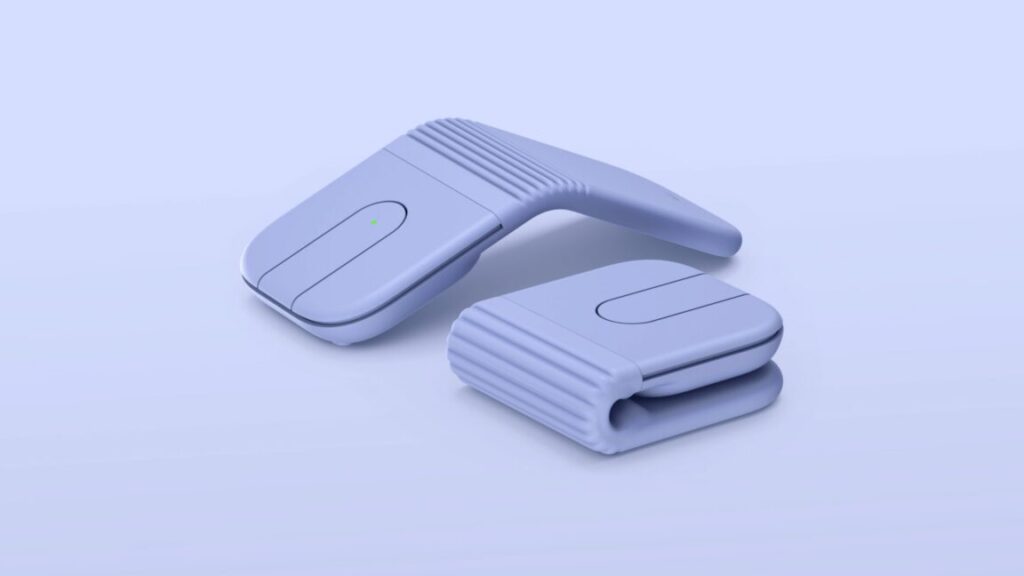
Table of Contents
The portability paradox of the mobile office
Walk into any crowded airport lounge or urban coffee shop and you’ll see the same scene: professionals hunched over laptops, their wrists locked in an awkward angle as they navigate complex spreadsheets or emails via a built-in trackpad. There is a clear tension between the desire for a precise pointing device and the friction of carrying one in a slim laptop sleeve.
Logitech is betting that a folding hinge is the solution to this friction. The company has officially launched the Mobi Fold, a wireless mouse priced at $80 that aims to bridge the gap between the compactness of a trackpad and the efficiency of a dedicated peripheral. According to Logitech, their internal data suggests a significant usage gap: while 72 percent of professionals own a mouse, only 26 percent actually use one when working in public spaces. The Mobi Fold is a direct attempt to capture that missing 46 percent by removing the bulk associated with traditional travel mice.
Engineering the bend
The defining feature of the Mobi Fold is its accordion-shaped silicone hinge, which allows the device to pivot at roughly 130 degrees. This transforms the mouse into a flat, compact object that fits easily into a pocket or a crowded bag. Beyond the physical fold, Logitech has integrated a series of smart triggers to minimize user annoyance. The device features an automatic power toggle; it wakes up when unfolded and sleeps when closed, removing the common frustration of forgetting to flip a physical power switch before packing up.
To prevent accidental clicks during the folding process, Logitech implemented a lift-sensing mechanism. When the mouse detects it has been raised from the surface, the primary buttons are disabled, though the tracking and touch-based scrolling remain active. Durability is also a key talking point, with official datasheets claiming the device is rated for 50,000 fold/unfold cycles under controlled conditions.
Ergonomics vs. Portability
However, the Mobi Fold represents a classic engineering trade-off. While the device is impressively small—clocking in at 2.79 ounces and occupying only 4.83 cubic inches when folded—the resulting shape is far from ergonomic. When deployed, the mouse creates a sharp, tented angle that doesn’t naturally contour to the palm. Compared to the rounded arch of the Microsoft Surface Arc Mouse or the twisting mechanism of the Dell MS700, the Mobi Fold feels more utilitarian than comfortable.
Tactility also takes a hit. The traditional scroll wheel has been replaced by a touch panel, and the left and right buttons are notably flat. While two programmable buttons are tucked under the touch panel, they rely entirely on the Logi Options+ software. Because the device lacks onboard memory, your custom shortcuts won’t follow you if you switch to a computer that doesn’t have the software installed—a frustrating trend in recent Logitech releases that increases dependency on the app ecosystem.
The MX Anywhere Alternative
For the power user, the Mobi Fold faces a steep challenge from within its own product line. The Logitech MX Anywhere 3S remains the gold standard for mobile productivity. While the Anywhere 3S is heavier (3.49 ounces) and bulkier, it offers a superior ergonomic hump and a far more tactile scroll wheel.
The battery life discrepancy is also telling. The Mobi Fold offers roughly 30 days of use on a charge, whereas the MX Anywhere 3 can push up to 70 days. However, the Mobi Fold does hold one significant advantage: a replaceable, rechargeable battery, which extends the long-term lifespan of the hardware compared to the sealed units found in most high-end wireless mice.
Logitech claims the Mobi Fold reduces muscle strain by 22 percent compared to a laptop trackpad. While that may be technically true, users who prioritize wrist health over absolute minimalism may find that the slight increase in bulk provided by the MX series is a price well worth paying.