Lenovo’s ThinkStation P4 Bets Big on Blackwell GPUs and Ryzen 9000 to Solve the Local AI Bottleneck
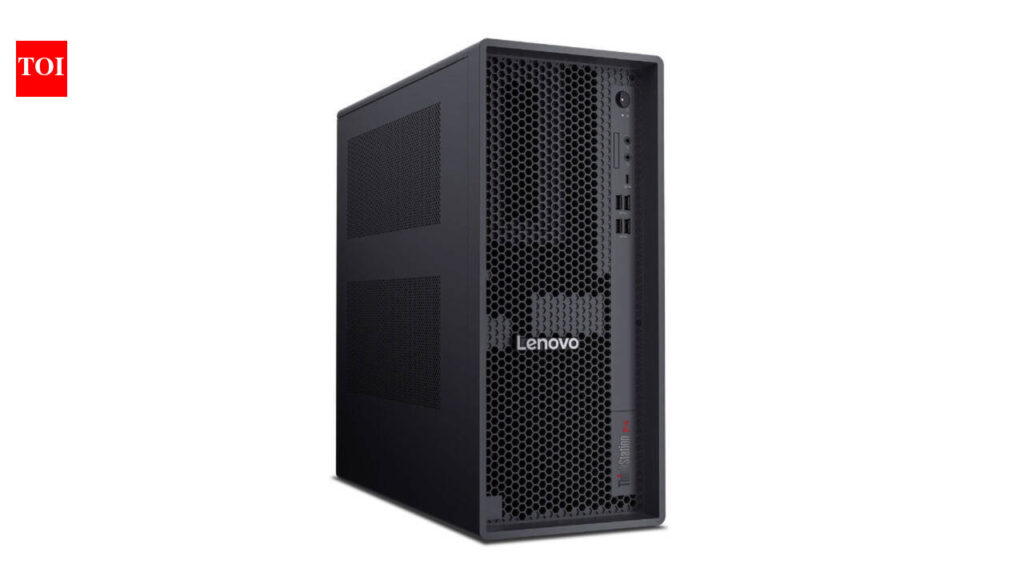
Table of Contents
Moving AI Off the Cloud
For the last two years, the narrative around AI has been dominated by the cloud. From Midjourney to ChatGPT, the heavy lifting happens in massive data centers, leaving the user’s hardware as little more than a portal. But for engineers, data scientists, and high-end creative professionals, the latency and privacy concerns of the cloud are becoming deal-breakers. Lenovo is attempting to address this with the launch of the ThinkStation P4, a workstation designed specifically to bring massive compute power back to the desk.
The P4 isn’t just a spec bump; it’s a calculated alignment with the current shift toward ‘Local AI.’ By pairing AMD’s latest silicon with Nvidia’s newest architecture, Lenovo is targeting a niche where the demand for VRAM and raw throughput outweighs the convenience of a subscription-based API.
The Silicon Core: AMD’s 3D V-Cache Advantage
At the heart of the ThinkStation P4 are the AMD Ryzen PRO 9000 Series processors. While clock speeds are always a highlight, the real story here is the integration of 3D V-Cache. In traditional computing, the CPU often spends precious cycles waiting for data to arrive from the RAM. 3D V-Cache stacks additional L3 cache vertically on the die, drastically reducing that latency.
For AI developers training small-to-medium language models (SLMs) or running complex physics simulations, this cache density is critical. It allows the P4 to handle larger datasets directly on the processor, minimizing the bottlenecks that typically plague workstation-class desktops. This makes the P4 a formidable tool for those who need the stability of a PRO-series chip with the performance of an enthusiast-grade gaming CPU.
Blackwell Power: The RTX PRO 6000 Integration
While the CPU manages the workflow, the Nvidia RTX PRO 6000 Blackwell GPUs handle the heavy lifting. The move to the Blackwell architecture represents a significant leap in tensor core efficiency. Unlike the consumer-grade RTX 40-series, the PRO 6000 is built for endurance and massive memory footprints, allowing professionals to load larger AI models into VRAM without crashing.
The synergy between the Ryzen 9000 and the Blackwell GPU allows the ThinkStation P4 to function as a local inference node. This is particularly relevant for industries like medical imaging or autonomous vehicle simulation, where sending sensitive data to a third-party cloud is a regulatory non-starter. The ability to run high-parameter models locally, with the thermal headroom of a dedicated workstation chassis, gives Lenovo a competitive edge over the more streamlined, but thermally constrained, laptop offerings from competitors.
Thermal Management and Industrial Design
Power is useless if the system throttles. Lenovo has redesigned the P4’s thermal architecture to accommodate the heat output of the Blackwell GPUs. The chassis utilizes a high-airflow design that prioritizes keeping the VRAM cool during long render cycles or training runs—tasks that can often push hardware to its limits for days at a time.
Positioning in a Crowded Market
The ThinkStation P4 enters a market where Dell’s Precision line and HP’s Z-series have long held sway. However, by leaning heavily into the AMD/Nvidia hybrid stack, Lenovo is positioning itself as the ‘performance-first’ option. The P4 isn’t trying to be a general-purpose office PC; it’s a specialized tool for the era of generative AI.
As enterprises move away from the ‘experimentation’ phase of AI and into the ‘implementation’ phase, the need for reliable, local hardware will only grow. The ThinkStation P4 is Lenovo’s bet that the future of professional AI isn’t just in the cloud, but sitting right under the desk.


