Lenovo’s ThinkStation P4 Bets Big on AMD 3D V-Cache and Blackwell GPUs for the AI Era
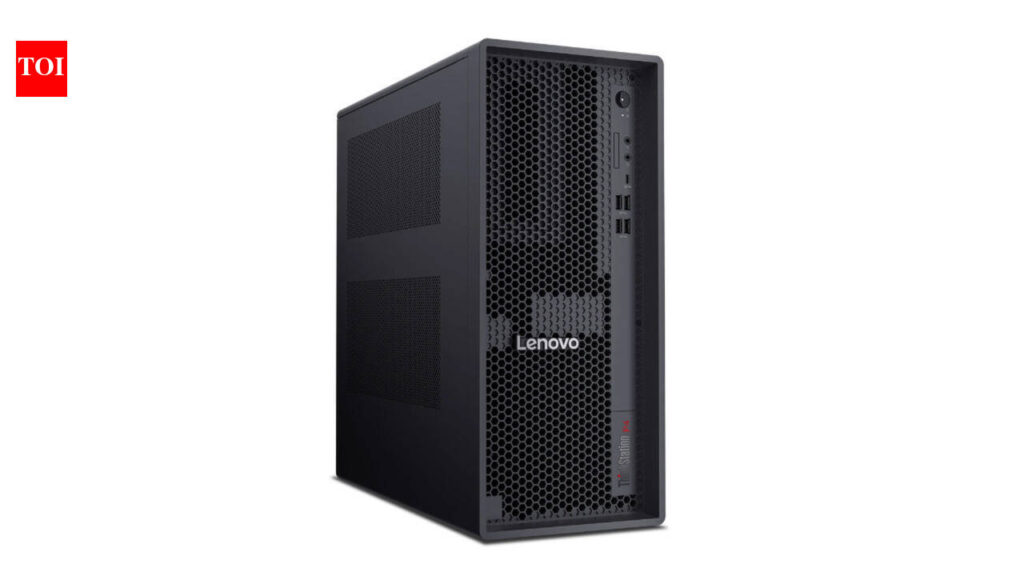
Table of Contents
A Shift Toward Localized AI Compute
Lenovo has officially unveiled the ThinkStation P4, a desktop workstation designed to bridge the gap between standard professional desktops and full-scale server racks. While the P-series has long been a staple for CAD engineers and data scientists, the P4 marks a pivot in strategy, prioritizing the massive memory bandwidth and compute density required for local Large Language Model (LLM) development and complex AI rendering.
The headline feature is the integration of AMD’s latest Ryzen PRO 9000 Series processors. More importantly, Lenovo is leaning heavily into AMD’s 3D V-Cache technology. By stacking L3 cache vertically, the P4 significantly reduces the latency associated with data fetching—a critical bottleneck when running the iterative, data-heavy simulations common in molecular modeling and high-frequency financial analysis. This isn’t just a clock-speed bump; it’s a fundamental architectural play to keep the CPU fed during intensive AI training cycles.
Blackwell Architecture and VRAM Demands
On the graphics side, Lenovo is pairing the AMD silicon with Nvidia’s RTX PRO 6000 GPUs based on the Blackwell architecture. The transition to Blackwell represents a leap in how the workstation handles tensor cores and floating-point operations. For the target audience—industry experts in generative AI and 3D visualization—the primary draw here is the expanded VRAM and the ability to handle larger datasets on-device without offloading to the cloud.
The synergy between Ryzen PRO’s security features and Blackwell’s compute power suggests Lenovo is targeting regulated industries, such as defense and healthcare, where data privacy prevents the use of public cloud AI. By providing a localized “AI powerhouse,” the P4 allows researchers to fine-tune models on sensitive data within a secure, on-premise environment.
Thermal Management and Industrial Design
Packing Ryzen PRO 9000s and Blackwell GPUs into a desktop chassis creates a significant thermal challenge. Lenovo has updated the P4’s internal airflow architecture, utilizing a modular cooling system that can be swapped or upgraded depending on the GPU configuration. This modularity is a hallmark of the ThinkStation line, allowing users to replace components without tearing down the entire system, which reduces downtime in production environments.
From a connectivity standpoint, the P4 is designed for the modern studio. It supports the latest PCIe 5.0 standards, ensuring that the massive throughput between the NVMe storage and the GPU remains unthrottled. While Lenovo has not yet released the full pricing tiers for every configuration, the inclusion of the RTX PRO 6000 suggests this is a premium offering aimed at the top end of the professional market.
The Competitive Landscape
The ThinkStation P4 enters a crowded market where Dell’s Precision and HP’s Z-series are fighting for the same AI-centric budget. However, by opting for the 3D V-Cache enabled AMD chips, Lenovo is carving out a niche for users who find Intel’s current offerings insufficient for specific memory-latency workloads. The P4 isn’t just another workstation; it is a statement that the “AI PC” trend is moving beyond simple NPU-accelerated laptops and into the realm of heavy-duty, localized compute.