Lenovo’s CES 2026 Rollables: A Glimpse Into the Post-Laptop Era
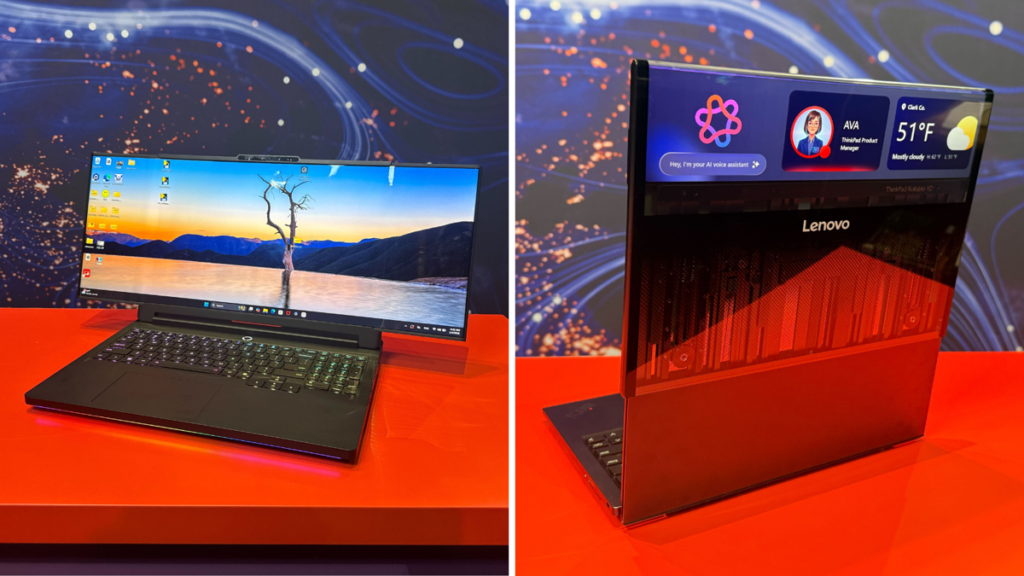
Table of Contents
Beyond the Fold: Lenovo’s New Bet on Expandable Glass
Six months after successfully bringing the world’s first rollable laptop to the consumer market, Lenovo has returned to CES 2026 with two new prototypes that suggest the company is no longer just experimenting with flexible displays—it is attempting to redefine the laptop form factor entirely. The ThinkPad Rollable XD Concept and the Legion Pro Rollable Concept represent a shift from the ‘folding’ trend that dominated the early 2020s toward a more fluid, expandable architecture.
Both devices leverage ultra-thin OLED panels, but they approach the problem of screen real estate from opposite directions. While the industry has largely focused on the ‘fold’ (as seen in the Samsung Galaxy Z Fold series or the Asus Zenbook 17 Fold), Lenovo is doubling down on the ‘roll.’ By housing the display within a motorized chassis, Lenovo avoids the permanent crease that has plagued foldable screens for years, though these prototypes introduce their own set of engineering hurdles.
The ThinkPad Rollable XD: A Business Tool with a Twist
The ThinkPad Rollable XD is designed as a productivity powerhouse, focusing on vertical expansion. The display can grow from a standard 13.3-inch footprint to nearly 16 inches in height, effectively increasing the usable workspace by 50% in a matter of seconds. This makes it an intriguing proposition for coders or writers who traditionally struggle with the limited verticality of portable devices.
The most striking feature, however, is the 180-degree wrap. The OLED panel doesn’t stop at the bezel; it curves over the top edge of the lid to create a secondary, world-facing display on the back. In a bold move toward ‘industrial transparency,’ Lenovo partnered with Corning to develop a specialized glass cover that protects the panel while leaving the internal mechanics visible. Users can actually see the fiber cables and motors that drive the rolling mechanism—a design choice that feels more like a piece of high-end horology than a standard PC.
Interaction on the XD is handled via physical buttons or haptic swipes along the lid’s edge, as the entire perimeter is touch-sensitive. While it lacks the gesture and voice controls found in earlier iterations, the current tactile interface feels more grounded in real-world utility.
Legion Pro Rollable: The ‘Arena’ Experience
If the ThinkPad is about productivity, the Legion Pro Rollable is about pure scale. This device moves away from vertical growth, instead expanding horizontally from both sides. The laptop operates in three distinct modes: ‘Focus Mode’ at 16 inches, ‘Tactical Mode’ at 21.5 inches, and a massive ‘Arena Mode’ that stretches the display to a full two feet.
For gamers, this essentially creates a built-in ultra-wide monitor without the need for a secondary peripheral. This is a direct challenge to the dual-screen approach taken by the Asus ROG Zephyrus Duo, offering a seamless, singular canvas rather than two separate panels. Under the hood, Lenovo isn’t cutting corners; the prototype is specced like a top-tier Legion Pro 7i, featuring Intel Core processors and the Nvidia GeForce RTX 5090 GPU.
However, the ‘Arena’ experience comes with a cost. The device is physically imposing and runs hot. Even during an idle demo, the rear fan vents were actively pushing out significant heat—a reminder that cramming a 5090 and a complex rolling motor into one chassis creates a thermal nightmare. There are also early signs of wear; subtle creasing was visible where the OLED retreats into its housing, and minor superficial marks appeared on the screen during unfurling. Lenovo claims the mechanism is rated for 25,000 cycles, but real-world durability remains the biggest question mark.
The Price of Innovation
Neither the XD nor the Legion Pro is guaranteed for retail, but Lenovo’s track record suggests otherwise. The transition from the original ThinkBook Plus Gen 6 concept to a retail product took roughly two years. If that timeline holds, these devices could hit the market by 2028.
The barrier for most users won’t be the technology, but the cost. With the previous rollable retailing at nearly $3,500, these high-end concepts—particularly the RTX 5090-powered Legion—will likely target a niche of ultra-premium enthusiasts. For now, these are engineering flexes, but they signal a future where the ‘laptop’ is no longer a static box, but a dynamic surface that adapts to the task at hand.


