Lenovo Pushes OLED Boundaries at CES 2026 with New Rollable ThinkPad and Legion Concepts
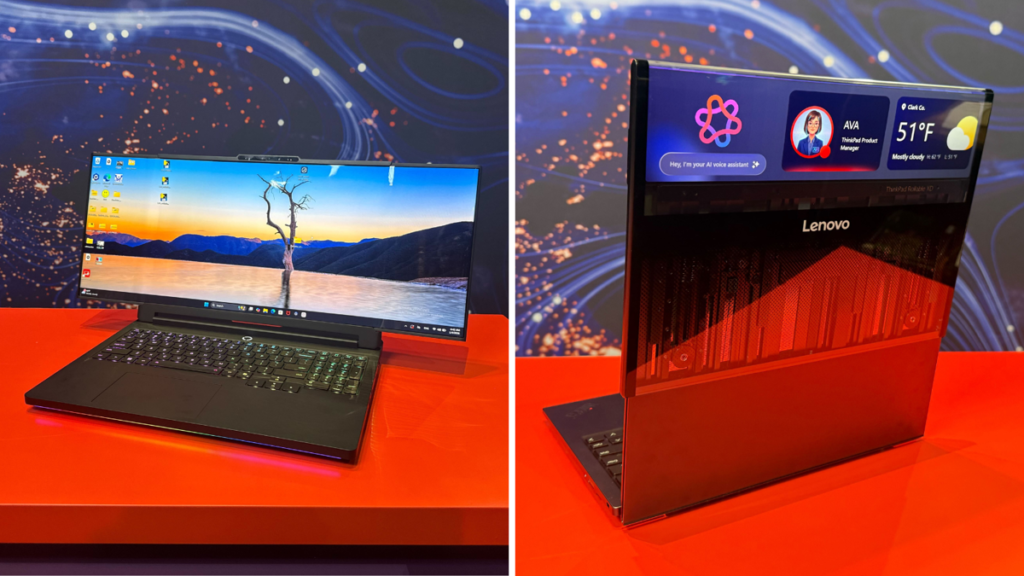
Table of Contents
Engineering the Unfoldable
While the industry has spent the last few years obsessed with the ‘fold,’ Lenovo is betting that the future of the portable workstation is actually rollable. At CES 2026, the company unveiled two distinct prototypes—the ThinkPad Rollable XD and the Legion Pro Rollable—both of which move beyond the simple hinge to create dynamic screen real estate that adapts to the user’s immediate needs.
These aren’t just visual exercises. Following the commercial release of the ThinkBook Plus Gen 6 Rollable AI, Lenovo is iterating on its flexible OLED technology, moving the mechanical actuators and fiber cables from the chassis base into the lid. The result is a thinner profile and a more seamless expansion process, though the company cautioned that these remain delicate prototypes currently undergoing durability testing.
ThinkPad Rollable XD: Verticality and Transparency
The ThinkPad Rollable XD targets the productivity market, focusing on vertical expansion. The device starts as a compact 13.3-inch laptop but can be extended to nearly 16 inches in height, a 50 percent increase in surface area that allows for deeper document scrolling or more complex spreadsheet views without the bulk of a traditional 16-inch machine.
The most striking design choice is the 180-degree wrap. The OLED panel extends over the top edge of the lid, creating a secondary ‘world-facing’ display on the back of the device. To achieve this, Lenovo collaborated with Corning to develop a specialized transparent glass cover. This allows users to see the internal motors and fiber optics that drive the rolling mechanism—a deliberate piece of industrial design that showcases the hardware’s complexity.
Interaction with the XD is handled through physical buttons and a touch-sensitive edge on the lid. While it lacks the voice and gesture controls of previous iterations, the tactile responsiveness suggests a shift toward more practical, intentional user inputs for professional environments.
Legion Pro Rollable: The ‘Arena’ Experience
If the ThinkPad is about efficiency, the Legion Pro Rollable is about immersion. This concept takes a horizontal approach to expansion, transforming from a standard 16-inch ‘Focus Mode’ into a 21.5-inch ‘Tactical Mode.’ In its most aggressive configuration, ‘Arena Mode,’ the screen expands to a full two feet, effectively deploying a built-in external monitor from within the chassis.
Under the hood, the Legion Pro Rollable is designed as a powerhouse, mirroring the specs of the Legion Pro 7i. It is slated to feature high-end Intel Core processors and the Nvidia GeForce RTX 5090 GPU. The 240Hz OLED panel ensures that the expansion doesn’t come at the cost of motion clarity, though early hands-on testing revealed some minor superficial marking and subtle creasing where the panel retreats into its housing.
The device is undeniably gaudy, leaning heavily into the ‘gamer’ aesthetic with RGB accent lighting, a glowing lid logo, and rainbow LED strips along the rear vents. However, this performance comes with a thermal cost; the chassis exhausts significant heat even during idle demo periods, highlighting the challenge of cooling a high-TGP GPU in a chassis with complex rolling internals.
The Path to Market
Lenovo claims the current rollable mechanism is rated for 25,000 cycles, a figure that suggests the company is eyeing a commercial release rather than a mere laboratory experiment. The transition from the initial ThinkBook concept to a retail product took approximately two years, suggesting a similar trajectory for these new models.
However, the cost of entry remains a significant barrier. With the previous rollable retail price hitting $3,499.99, these new concepts—particularly the RTX 5090-equipped Legion—will likely target the extreme high-end of the enthusiast and enterprise markets.


