Lenovo Pushes OLED Boundaries at CES 2026 with Dual Rollable Laptop Concepts
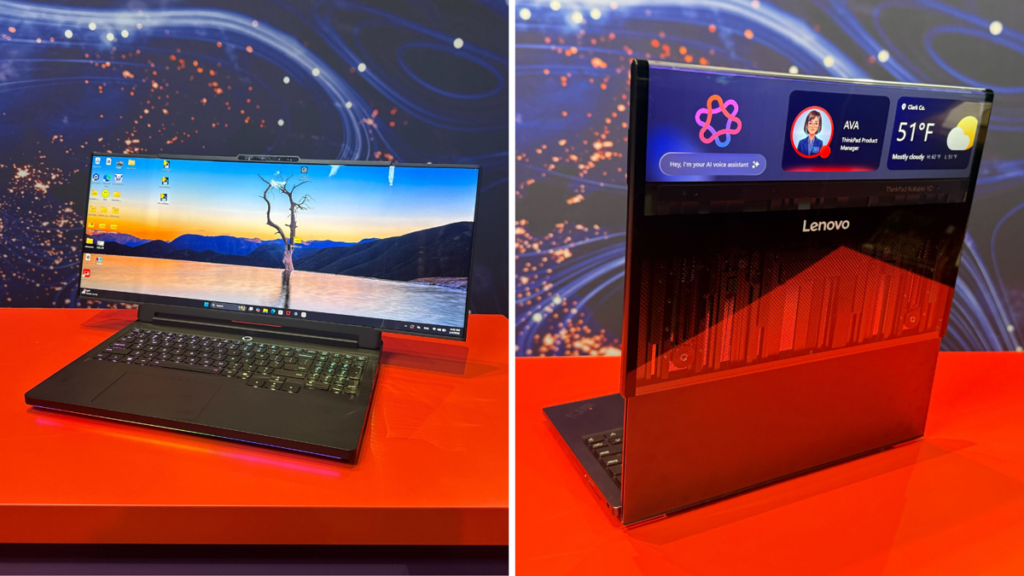
Table of Contents
Beyond the Fold: Lenovo’s New Strategy for Flexible Displays
Lenovo is doubling down on its bet that the future of portable computing isn’t just foldable, but expandable. At CES 2026, the company unveiled two distinct prototypes—the ThinkPad Rollable XD and the Legion Pro Rollable—that move beyond the hinge-based designs seen in early foldable PCs, opting instead for motorized OLED panels that grow in real-time.
These devices arrive roughly six months after Lenovo began shipping the first commercially available rollable laptop, the ThinkBook Plus Gen 6. While the new concepts remain in the prototype stage, they represent a significant leap in mechanical engineering, shifting the rolling mechanism from the chassis base into the lid to allow for more ambitious screen geometries.
The ThinkPad Rollable XD: A Productivity Powerhouse
The ThinkPad Rollable XD is clearly aimed at the enterprise segment, where screen real estate is often at odds with portability. The device features an OLED panel that expands vertically, growing from a standard 13.3-inch display to nearly 16 inches. This 50 percent increase in surface area occurs in seconds, effectively turning a compact ultraportable into a workstation-class screen without adding the bulk of a larger chassis.
The most striking engineering feat of the XD is its “world-facing” display. In a partnership with Corning, Lenovo has developed a transparent glass cover that allows the OLED panel to wrap 180 degrees over the top edge of the lid. This creates a secondary screen on the back of the device, but more importantly, it serves as a window into the machine’s internals. Users can actually see the fiber cables and motors driving the expansion mechanism, a design choice that feels more like a showcase of technical prowess than a purely functional feature.
Interaction is handled through a combination of physical buttons and a capacitive edge on the lid, allowing users to swipe to adjust the screen height. Notably, the voice and gesture controls present in previous iterations have been omitted here, suggesting Lenovo is prioritizing tactile, reliable inputs for its business-centric line.
Legion Pro Rollable: The ‘Arena Mode’ Beast
While the ThinkPad focuses on vertical growth, the Legion Pro Rollable expands horizontally, targeting the high-end gaming market. The device utilizes a 240Hz OLED panel that offers three distinct modes: a 16-inch “Focus Mode,” a 21.5-inch “Tactical Mode,” and a massive “Arena Mode” that extends the display to a full two feet in width.
For gamers, this solves a perennial problem: the trade-off between a portable laptop and the immersion of an external monitor. By unfurling the screen, the Legion Pro creates a makeshift ultrawide experience that could potentially outperform the dual-screen configurations seen in competitors like the Asus ROG Zephyrus Duo by providing a seamless, single-surface canvas.
Under the hood, Lenovo isn’t cutting corners. The prototype is configured similarly to the Legion Pro 7i, featuring high-end Intel Core processors and the Nvidia GeForce RTX 5090 GPU. However, this power comes with a cost. During demonstrations, the device emitted significant heat even while idling, and the chassis remains noticeably chunky to accommodate the cooling required for such high-wattage components and the motorized screen housing.
The Path to Production
Despite the polish, the “prototype” label is evident. Demo units showed subtle creasing where the OLED panel retreats into the housing, and some superficial scuffing on the screen surface—though Lenovo notes the mechanism is currently rated for 25,000 roll cycles.
The transition from concept to consumer is a slow one at Lenovo. The original rollable concept took two years to hit the market. Given that the previous ThinkBook rollable carried a premium price tag of $3,499.99, any commercial version of the XD or Legion Pro will likely be positioned as luxury halo products for early adopters and power users. For now, these devices serve as a loud statement that Lenovo intends to lead the industry in flexible form factors, regardless of the engineering hurdles.


