Lenovo Doubles Down on Rollables at CES 2026 with Expanding ThinkPad and Legion Concepts
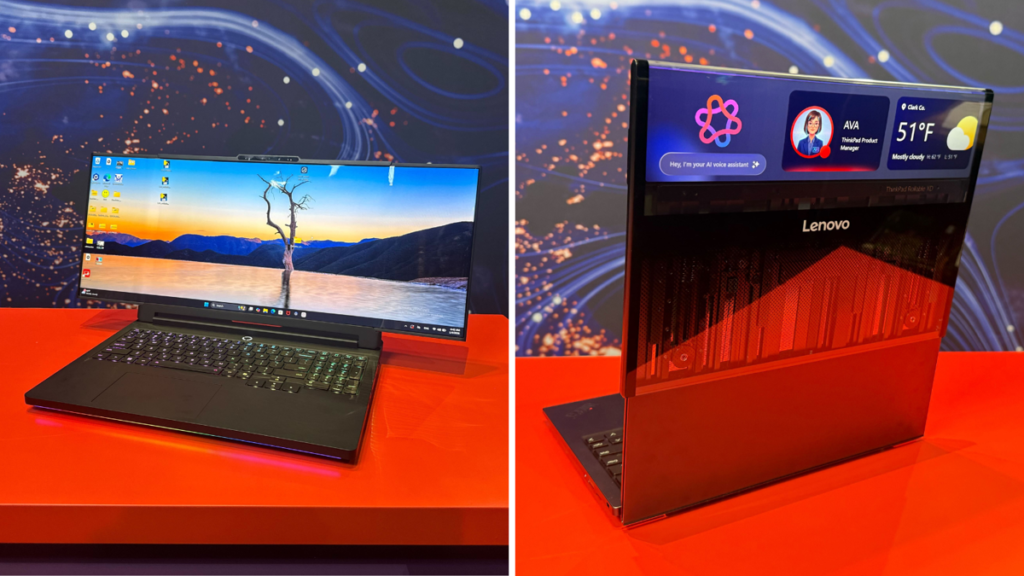
Table of Contents
Beyond the Fold: Lenovo’s New Bet on Kinetic Displays
While the industry has spent the last few years attempting to perfect the foldable laptop—often struggling with the dreaded ‘crease’ and precarious hinge durability—Lenovo is pivoting toward a different kind of flexibility. At CES 2026, the company unveiled two new concept machines: the ThinkPad Rollable XD and the Legion Pro Rollable. These aren’t just iterative updates to the ThinkBook Plus Gen 6; they represent a fundamental shift in how Lenovo views screen real estate, moving away from static panels toward kinetic displays that physically expand based on the user’s needs.
The ThinkPad Rollable XD is designed for the productivity power user. In its base state, it functions as a standard 13.3-inch ultraportable. However, with a swipe across the lid or a button press, the OLED panel extends vertically, pushing the screen height to nearly 16 inches. This 50 percent increase in surface area transforms the device from a compact laptop into a vertical canvas, ideal for long-form coding or deep-dive document review without the bulk of a 16-inch chassis.
A Peek Under the Hood
Perhaps the most striking engineering feat of the XD Concept is its ‘world-facing’ display. In a partnership with Corning, Lenovo has developed a transparent glass cover that allows the OLED panel to wrap 180 degrees over the top edge of the lid. This creates a secondary screen on the back of the device, but more importantly, it serves as a window into the machine’s internal workings. Users can see the fiber cables and precision motors that drive the rolling mechanism, a design choice that feels less like a consumer product and more like a showcase of mechanical prowess.
The control scheme has also evolved. Moving away from the voice commands and hand gestures seen in previous iterations, the XD relies on a tactile, touchscreen-integrated lid. While the company cautioned that these prototypes are delicate, the level of polish suggests that Lenovo is moving closer to a production-ready version of this form factor.
The Gaming Giant: Legion Pro Rollable
If the ThinkPad is about precision, the Legion Pro Rollable is about scale. While most gaming laptops are stuck in a trade-off between portability and screen size, the Legion Pro attempts to solve both. The device features a 240Hz OLED display that can expand horizontally across three distinct modes.
- Focus Mode: A standard 16-inch display for concentrated gaming.
- Tactical Mode: An expansion to 21.5 inches, providing a wider field of view for immersive simulations.
- Arena Mode: A full expansion that stretches the display to two feet, effectively turning the laptop into its own ultra-wide external monitor.
Internally, the Legion Pro Rollable doesn’t compromise on power. It is spec’d similarly to the high-end Legion Pro 7i, packing Intel Core processors and the Nvidia GeForce RTX 5090. However, that power comes with a thermal cost. During demonstrations, the device emitted significant heat even while idling, a reminder that squeezing a 5090 and a motorized OLED system into a portable chassis creates a massive cooling challenge.
The Durability Question
Despite the ‘wow’ factor, rollables face a steep climb toward mass-market viability. During testing, superficial skid marks were visible on the Legion Pro’s screen upon unfurling, and subtle creasing remained where the panel retreats into its housing. Lenovo claims the current mechanism is rated for 25,000 roll cycles, but for a device intended to be used multiple times a day, that ceiling may be lower than enthusiasts would hope.
The financial barrier is also steep. Given that the original ThinkBook Plus Gen 6 entered the market at $3,499.99, it is unlikely these concepts will target the budget-conscious. Instead, Lenovo is positioning itself as the primary innovator in the ‘flexible’ category, challenging the dominance of traditional clamshells and the emerging foldables from competitors like Asus and Samsung.


