Lenovo Bets on Modularity and AI Hardware with Bold MWC 2026 Concept Showcase
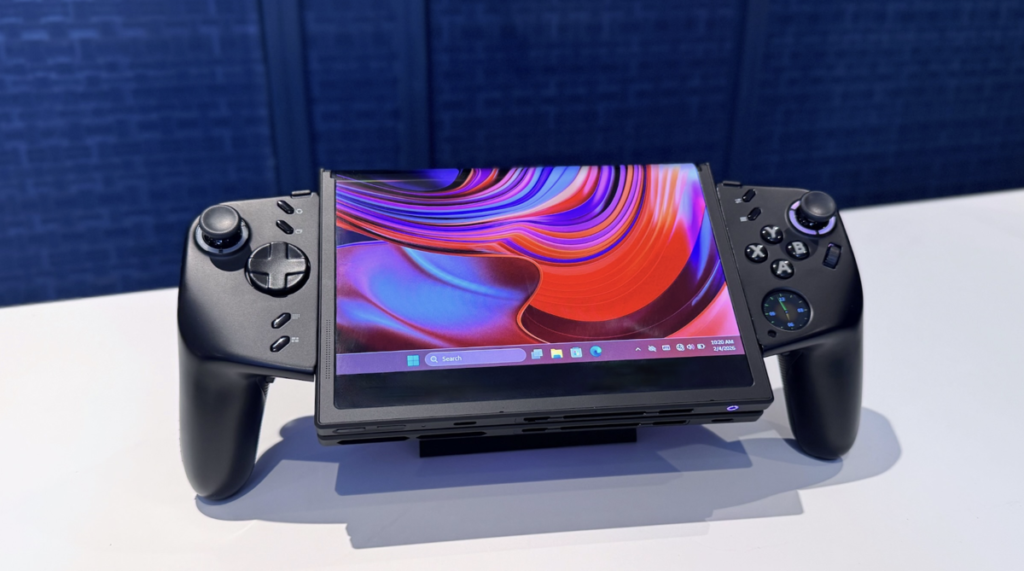
Table of Contents
A Strategic Pivot Toward Flexibility
Lenovo has arrived at Mobile World Congress 2026 not just to refresh its existing catalog, but to signal a fundamental shift in how it views the PC. Following a dominant showing at CES, the hardware giant is using Barcelona as a staging ground for a series of ambitious concepts that prioritize modularity, repairability, and a more integrated approach to artificial intelligence.
While the company continues to flood the market with traditional laptops and tablets, the real story of MWC 2026 lies in the prototypes. Lenovo is moving away from the “black box” design philosophy of the last decade, leaning instead into hardware that users can adapt, repair, and expand.
The Legion Go Fold: Gaming’s New Form Factor
The most talked-about reveal is the Legion Go Fold Concept. Long rumored in leak circles, the device attempts to bridge the gap between a handheld console and a full-fledged productivity machine. It features a 7.7-inch POLED display that unfolds into a substantial 11.6-inch canvas.
Unlike many foldable experiments, Lenovo is providing concrete specs: the prototype is powered by Intel’s Lunar Lake architecture with 32GB of RAM. The versatility is pushed further by a detachable wireless keyboard and a controller that doubles as a vertical mouse, effectively transforming the handheld into a compact Windows clamshell. Given the inclusion of specific internal components, there is a stronger-than-usual signal that this could transition from a concept to a retail product.
Modularism and the End of Planned Obsolescence?
Perhaps the most significant statement is the ThinkBook Modular AI PC Concept. In an era of soldered RAM and glued-in batteries, Lenovo is experimenting with a Framework-style approach to hardware. The system utilizes pogo-pin connectors to allow users to swap ports and modules on the fly, paired with a detachable secondary display and keyboard.
This push toward longevity isn’t limited to concepts. Lenovo is continuing the momentum from its ThinkPad X1 Carbon Gen 14 Aura Edition, which debuted earlier this year with a “Space Frame” design. By making internals more accessible in its T-Series commercial line, Lenovo is acknowledging a growing enterprise demand for sustainable, long-lifecycle hardware.
3D Visuals and AI Desktop Companions
For creators, the Yoga Book Pro 3D Concept brings glasses-free 3D technology to a dual-OLED setup. Powered by an Intel Core Ultra 7 and Nvidia’s RTX 5070, the device uses eye-tracking to render depth without the need for peripherals. The addition of snap-on tactile pads for specific touch menus suggests Lenovo is thinking deeply about the UX of 3D spatial computing on a 2D plane.
Meanwhile, Lenovo is attempting to move AI off the screen and onto the desk. The AI Work Companion (a consumer-focused task manager) and the AI Workmate (a business-centric device capable of projecting content and summarizing documents via local AI processing) represent a move toward “ambient computing.” The Workmate, in particular, emphasizes on-device processing, a critical detail for security-conscious enterprise clients who are wary of cloud-based AI leaks.
The Retail Lineup: Yoga 9i Aura Edition
Amidst the prototypes, the Yoga 9i 2-in-1 Aura Edition serves as the flagship consumer anchor. Updating its design with an Intel Core Ultra Series 3 chip and the return of the headphone jack, the device will retail for $1,949 starting in May. The integration of a magnetic Yoga Pen Gen 2 enabling a new “Canvas mode” highlights a refined focus on the hybrid professional.
Across the enterprise sector, the 2026 T-Series updates emphasize a more utilitarian path forward, with upgraded 5MP cameras and improved audio, ensuring that while the concepts capture the headlines, the core business remains grounded in iterative, reliable improvement.