Lenovo Bets on Modular Hardware and Foldable Gaming at MWC 2026
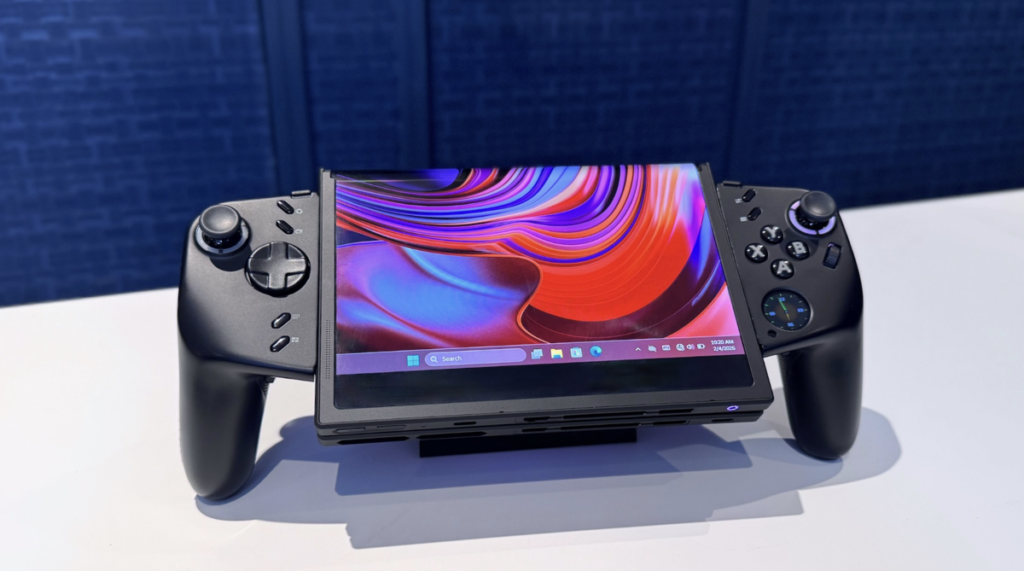
Table of Contents
A Pivot Toward Flexibility and Repairability
Lenovo has arrived at Mobile World Congress 2026 with a strategy that suggests a growing restlessness with the traditional laptop form factor. While the company has spent years refining the clamshell, its latest showcase in Barcelona focuses on hardware that can be dismantled, unfolded, and expanded. From a foldable gaming handheld to a modular business PC, Lenovo is attempting to solve the tension between high-performance computing and long-term device sustainability.
The most talked-about reveal is the Legion Go Fold Concept. Following a series of leaks, Lenovo confirmed a prototypical handheld that bridges the gap between a portable console and a full-fledged Windows laptop. The device features a 7.7-inch POLED display that unfolds into a massive 11.6-inch canvas. To make the transition to productivity viable, Lenovo has paired it with a detachable wireless keyboard. In a clever bit of engineering, one of the controllers can be repurposed as a vertical mouse, effectively turning the handheld into a compact workstation. Under the hood, it runs on Intel’s Lunar Lake architecture with 32GB of RAM, signaling that this isn’t just a visual demo, but a performance-oriented prototype.
The Modular Gamble
While the foldable gaming device grabs the headlines, the ThinkBook Modular AI PC Concept may be the more significant strategic move. In an era where consumers are increasingly demanding a right-to-repair—and where companies like Framework have proven there is a market for modularity—Lenovo is integrating these philosophies into its enterprise line. The concept allows users to swap ports and peripherals on the fly via integrated pogo-pin connectors, ensuring the device can evolve as the user’s needs change.
This push toward longevity isn’t limited to concepts. Lenovo is doubling down on the repairability trends started earlier this year with the ThinkPad X1 Carbon Gen 14 Aura Edition. The new T-Series models debuting at MWC 2026 feature updated internal chassis designs specifically intended to make components easier to replace, moving away from the soldered-down components that have plagued thin-and-light laptops for the last decade.
Pushing the Boundaries of the Display
Lenovo continues its experimentation with spatial computing through the Yoga Book Pro 3D Concept. This dual-display machine is designed specifically for 3D creators, utilizing a glasses-free 3D system that tracks eye movement to render depth in real-time. Powered by an Intel Core Ultra 7 and an Nvidia GeForce RTX 5070, the hardware is robust enough to handle actual production workloads, not just simple demos. The addition of snap-on tactile pads for the lower touchscreen suggests a move toward a more hybrid interface that mixes traditional keyboard input with specialized creative controls.
The AI Desktop Ecosystem
Beyond the laptops, Lenovo is attempting to move AI off the screen and into the physical environment. Two new prototypes, the AI Work Companion and the AI Workmate, aim to redefine the “desk accessory.” The Work Companion acts as a minimalist secretary, syncing schedules and monitoring screen time to suggest breaks. The Workmate, however, is more ambitious; it is a gesture- and voice-controlled companion capable of scanning physical documents and projecting summaries onto nearby surfaces using on-device AI processing.
For users seeking immediate upgrades rather than future concepts, the Yoga 9i 2-in-1 Aura Edition is the centerpiece of the consumer lineup. Updated with an Intel Core Ultra Series 3 chip and the return of the headphone jack, it ships with a magnetically attached Yoga Pen Gen 2. The device will be available in May for $1,949, positioning it as the premium flagship for the 2026 cycle.
As Lenovo rolls out its Qira AI agent across more than 20 devices in the coming weeks, the company is clearly betting that the next phase of the PC era isn’t just about smarter software, but about hardware that can physically adapt to the user.


