Lenovo Bets on Blackwell and 3D V-Cache with the New ThinkStation P4
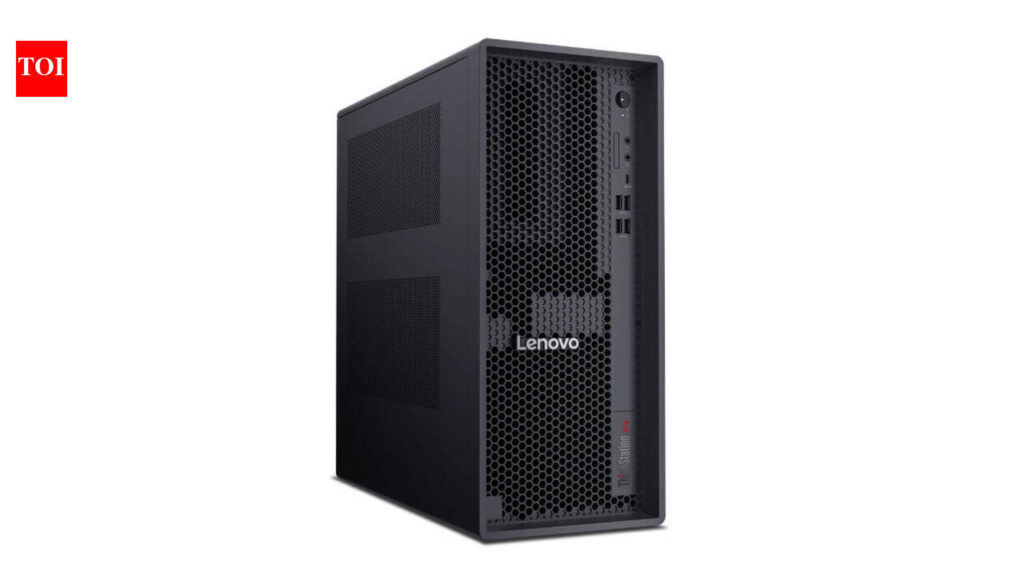
Table of Contents
A Shift Toward Local AI Compute
Lenovo has officially unveiled the ThinkStation P4, a desktop workstation that signals a clear pivot toward high-density AI computing at the edge. While previous iterations of the ThinkStation line focused on general-purpose engineering and CAD stability, the P4 is engineered specifically to handle the heavy lifting of local LLM (Large Language Model) development and complex data synthesis.
The centerpiece of the P4 is the integration of AMD’s Ryzen PRO 9000 Series processors. More importantly, Lenovo has opted for the variants featuring 3D V-Cache technology. By stacking L3 cache vertically on the processor die, the P4 drastically reduces the latency associated with memory access—a critical bottleneck when training small-scale AI models or running high-fidelity simulations that would otherwise stutter on standard enterprise chips.
This hardware choice suggests Lenovo is targeting a specific niche of developers who find the traditional Threadripper-class workstations too cumbersome for a standard desk, but find consumer-grade desktops insufficient for sustained professional workloads.
Blackwell Architecture Meets Enterprise Stability
On the graphics and compute front, the ThinkStation P4 leverages the Nvidia RTX PRO 6000, now based on the Blackwell architecture. The leap to Blackwell isn’t just about raw clock speeds; it’s about the revamped Tensor cores and improved energy efficiency per TFLOP, which allows the P4 to maintain peak performance without the thermal throttling common in smaller workstation chassis.
The RTX PRO 6000 is designed for environments where reliability is non-negotiable. Unlike consumer GeForce cards, the Blackwell-based PRO series offers ECC (Error Correction Code) memory, which is essential for researchers who cannot afford a single bit-flip during a multi-day render or a complex scientific calculation. By pairing these GPUs with the Ryzen PRO 9000, Lenovo has created a machine that balances massive parallel processing power with the security and manageability features required by corporate IT departments.
Thermal Management and Modular Design
Given the heat output of the Blackwell GPUs and high-wattage Ryzen chips, the P4’s chassis has undergone a significant redesign. Lenovo has moved toward a more modular airflow system, allowing users to swap out components or add additional storage drives without compromising the cooling path to the CPU.
Industry observers note that this modularity is a direct response to the rapid pace of AI hardware evolution. Because GPUs are evolving every 12 to 18 months, the P4 is built to be updated piecemeal rather than replaced entirely, reducing the total cost of ownership for studios and research labs.
Positioning in a Crowded Market
The ThinkStation P4 enters a market where Dell’s Precision and HP’s Z-series have long held sway. However, the specific combination of AMD’s 3D V-Cache and Nvidia’s Blackwell gives Lenovo a distinct edge in specialized compute tasks. While Dell and HP often rely heavily on Intel’s Xeon ecosystem, Lenovo’s aggressive push into the AMD PRO space offers a compelling performance-per-watt alternative.
For the end user, this means the P4 is less of a general-purpose office computer and more of a localized server. It is built for the data scientist who needs to run PyTorch or TensorFlow locally, the 3D artist working in Unreal Engine 5, and the cybersecurity analyst performing deep packet inspection on massive datasets.
Pricing and regional availability have not yet been fully detailed for all markets, but the P4 is expected to roll out to enterprise partners first, followed by a wider professional retail release.


