Investigation Launches After School Bus Ploughs Through Barriers into Belgian Train
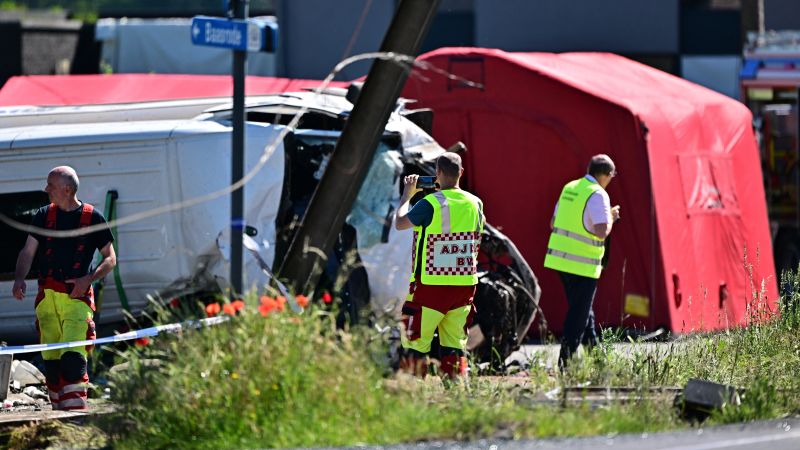
Table of Contents
Tragedy in Buggenhout
A quiet Tuesday morning in northern Belgium turned catastrophic when a school minibus, carrying students from a local special education facility, collided with a train at a level crossing in Buggenhout. The accident resulted in four deaths, including two children aged 12 and 15, a 27-year-old attendant, and the 49-year-old driver. Five other children sustained serious injuries and remain in stable condition in local hospitals.
The scene was one of devastation; emergency responders arrived to find the minibus flipped on its side, its chassis crumpled and windows shattered. The train, while sustaining minimal physical damage and reporting no injuries among its passengers, was the catalyst for a wider inquiry into how a vehicle could breach a secured crossing during a live rail signal.
The Failure of the Barrier System
At the heart of the current investigation is a critical technical question: why did the bus enter the crossing despite active safety protocols? According to Thomas Baeken of Infrabel, the Belgian rail track operator, preliminary evidence from footage and sensor data confirms that the barriers were fully deployed and the red warning signals were operational at the time of impact.
The incident highlights a recurring vulnerability in rail infrastructure—the “human-machine interface.” While Infrabel’s systems functioned as designed, the physical barriers provided no resistance to the minibus. The train driver reportedly engaged the emergency brakes upon sighting the vehicle, but the momentum of the train made a collision inevitable given the short distance of the crossing.
Forensic and Technical Analysis
The Public Prosecution Service, represented by spokesperson Lisa De Wilde, has confirmed that an autopsy will be performed on the deceased bus driver. While the train driver tested negative for drugs and alcohol, investigators are now looking into the mechanical state of the bus and whether any external distractions or medical emergencies contributed to the driver’s decision to bypass the barriers.
A forensic laboratory and a specialized traffic expert have been deployed to the site to reconstruct the exact timeline of the breach. The inquiry is focusing on the latency between the activation of the red lights and the moment the bus entered the tracks, as well as the structural integrity of the barriers themselves.
Infrastructure and Policy Implications
The tragedy has prompted immediate reactions from the highest levels of government. Belgian Prime Minister Bart De Wever and Flemish Education Minister Zuhal Demir both expressed their condolences, but the incident also raises urgent questions about the safety of level crossings in areas servicing special education schools, where driver stress and passenger needs may differ from standard transit.
Across Europe, the push for the total elimination of level crossings—replacing them with underpasses or overpasses—has been a slow but steady trend. This accident underscores the inherent risk of relying on “passive” safety measures like barriers, which can be ignored or bypassed, rather than “active” grade separation that physically prevents vehicles from entering the rail path.
As the investigation continues, the focus remains on whether the warning systems in Buggenhout are sufficient for the volume and type of traffic in the area, or if the failure was an isolated instance of catastrophic human error.


