HoverAir Aqua Attempts to Solve the ‘Water Anxiety’ of Drone Photography
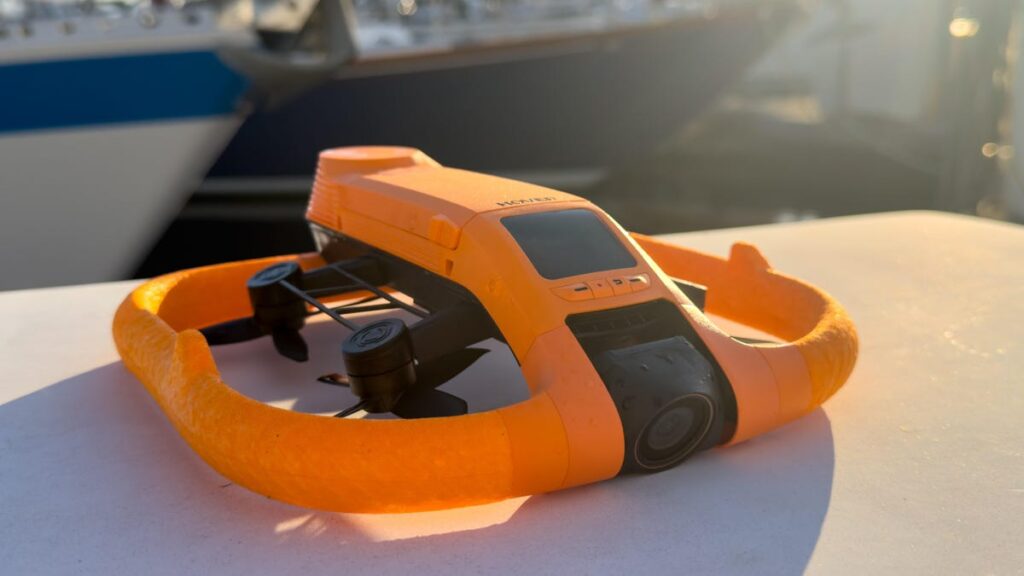
Table of Contents
The End of the ‘Water-Dunk’ Dread
For most drone pilots, flying over a body of water is a high-stakes gamble. Regardless of the hardware’s stability or the pilot’s skill, there is a persistent, nagging anxiety that a single gust of wind or a software glitch will turn an expensive piece of electronics into a very expensive anchor. The HoverAir Aqua is designed specifically to erase that hesitation, positioning itself not just as a flying camera, but as a rugged companion for aquatic sports.
Unlike traditional quadcopters that require a dry landing pad and a wide berth from the surf, the Aqua is built to coexist with the water. It doesn’t just survive a splash; it is designed to be tossed overboard, bob on the surface, and launch itself directly from the drink. For those engaged in surfing, kayaking, or paddleboarding, this shift in durability changes the utility of the device from a curated cinematography tool to a spontaneous action camera.
Hardware Built for Buoyancy
At first glance, the Aqua looks less like a professional cinema drone and more like a specialized piece of sporting equipment. Weighing in at 249g—comfortably under the threshold for FAA registration in many jurisdictions—the drone features distinctive foam guards on each side. These aren’t just for impact protection; they provide the essential buoyancy required to keep the device afloat when it’s not in the air.
The interface is surprisingly tactile for a modern gadget. A 1.6-inch AMOLED screen on the top allows users to toggle modes and review footage without needing to dive into a smartphone app immediately. However, the real magic lies in the ecosystem’s second half: the Lighthouse. This chunky, orange wearable transmitter acts as both a beacon and a remote. By strapping the Lighthouse to an arm or leg, the user becomes the anchor point for the drone’s autonomous tracking systems.
Both the drone and the Lighthouse carry an IP67 rating, meaning they can withstand significant immersion. This reliability is backed by a physical design that prioritizes seals, including a critical silicon plug for the charging port and a securely latched battery system. In a real-world testing scenario in the waters near Seattle, the transition from floating to flying is visceral; the rotors cut through the water with a loud, sputtering intensity before the drone clears the surface and locks onto the target.
Autonomy Over Manual Piloting
The Aqua isn’t designed for the hobbyist who wants to manually orbit a landscape. Instead, it focuses on ‘follow-me’ logic. Through its OmniTerrain mode, the drone leverages the Lighthouse beacon to maintain a lock on the user. In ‘Kayak mode,’ for instance, the drone typically trails the paddler from behind, maintaining a customizable distance that can be adjusted from close-up to a wider perspective.
One of the more impressive technical additions is the ‘Turtle Flip.’ Given the lightweight nature of the drone, it is prone to being overturned by moderate surf or a clumsy launch. The Turtle Flip allows the Aqua to automatically right itself if it ends up upside-down in the water, removing the need for the user to swim back and manually reposition the hardware.
Diverse Tracking Logic
Beyond basic following, the Aqua offers several cinematic presets that usually require a professional pilot’s touch:
- Orbit Follow: The drone executes lazy, sweeping circles around the subject.
- Spiral: A combination of ascending altitude and orbiting movement.
- Zoom Out: A rapid retreat that provides a sense of scale to the surrounding environment.
- Dolly/Angle Track: Traditional cinematic slides used for focused subject tracking.
The camera’s ability to rotate 90 degrees downward is a thoughtful touch, allowing the drone to record underwater footage while it is still bobbing on the surface, effectively bridging the gap between a GoPro and a DJI Mavic.
The Regulatory Hurdle
Despite the technical promise, the HoverAir Aqua faces a significant geographical limitation. At a price point of $1,299, it is a premium investment, but it is currently unavailable in the United States. The company has cited ‘administrative and regulatory complexities’ as the cause for the US blackout, though it remains available in 50 other global markets.
For those who can access it, the Aqua represents a shift in how we capture adventure. By removing the fear of the crash, it allows the athlete to focus on the sport while the hardware handles the cinematography. It isn’t trying to replace the high-end aerial photography of a Mavic 3; it’s trying to replace the struggle of mounting a camera to a surfboard or a kayak bow.