Honor Magic V6: Pushing the Limits of Thinness and Battery, but Software Remains a Hurdle
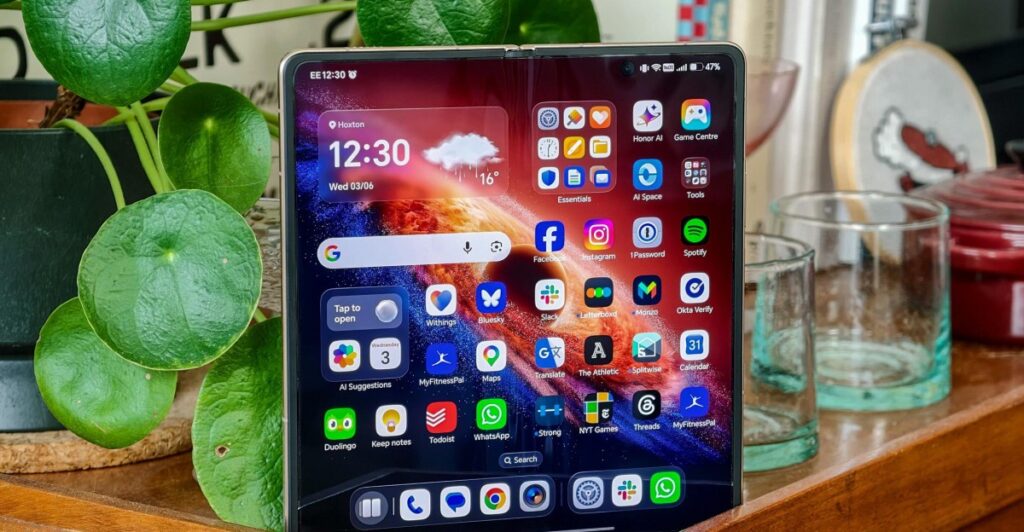
Table of Contents
Engineering Marvels in Incremental Steps
The foldable smartphone market has reached a curious plateau. For years, the narrative was one of survival—making screens that didn’t crack and hinges that didn’t crunch. Now, we’ve entered the era of refinement. The Honor Magic V6, which has finally begun its global rollout starting in Malaysia and Singapore, is a testament to this shift. On paper, it is a record-breaker, claiming three distinct ‘firsts’ in the foldable category. In reality, the experience is a mix of genuine innovation and marginal gains.
The most immediate draw is the physical profile. At 8.75mm when folded (specifically the white model), the Magic V6 is effectively the same thickness as a standard flagship like the iPhone 17 Pro Max. When unfolded, it shrinks to a mere 4mm. While Honor can technically claim the title of the world’s thinnest foldable, the victory is nearly academic; it is only 0.05mm thinner than its predecessor. For the average user, this is a difference equivalent to a human hair—imperceptible in the pocket, though impressive in a laboratory.
The Battery Breakthrough
Where the Magic V6 actually moves the needle is in endurance. Foldables have historically been hampered by the physical impossibility of fitting large batteries into thin chassis. Honor has countered this by utilizing advanced silicon-carbon cells, allowing them to cram a 6,660mAh battery into the global version (China receives an even larger 7,150mAh variant).
This isn’t just a numbers game; it translates to a fundamental shift in how the device is used. While the Magic V5 was a reliable one-day phone, the V6 comfortably stretches into a second day. For power users who treat their foldable as a primary productivity hub, this removes the ‘battery anxiety’ that has long plagued the form factor. It is the only one of Honor’s three ‘firsts’ that fundamentally alters the user experience.
Durability and the IP69 Standard
Honor is also debuting an IP69 rating, a significant step up from the IP68 standard found in competitors like the Pixel 10 Pro Fold. While IP68 protects against submersion, IP69 ensures the device can withstand high-pressure, high-temperature water jets. While few users intentionally subject their phones to industrial power washers, the rating signals a maturing level of confidence in the device’s sealing. However, the inherent fragility of foldable tech remains: the inner screen is still soft, and the hinge remains a complex point of failure that no IP rating can fully mitigate.
The Software Struggle
Hardware triumphs aside, the Magic V6 is held back by its own skin. MagicOS continues to be a point of friction. The user interface feels cluttered and heavily influenced by Apple’s design language—specifically the ‘Liquid Glass’ aesthetic—but without the same cohesive polish. Honor continues to preload the system with proprietary apps, and the multitasking workflows lack the intuitive fluidity found in Oppo’s software ecosystem.
While Honor is now promising seven years of OS and security updates—matching the industry gold standard set by Google and Samsung—long-term support is only valuable if the daily experience is pleasant. Currently, the software feels like a secondary priority compared to the engineering of the chassis.
The Hardware Trade-off
The internal specifications are exactly what you’d expect from a 2026 flagship: the Qualcomm Snapdragon 8 Elite Gen 5, 16GB of RAM, and 512GB of storage. The triple-camera array is formidable, likely among the best in the foldable segment, but it still can’t beat a traditional ‘slab’ phone. The physical constraints of a foldable chassis mean smaller sensors and inconsistent color processing compared to a dedicated camera phone.
Ultimately, the Magic V6 is a device for the enthusiast who wants the absolute cutting edge of hardware engineering. It is thinner, tougher, and lasts longer than almost anything else on the market. But until Honor refines MagicOS, it remains a brilliant piece of hardware running a frustrating piece of software.