High-Stakes Rescue in Laos: Cave Divers Battle Floodwaters to Reach Seven Trapped Villagers
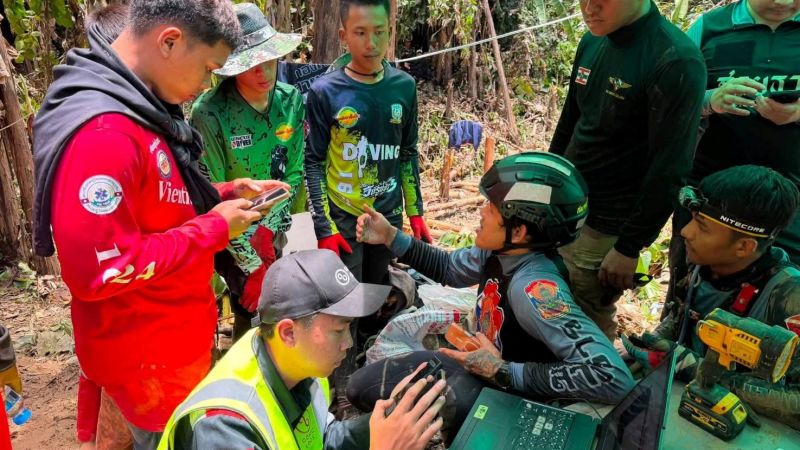
Table of Contents
A Race Against the Elements in Xaisomboun
In the rugged, mountainous terrain of central Laos’ Xaisomboun province, an international coalition of specialist divers is engaged in a precarious race against time. Seven villagers, who entered a cave system last Wednesday in search of gold, remain trapped deep underground after sudden flash flooding sealed the primary exit. As the operation enters its second week, the mission has evolved into a complex technical challenge, requiring the precision of the world’s most experienced subterranean rescuers.
The operation has drawn a surge of global expertise, with more than 100 personnel now on-site. Among them are 15 elite divers whose resumes include the 2018 Tham Luang rescue in Thailand, where a youth soccer team was saved in a similarly harrowing operation. This historical precedent is proving critical, as the team applies a mix of high-end geological mapping and specialized diving equipment to navigate a system that is as volatile as it is claustrophobic.
The Technical Bottleneck: 60 Centimeters of Space
According to the Metta Tham Kalasin (MTK) Command and Control Center, the path to the survivors is a 340-meter tunnel that presents a brutal physical barrier. In several critical sections, the passage narrows to just 60 centimeters (approximately 23 inches) in width. These “restrictions” force divers to tilt their bodies sideways and crawl flat on their stomachs through muddy, jagged rock formations.
The logistical complexity is compounded by the cave’s architecture. Thai diver Kengkad Bongkawong noted that the entry point plunges at a 45-degree angle, creating a one-way traffic system where rescuers cannot pass one another. This requires a meticulously coordinated rotation of divers to ensure that those exiting the cave do not block the path of those attempting to reach the survivors.
To mitigate the risk of asphyxiation or toxic gas buildup, the MTK team has deployed a sophisticated air-line system. This infrastructure pumps fresh air deep into the tunnel, while divers utilize gas monitors and breathing masks to track oxygen levels in real-time. The use of guide cables has also been implemented to ensure divers can maintain their orientation in the pitch-black, silt-heavy water.
Calculating the Odds of Survival
Despite the deteriorating weather, there are signs of cautious optimism. The state-run Lao News Agency reports that the villagers are believed to be perched on an elevated ledge within an underground cavern that allows for continuous airflow. This natural ventilation is the primary reason experts believe the group may still be alive after seven days without standard supplies.
“Given the geography and the living conditions of the victims, if they are in that specific area, their chances of survival are very high,” Bongkawong told CNN, emphasizing that the accuracy of the current geological maps provides a clear target for the rescue teams.
The Human and Environmental Risks
However, the environment remains hostile. Finnish diver Mikko Paasi described the approach as a grueling four-kilometer jungle trek before even reaching the cave mouth. Once inside, rescuers face the constant threat of “bad air” and the possibility of further tunnel collapses triggered by ongoing rains.
Arnold Dix, a geologist and disaster rescuer known for leading the 2023 rescue of 41 Indian miners, warned that the window for a successful recovery is closing. He noted that after a week in such conditions, the risk of secondary illness and hypothermia increases significantly. Furthermore, the risk to the rescuers themselves is acute; a sudden rush of water into the narrow tunnels could trap the divers along with the villagers.
While the primary effort focuses on the flooded tunnel, a secondary rope team is currently rappelling from four separate shafts discovered on the mountain above the cave, searching for an alternative dry route to the cavern. As the one-party state of Laos maintains tight control over information, the international community remains reliant on updates from the MTK Command Center and social media posts from the divers on the front line.