Google’s Shift Toward ‘Actionable AI’ Could Render the Traditional App Store Obsolete
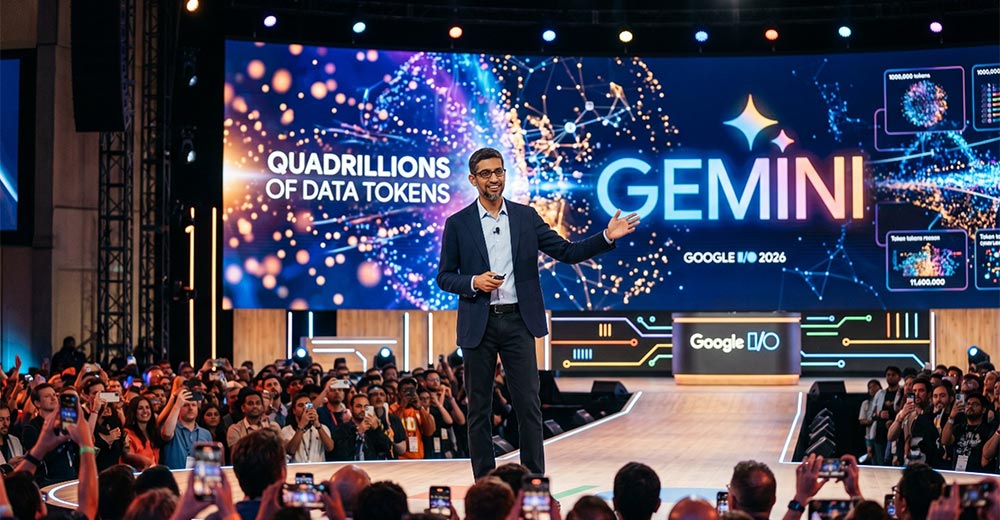
Table of Contents
The End of the App Grid
For nearly two decades, the mobile experience has been defined by the ‘grid’—a collection of colorful icons that users tap to perform specific tasks. From ordering food on Uber Eats to checking the weather on AccuWeather, the workflow has always been: find app, open app, navigate UI, execute task. But Google’s latest reveals at I/O 2026 suggest that this paradigm is reaching its expiration date.
The core of the shift is what Google is calling ‘Agentic Orchestration.’ Rather than acting as a search engine that points you toward an app, Gemini is evolving into a system-level layer that executes tasks across multiple services without the user ever leaving the primary AI interface. This isn’t just a voice assistant improvement; it is a fundamental redesign of how software interacts with hardware.
Generative UI and the Death of the Static Interface
One of the most striking demonstrations at I/O was the introduction of Generative UI. Instead of launching a third-party app with its own rigid design and navigation menus, Google’s AI now generates a temporary, purpose-built interface on the fly. If you ask the AI to plan a trip to Tokyo, it doesn’t just give you a list of links; it builds a bespoke dashboard combining flight data from Google Flights, hotel availability from Marriott, and itinerary suggestions from local guides—all rendered in a unified, transient UI.
For developers, this is a precarious moment. If the user never opens the app, the concept of ‘app engagement’—the primary metric for almost every mobile startup since 2008—becomes irrelevant. When the AI handles the API call and presents the data in its own skin, the brand identity of the standalone app vanishes. We are moving toward a ‘headless’ software era where the app is merely a backend data provider for a front-end controlled by Google.
The API Economy vs. The Attention Economy
This transition signals a pivot from the attention economy to an API economy. In the traditional app model, developers fight for the user’s gaze, utilizing notifications and habit-forming UX to keep them inside the app. In an agent-centric world, the value shifts to the quality of the API. The winner is no longer the company with the prettiest interface, but the one whose data is most easily ingested and executed by Gemini.
This puts Google in a delicate position with its own ecosystem. Android’s success was built on a thriving community of third-party developers. If Google’s AI effectively ‘wraps’ these apps, stripping away their branding and monetization hooks (like in-app ads), the incentive to build for Android could plummet. We’ve seen similar tensions with Apple Intelligence, but Google’s integration is deeper, leveraging its dominance in search and cloud infrastructure to create a more seamless, and perhaps more suffocating, integration.
The Friction Gap
The drive toward this ‘extinction event’ for apps is fueled by the friction gap. Opening an app takes seconds; navigating a menu takes more. An AI agent reduces this to zero. However, the transition won’t be instantaneous. Complex tasks—like high-end video editing in Adobe Premiere Rush or deep gaming in Genshin Impact—still require the dedicated control and processing power of a standalone application.
But for the 80% of apps that serve as glorified portals for data—banking, food delivery, travel, and basic productivity—the standalone model is now a liability. Google I/O 2026 wasn’t just a showcase of new features; it was a roadmap for a world where the icon on your home screen is no longer the destination, but a legacy relic of a pre-agentic age.