Godox Challenges High-End Macro Lighting with the MF-T76 Twin-Flash System
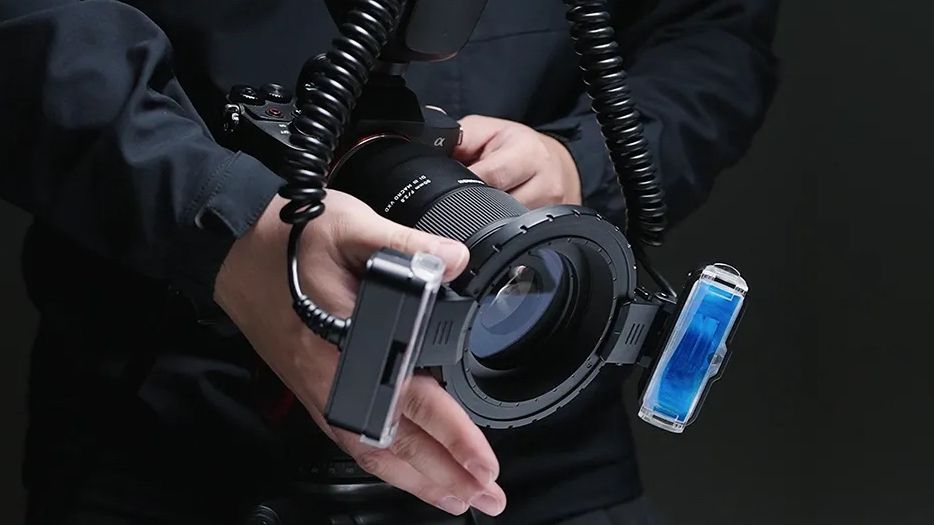
Table of Contents
Breaking the Ring Flash Mold
For macro photographers, the struggle is always a battle against the lens. When you move in for an extreme close-up, the lens barrel often becomes a physical barrier, casting an unwanted shadow across the subject. While circular ring flashes have long been the go-to solution for dentists and forensic investigators to solve this, they often produce a flat, clinical light that lacks depth. Godox is attempting to pivot this dynamic with the launch of the MF-T76, a twin-strobe macro system designed to offer more creative flexibility than its predecessors.
The MF-T76 is a strategic evolution of the MF-R76. While the latter utilized a fixed ring design, the T76 separates the lighting into two independent flash units. This allows photographers to position the strobes specifically around the lens, enabling the creation of artificial shadows and highlights that give a three-dimensional feel to small-scale subjects—something that is nearly impossible with a traditional ring light.
Technical Specifications and Ecosystem Integration
Under the hood, the MF-T76 delivers a combined flash power of 76Ws. For those who need precise control, the units offer manual power settings ranging from full power down to 1/256, adjustable in one-third stop increments. To make the transition between shots faster, Godox has included built-in modeling lights, which serve two purposes: aiding autofocus in dark environments and allowing the photographer to preview the lighting ratios before committing to a shot.
The system is built for modern workflows, supporting High Speed Sync (HSS) to allow for fast shutter speeds even in bright daylight. Furthermore, it integrates into the broader Godox 2.4G Wireless X System. This means the MF-T76 isn’t just a standalone tool; it can be triggered in unison with other Godox flashguns to create complex, multi-point lighting setups for larger subjects.
Broad Compatibility Across Platforms
Godox has released the MF-T76 in three dedicated TTL (Through-The-Lens) versions to ensure seamless communication with the most popular mirrorless and DSLR systems. This automatic metering is critical for macro work, where a slight shift in the lens position can drastically change the light requirement.
- Canon (F-T76 C): Compatible with a wide range of bodies including the EOS R series (R7, RP, R), as well as legacy DSLRs like the 5D Mark IV and 80D.
- Sony (MF-T76 S): Supports the A7 series (A7 IV, A7R V, A7C II), A9 III, and the ZV-E10, making it a strong choice for the current mirrorless market.
- Nikon (MF-T76 N): Works with Z-series mirrorless (Z8, Zf, Z6) and classic D-series bodies like the D850 and D780.
Disrupting the Professional Pricing Tier
The most significant impact of the MF-T76 isn’t necessarily its technical specs, but its price point. Retailing around $249 (with slight variations in the EU and AU markets), the system is positioned as a direct, affordable alternative to the proprietary twin-flash systems offered by Canon and Nikon, which often cost double or triple the price.
In the North American market, the hardware will also be available under the Flashpoint brand via Adorama, further expanding its reach. By offering TTL functionality and HSS at this price, Godox is effectively lowering the barrier to entry for wildlife photographers and medical professionals who previously had to choose between overpriced first-party gear or cumbersome manual setups.
As macro photography continues to grow in popularity—driven by the increasing resolution of modern sensors—the demand for controlled, non-flat lighting is peaking. The MF-T76 arrives at a time when photographers are looking for a middle ground between the simplicity of a ring flash and the complexity of a full studio setup.


