Gigabyte Bets Big on ‘Local AI’ and 5K Gaming Displays at Computex 2026
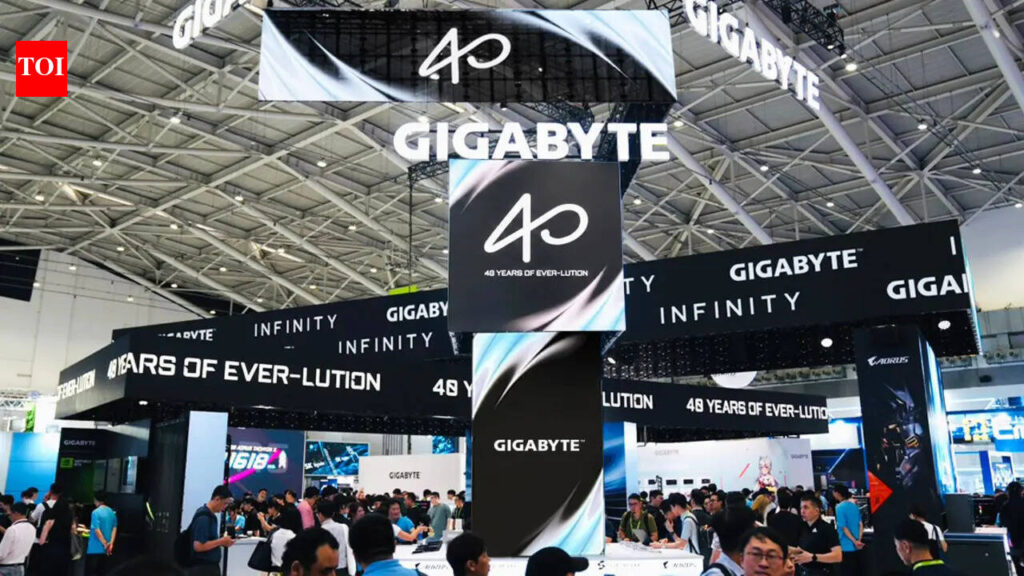
Table of Contents
Moving the LLM from the Cloud to the Chassis
At Computex 2026, Gigabyte is making a calculated pivot away from the reliance on cloud-based AI, positioning itself as the primary hardware architect for ‘Local AI.’ The centerpiece of this strategy is the AI TOP ecosystem, a specialized hardware framework designed to let developers and power users run large language models (LLMs) and generative AI locally without the latency or privacy concerns associated with third-party API calls.
While most consumers interact with AI through a browser, Gigabyte’s AI TOP approach focuses on the infrastructure required for high-token throughput and massive VRAM availability. By integrating multi-GPU configurations and high-bandwidth memory architectures, the system aims to bridge the gap between consumer-grade PCs and enterprise-level AI servers. This is a direct response to the growing trend of open-source models like Llama and Mistral, which are increasingly being optimized for local deployment.
The Thermal Challenge of the RTX 50 Series
The conversation around AI hardware inevitably leads to heat. With the arrival of the NVIDIA GeForce RTX 50 series, the thermal envelope has shifted. Gigabyte showcased a new suite of cooling solutions specifically engineered for these cards, moving beyond standard heatsinks into more aggressive vapor chamber designs and hybrid liquid-cooling loops.
The new thermal architecture isn’t just about preventing throttling; it’s about sustaining the clock speeds required for AI training and high-fidelity gaming. Attendees at the booth noted a significant shift in chassis design, with more focused airflow channels and redesigned fan blade geometries to handle the increased TDP of the 50-series silicon. These cooling solutions are being bundled into a new generation of custom PC builds that Gigabyte is positioning as ‘AI Workstations’ for creators.
Pushing Pixels: The 5K AORUS Leap
On the display front, Gigabyte is attempting to push the gaming industry past the 4K plateau. The company unveiled a series of next-gen AORUS monitors featuring 5K resolution. While 4K has been the gold standard for years, the jump to 5K offers a critical increase in screen real estate and pixel density that is particularly beneficial for developers working in multi-window environments or gamers utilizing ultra-wide immersive setups.
These monitors aren’t just about resolution. The new panels integrate updated refresh rate technology to ensure that the jump in pixel count doesn’t result in input lag—a perennial problem when scaling resolution on gaming hardware. When paired with the RTX 50 series, these displays are intended to showcase the raw power of DLSS 4 (or its 2026 equivalent), where AI-driven upscaling makes 5K gaming viable without requiring unrealistic hardware overhead.
AORUS MASTER 16 and the AI Laptop Pivot
The hardware highlights culminated in the AORUS MASTER 16, a laptop that has already begun picking up industry awards for its integration of AI-accelerated workflows. Unlike previous ‘AI PCs’ that simply included a NPU for basic background tasks, the MASTER 16 leverages its hardware to actively optimize system performance in real-time, adjusting power limits based on the specific AI workload being executed.
The laptop serves as a mobile manifestation of the AI TOP philosophy, bringing a level of compute power to the portable form factor that was previously reserved for desktop rigs. For the professional user, this means the ability to run local inference and data processing on the go, further decoupling the creative process from the cloud.