Figure AI’s 30-Hour Livestream Was a High-Stakes Stress Test for the Humanoid Labor Market
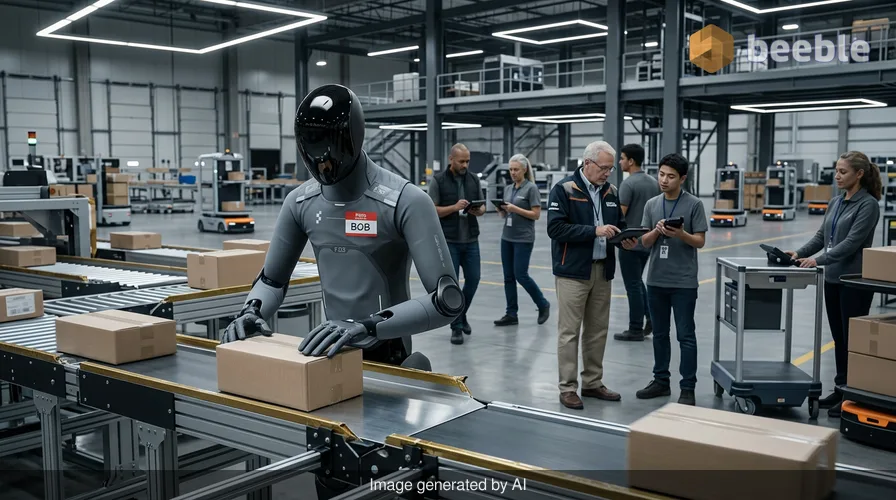
Table of Contents
The monotony of the machine
For the last few years, the public discourse surrounding humanoid robots has been dominated by two extremes: polished, highly edited promotional clips and cinematic fears of a robotic uprising. This week, Figure AI opted for a third path: raw, unedited boredom. In a move that felt more like a Twitch stream than a corporate product launch, the San Jose-based startup livestreamed its humanoid robots performing a repetitive warehouse task for over 30 continuous hours.
The setup was deceptively simple. A bipedal machine—affectionally dubbed ‘Bob’ by the X (formerly Twitter) community—stood before a conveyor belt. Its objective was a textbook industrial loop: identify a package, pick it up, and place it on the belt with the barcode facing down. When one robot’s battery depleted, another—Frank or Gary—stepped in to maintain the cycle. By the time a fourth unit, Rose, joined the rotation on Thursday evening, the stream had become a global spectacle of ‘robotic ASMR,’ drawing millions of viewers to watch a machine do something profoundly dull.
Solving for the ‘cumulative error’
To the casual observer, the livestream was a demo of box-moving. To robotics engineers, it was a demonstration of resilience. In the field of autonomous hardware, the primary adversary is not a lack of strength, but the accumulation of microscopic errors. In traditional robotics, a sensor glitch or a slight software hang after a few hours of operation can lead to a total system failure.
By maintaining a loop for 30 hours, Figure AI aimed to prove that its hardware and software stack could withstand the grind of a standard industrial shift without crashing. This is the critical gap between a ‘science project’ and a viable commercial product. Most industrial robots are bolted to the floor, performing rigid, pre-programmed movements. If a part is shifted two inches, the robot fails. Figure’s approach relies on vision and real-time AI, allowing the machine to adapt to the environment rather than demanding the environment be built around the machine.
The teleoperation debate
The stream was not without its skeptics. Throughout the broadcast, eagle-eyed viewers noted moments where the robots paused unexpectedly or made idiosyncratic gestures, such as touching their heads. These ‘glitches’ sparked immediate speculation that the machines were being teleoperated—a common industry practice where a human remotely controls the robot to simulate autonomy.
Figure AI CEO Brett Adcock countered these claims, asserting that the robots are fully autonomous. According to Adcock, those pauses were not signals of human intervention, but the AI ‘resetting’ itself after a moment of sensory confusion—essentially a digital beat of thought before correcting a trajectory. While this autonomy is impressive, the reality of a real-world logistics center is far more chaotic than a controlled lab in San Jose. In a high-volume facility like those run by Amazon, a package knocked off a belt or a misread barcode can create a systemic bottleneck that a current-gen humanoid might struggle to resolve without human oversight.
The economics of the human form
The immense capital flowing into Figure AI—which now carries a valuation approaching $40 billion—is a bet on the versatility of the human shape. The logic is pragmatic: the world is already built for humans. Warehouses have stairs, narrow aisles, and workstations designed for two arms and two legs. By building a robot that fits these existing dimensions, Figure eliminates the need for companies to spend billions redesigning infrastructure to accommodate specialized automation.
This is an attempt to capture what some investors view as the ‘digital crude oil’ of the century: scalable labor. With persistent labor shortages in physically taxing sectors, the value proposition is a workforce that doesn’t require heating, lighting, or safety breaks. While Bob and Gary aren’t ready to replace the local sorting crew tomorrow, the data from this 30-hour marathon is being fed back into the models to shave seconds off cycle times and improve spatial awareness.
The success of the livestream suggests that the industry is moving away from the era of the ‘high-tech novelty.’ If Figure AI can transition these machines from lab curiosities to invisible, reliable appliances, the impact will be felt less in the headlines and more in the efficiency of the global supply chain.