ASUS Leans Into Luxury with ROG Ally X20 Anniversary Bundle and AR Integration
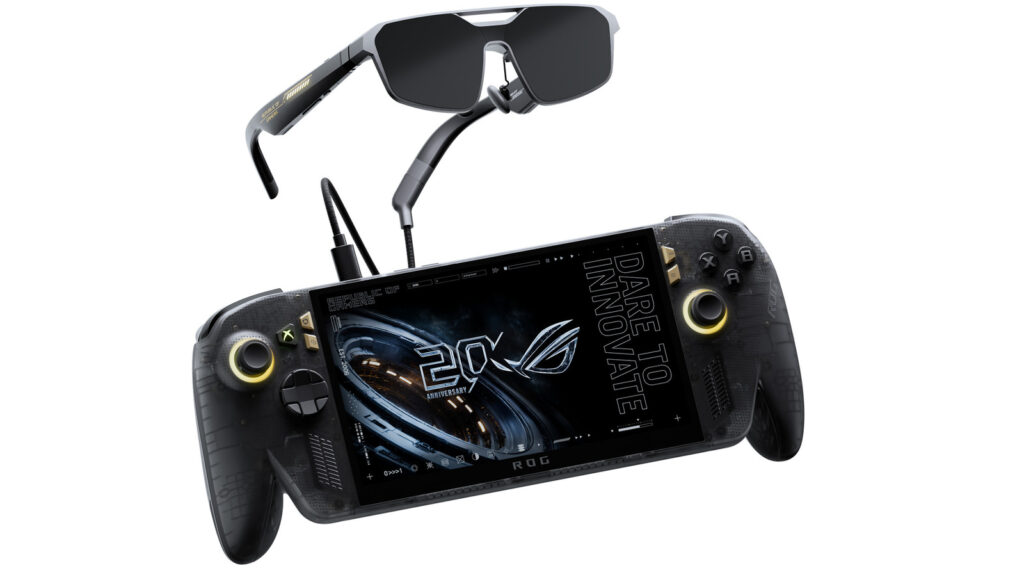
Table of Contents
A Bold Play for the Collector’s Market
ASUS is marking two decades of its Republic of Gamers (ROG) brand not with a simple software update or a commemorative skin, but with a high-end hardware offensive. The newly unveiled ROG Ally X20 is less of a standard product refresh and more of a luxury statement piece, bundling a revised handheld PC with a high-performance AR headset in a package designed for enthusiasts and collectors.
At first glance, the X20 deviates from the utilitarian aesthetic of the original Ally X. ASUS has opted for a translucent black chassis, a design choice that exposes the internal cooling architecture and processor—a nod to the industrial design trends of the early 2000s. This is paired with gold accents throughout the device, signaling its status as a “collector’s item” rather than a mass-market peripheral.
The Shift to Nebula HDR OLED
The most significant hardware leap in the X20 is the display. Moving away from the standard LCDs found in previous iterations, the X20 integrates a 7.4-inch Nebula HDR OLED panel. The specs are aggressive: a 120Hz refresh rate, 1,080p resolution, and a peak brightness of 1,400 nits. For those who play in high-glare environments, the addition of Corning DXC glass with an anti-reflective coating is a practical necessity.
However, OLED panels are notoriously susceptible to heat-induced degradation and burn-in—a critical concern for a device that houses a powerful AMD chip in a cramped chassis. ASUS claims to have addressed this by redesigning the internal airflow channels specifically to keep display temperatures stable, though real-world thermal throttling tests will be necessary to verify these claims.
Precision Controls and AI Processing
Beyond the screen, ASUS has targeted the primary pain point of handheld gaming: stick drift. The X20 introduces TMR (Tunnel Magnetoresistance) joystick technology. While Hall Effect sensors have become the gold standard for durability, TMR is positioned as the next step, promising higher precision and better energy efficiency, which theoretically extends battery life during long sessions.
The internal architecture remains formidable, powered by the AMD Ryzen AI Z2 Extreme processor. With 24GB of LPDDR5X RAM and a 1TB PCIe 4.0 NVMe SSD, the device is built to handle AAA titles. Interestingly, the X20 now includes Auto SR (Super Resolution) preview, a feature previously gated for Windows 11 Copilot+ PCs, suggesting ASUS is tightening its integration with Microsoft’s AI-driven ecosystem to boost frame rates and image clarity.
The AR Dimension: Xreal R1 Integration
The most ambitious part of the bundle is the inclusion of the ROG Xreal R1 Edition 20 AR glasses. This isn’t just a secondary accessory; it’s a fundamental shift in how the handheld is intended to be used. By connecting via USB-C, the glasses project a virtual 171-inch screen into the user’s field of vision at a simulated distance of 4 meters.
Technical specs for the headset are equally high-end, featuring micro-OLED technology that enables a 240Hz refresh rate and a near-instant 0.01ms response time. The inclusion of native 3DoF (Three Degrees of Freedom) allows for intuitive head tracking, meaning the virtual screen remains stable as the player moves.
The Cost of Collectibility
While ASUS has remained tight-lipped on official pricing, a quick look at the component costs paints a steep picture. The standard ROG Ally X typically retails around $1,000, and the Xreal R1 glasses are priced at $849. When you add the “collector’s edition” premium for the OLED panel and the anniversary aesthetics, the X20 bundle is likely to push toward or even exceed the $2,000 mark.
This pricing strategy shifts the Ally X20 away from the Steam Deck’s value-driven market and places it firmly in the luxury enthusiast tier, targeting users who prioritize cutting-edge display tech and brand prestige over raw affordability.


