Acer Bets on Intel’s Custom Silicon with the Predator Atlas 8 Handheld
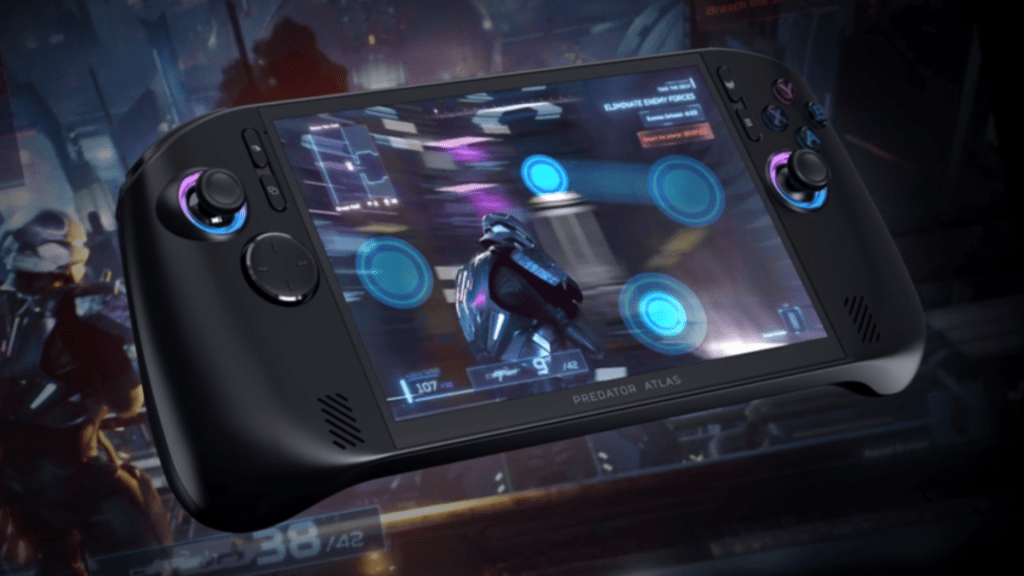
Table of Contents
A New Architecture for a Crowded Market
At Computex 2026, Acer unveiled the Predator Atlas 8, a high-performance gaming handheld that signals a strategic shift in the company’s approach to portable gaming. While Acer has flirted with the handheld space previously with the Nitro Blaze series, the Atlas 8 is the first to carry the prestige Predator branding, positioning it as a flagship device rather than a budget entry.
The centerpiece of the Atlas 8 is not the chassis or the screen, but the silicon. The device debuts the Intel Arc G3 Extreme, a chip based on the Panther Lake (Core Ultra 3) architecture. This represents a pivotal moment for Intel: the G3 is the company’s first custom-engineered chip specifically designed for the unique power and thermal constraints of handhelds. For years, the segment has been dominated by AMD’s Ryzen Z series, leaving Intel to rely on generic laptop chips that often struggled with efficiency—a problem most evident in the lukewarm reception of the MSI Claw.
Breaking Down the G3 Extreme
According to Intel, the G3 Extreme integrates Arc B390-level graphics, capable of supporting Intel XeSS 3 upscaling to maintain playable frame rates at higher resolutions. The core configuration is tailored for bursty gaming workloads, featuring two performance cores, eight efficiency cores, and four low-power E-cores. A non-Extreme variant is also expected, which scales back the efficiency core count by two and utilizes Arc B370 graphics.
The technical challenge for Acer and Intel isn’t just raw power, but the precarious balance of thermals and battery life. To combat the heat generated by the G3, Acer has implemented a dual-fan system, including the signature Predator AeroBlade metal fan. Power is supplied by a beefy 80 watt-hour battery in the top-tier models, though a 60 watt-hour option will likely be available for lower-spec versions.
The Hardware Suite
The Atlas 8 features an 8-inch IPS display with a 1200p resolution and a 120Hz refresh rate, aiming for a middle ground between the Steam Deck’s compactness and the Legion Go’s oversized screen. Internally, the device pushes the boundaries of handheld specs with up to 24GB of RAM and 1TB of Gen 4 storage, though these high specifications will undoubtedly push the retail price into the premium bracket.
On the periphery, Acer has opted for Hall Effect analog triggers to prevent the wear-and-tear issues common in traditional potentiometers. While there is no explicit mention of anti-drift technology for the primary sticks, the inclusion of two rear programmable buttons and adjustable trigger steps suggests a controller layout designed for competitive gaming.
Connectivity is handled via two Thunderbolt 4 USB-C ports and Killer Wi-Fi 7, ensuring the device can handle high-speed external storage and low-latency online play.
The Economic Timing
The Atlas 8 is slated for an October release, but it enters a market that looks vastly different than it did during the initial handheld gold rush of 2023. The industry is currently grappling with memory and storage shortages that have inflated BOM (Bill of Materials) costs across the consumer PC sector.
Price sensitivity is at an all-time high. With Valve recently adjusting the Steam Deck’s pricing and the Lenovo Legion Go 2 pushing toward the $1,500 to $2,000 range, the “affordable alternative to a gaming PC” narrative has effectively vanished. The Predator Atlas 8 is no longer competing with a console; it is competing with high-end gaming laptops.
Whether Intel’s custom silicon can provide the efficiency gains necessary to justify a premium price tag remains to be seen. If the G3 Extreme can outperform the Ryzen Z series in battery longevity while maintaining the B390’s graphical punch, Acer may find a lucrative niche. If not, the Atlas 8 risks becoming another expensive experiment in a market already saturated with options.


