Lenovo Doubles Down on Modular Design and AI Ambitions at MWC 2026
From a foldable gaming handheld to modular AI PCs, Lenovo unveils a massive wave of concept hardware and new laptops at Mobile World Congress 2026.
A Strategic Pivot Toward Modularity and Flexibility
Lenovo arrived at Mobile World Congress (MWC) 2026 not just to refresh its existing product lines, but to signal a fundamental shift in how it views the lifecycle of a PC. Following a high-profile presence at CES, the company’s Barcelona showcase is dominated by six concept devices that challenge the traditional, static nature of laptop and handheld hardware.
The most disruptive of these is the ThinkBook Modular AI PC Concept. In an industry often criticized for planned obsolescence, Lenovo is experimenting with a “Framework-style” approach, allowing users to swap ports and peripherals on the fly. The device features integrated pogo-pin connectors for seamless power and data transfer between modules, including a detachable secondary display and keyboard. This design suggests a future where a laptop can be fundamentally reconfigured based on the user’s immediate workflow, potentially extending the hardware’s lifespan by allowing individual components to be upgraded without replacing the entire chassis.
Redefining the Gaming Handheld
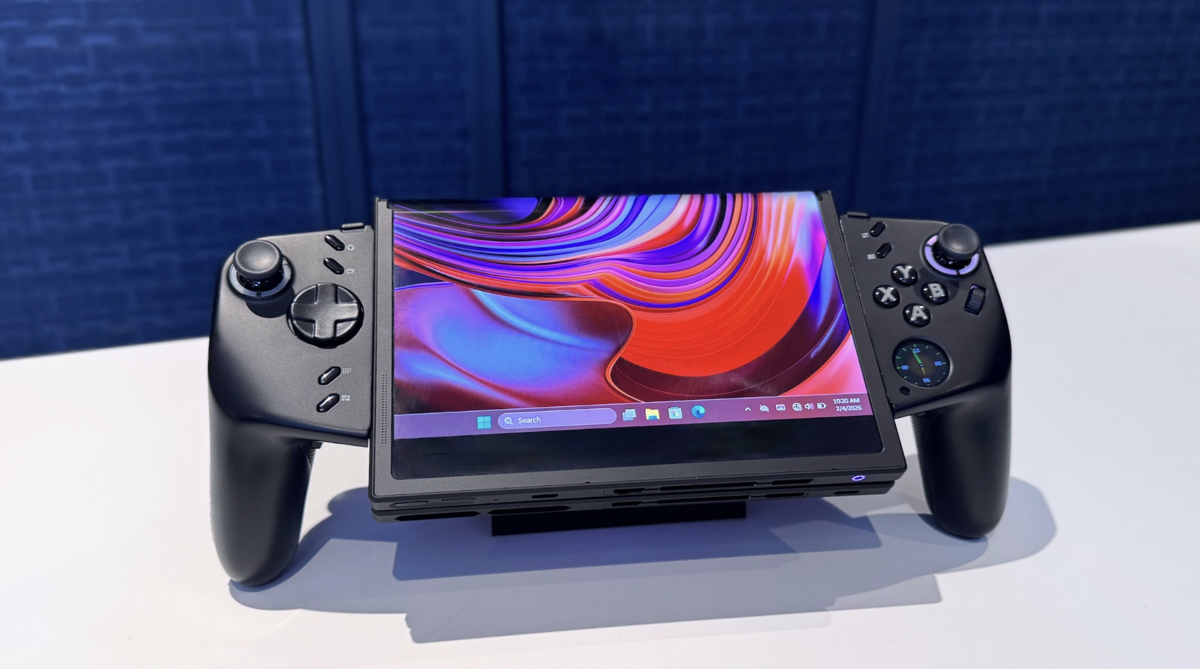
While the modular PC targets the enterprise sector, the Legion Go Fold Concept is aimed squarely at the enthusiast market. Confirming rumors that had leaked earlier in the month, Lenovo unveiled a prototype that bridges the gap between a handheld console and a full-fledged Windows laptop. The device features a 7.7-inch POLED display that unfolds into an 11.6-inch canvas, usable in both landscape and portrait orientations.
Unlike many “concept” devices that lack technical specifics, Lenovo provided concrete internals: the Fold is powered by an Intel Lunar Lake chip paired with 32GB of RAM. To complete the transformation into a productivity machine, it includes a detachable wireless keyboard and a controller that doubles as a vertical mouse. While Lenovo maintains that concept devices aren’t guaranteed for production, the inclusion of specific silicon suggests this is a viable roadmap for the next generation of the Legion Go series.
AI Beyond the Operating System
Lenovo is also attempting to move AI out of the software layer and into physical, ambient hardware. The AI Work Companion and AI Workmate represent two different philosophies of desk-side assistance. The Companion is an inconspicuous, clock-like device designed to act as a personal secretary, using a “Thought Bubble” interface to sync schedules and monitor screen time to prevent burnout. In contrast, the Workmate is a more anthropomorphic, lamp-like device intended for business environments, capable of scanning documents and projecting content onto nearby surfaces using local, on-device AI processing.
This hardware push coincides with the expansion of Qira, Lenovo’s personal AI agent, which is slated to roll out to over 20 different devices in the coming weeks, further integrating the ecosystem.
The Production Line: Yoga and ThinkPad Refreshes
Amidst the prototypes, Lenovo introduced several market-ready machines. The Yoga 9i 2-in-1 Aura Edition leads the consumer charge, featuring an Intel Core Ultra Series 3 chip and a refined, lighter chassis. Notably, Lenovo listened to user feedback by reintroducing the headphone jack and adding a magnetic case for the Yoga Pen Gen 2, which enables a new “Canvas mode” for artists. The Yoga 9i will hit shelves in May with a starting price of $1,949.
On the enterprise side, the new T-Series ThinkPads emphasize a trend toward repairability. Following the “Space Frame” design success of the X1 Carbon Gen 14, the 2026 T-Series models feature more accessible internals, upgraded speakers, and an optional 5MP camera. While official launch dates for the full ThinkPad and ThinkBook lineup remain fluid, all are expected to arrive throughout 2026.
Creative Frontiers with 3D Displays
Rounding out the concepts is the Yoga Book Pro 3D Concept. Aimed at creators, this dual-display OLED machine utilizes eye-tracking technology to render glasses-free 3D visuals. Powered by an Intel Core Ultra 7 and an Nvidia GeForce RTX 5070, the laptop includes unique snap-on pads for the lower touchscreen to trigger specialized menus, positioning it as a high-end workstation for 3D modeling and spatial design.
Related News
Related Articles

Nintendo Signals Next-Gen Leap with ‘Pokémon Winds and Waves’ Exclusivity for Switch 2
The Pokémon Company unveils Winds and Waves, the first major title confirmed exclusively for the Nintendo Switch 2, featuring an oceanic open world and new starters.
Xiaomi Doubles Down on Mid-Range Display Tech with Fire TV-Powered Mini LED Series in India
Xiaomi expands its Indian portfolio with the TV FX Mini LED series, integrating Amazon Fire TV and QD Mini LED tech across four sizes from 43 to 75 inches.
Sony’s Move to Kill Physical Discs by 2028 Signals a Crisis for Game Preservation
Sony announces the end of physical PlayStation discs by January 2028, highlighting the precarious nature of digital ownership and game archiving.
Comments (0)