Lenovo Floods MWC 2026 with Foldable Gaming Handhelds and Modular AI PC Concepts
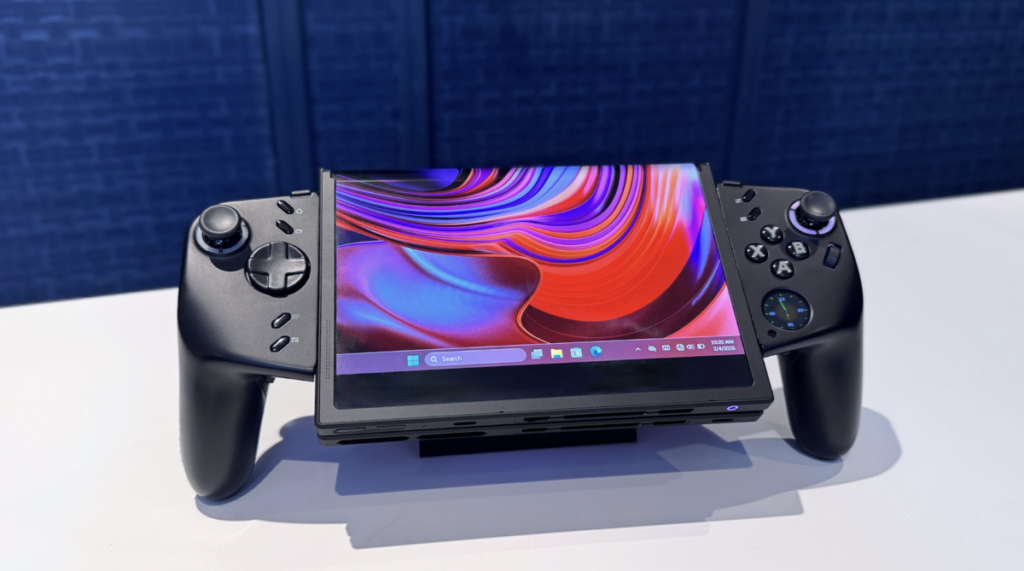
Table of Contents
A Hardware Blitz in Barcelona
Lenovo has arrived at Mobile World Congress (MWC) 2026 not just to compete, but to overwhelm. Following a dominant showing at CES earlier this year, the PC giant is doubling down on its 2026 portfolio with a massive wave of hardware that blurs the line between consumer electronics and experimental prototypes. While the announcement list is exhaustive—spanning tablets, monitors, and enterprise laptops—the real story lies in Lenovo’s aggressive pivot toward modularity and flexible form factors.
The Legion Go Fold: A New Shape for Gaming
The most talked-about reveal is the Legion Go Fold Concept. After weeks of leaks, Lenovo has confirmed a handheld that attempts to solve the “small screen” problem of portable gaming. The device features a 7.7-inch POLED display that unfolds into a massive 11.6-inch canvas, usable in both landscape and portrait orientations.
What elevates this beyond a simple folding tablet is its versatility. It ships with a detachable wireless keyboard, effectively transforming the handheld into a clamshell Windows laptop. In a clever bit of engineering, one of the controllers doubles as a vertical mouse. Under the hood, Lenovo is powering the prototype with Intel’s Lunar Lake architecture and 32GB of RAM, suggesting that while this is a “concept,” the company is thinking seriously about production specs.
Modular Design and the Fight Against E-Waste
Perhaps more significant for the industry is the ThinkBook Modular AI PC Concept. At a time when “right to repair” is becoming a regulatory focal point, Lenovo is experimenting with a chassis that allows users to swap ports and components on the fly—a philosophy reminiscent of Framework laptops. The system utilizes integrated pogo-pin connectors for power and data transfer, allowing for a highly adaptable set of modules, including a detachable secondary display and keyboard.
This commitment to longevity isn’t limited to concepts. Lenovo’s 2026 T-Series commercial laptops have been redesigned for better repairability, and the previously announced ThinkPad X1 Carbon Gen 14 Aura Edition continues to push the “Space Frame” design to make internals more accessible.
3D Creativity and the AI Desktop
For the creative crowd, the Yoga Book Pro 3D Concept introduces a dual-display setup aimed at 3D artists. Using eye-tracking technology to render objects without the need for glasses, the laptop is powered by an Intel Core Ultra 7 and Nvidia GeForce RTX 5070 graphics. The inclusion of snap-on pads for the lower touchscreen suggests a deep integration of tactile and spatial inputs.
Lenovo is also attempting to move AI off the laptop and onto the desk. Two new prototypes—the AI Work Companion and the AI Workmate—aim to serve as physical hubs for productivity. The former acts as a discreet secretary managing schedules and burnout prevention, while the latter, a more anthropomorphic device, can scan documents and project content onto nearby surfaces using local AI processing.
The Consumer Core: Yoga 9i Aura Edition
While the concepts grab the headlines, the Yoga 9i 2-in-1 Aura Edition is the practical anchor of the MWC showcase. Updated with an Intel Core Ultra Series 3 chip, the device is lighter and restores the fan-favorite headphone jack. A new “Canvas mode” is enabled via a magnetically attached Yoga Pen Gen 2, positioning the device as a premium tool for digital artists. The Yoga 9i is slated for a May release with a price tag of $1,949.