Israel to Cede Strategic Southern Lebanon Zones in Trilateral Framework Deal
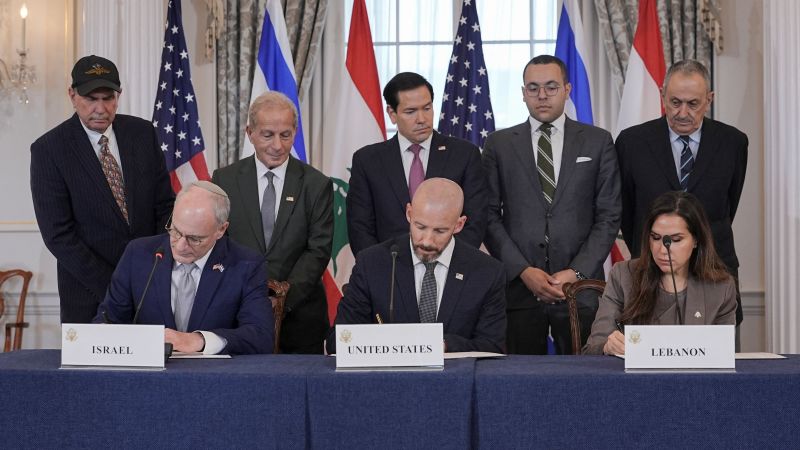
Table of Contents
A Fragile First Step in Washington
In a high-stakes diplomatic push led by the Trump administration, Israel and Lebanon have signed a framework agreement in Washington, D.C., marking a rare moment of formal coordination between two nations that have never maintained diplomatic relations. The deal, signed at the State Department on June 26, 2026, stipulates that the Israel Defense Forces (IDF) will withdraw from two specific sectors in southern Lebanon, transferring control of these sites to the Lebanese military.
The signing ceremony was attended by US Secretary of State Marco Rubio, State Department Counselor Daniel Holler, Israel’s Ambassador to the U.S. Yechiel Leiter, and Lebanon’s Ambassador to the U.S. Nada Hamadeh Moawad. While the agreement is framed as a “beginning of the beginning,” it represents a calculated geopolitical gamble intended to stabilize a volatile border and pave the way for a more comprehensive peace treaty.
The Geometry of Withdrawal
The specifics of the withdrawal are strategically narrow. Prime Minister Benjamin Netanyahu confirmed that the IDF will pull back from two distinct areas: one situated north of the Litani River and another to the south. For years, the Litani River has served as a critical tactical boundary in the region; by vacating these specific sites, Israel is utilizing what sources describe as “symbolic” gestures to provide the Lebanese government with a tangible victory in sovereignty.
In a pre-recorded address, Netanyahu characterized the move as a tactical optimization, stating that the IDF is leaving sites it “does not need.” However, the Prime Minister was quick to qualify the victory, noting that Israel will maintain its presence in significant portions of southern Lebanon. The caveat is clear: full withdrawal is contingent upon the total disarmament of Hezbollah, a condition that remains a central friction point in the region.
The Lebanese Sovereignty Pivot
For Lebanon, the agreement is being messaged as a restoration of national dignity. Ambassador Nada Hamadeh Moawad described the framework as the first critical step toward restoring the country’s territorial integrity. This sentiment was echoed by Lebanese President Joseph Aoun, who praised the US-led negotiations and emphasized the need for a state that has “no partner in its sovereignty,” a thinly veiled critique of the influence exerted by Iran and its proxy, Hezbollah.
To ensure the vacuum left by the IDF is not immediately filled by non-state actors, the Lebanese Armed Forces (LAF) will enter these zones as part of a pilot program integrated into the current ceasefire agreement. This transition aims to institutionalize the Lebanese state’s authority over its southern border, moving away from the shadow-governance of militant groups.
Internal Fractures and External Pressure
Despite the diplomatic optics in Washington, the agreement faces fierce opposition within Lebanon. Hassan Fadallah, a Hezbollah member of parliament, condemned the negotiations as criminal, urging the government to retract the deal. Speaking to the pro-Hezbollah Al-Mayadeen network, Fadallah reiterated the group’s refusal to engage in direct negotiations with the Israeli state, signaling that the framework may struggle to achieve stability on the ground if Hezbollah chooses to obstruct the LAF’s deployment.
From the Israeli perspective, Netanyahu framed the deal as a strategic blow to Tehran. By aligning Lebanon and the US in a formal framework, Israel argues it is stripping Iran of its ability to dictate terms through force. Secretary of State Marco Rubio acknowledged the immense difficulty of the task, reminding the parties that while the framework is signed, the arduous work of a permanent peace remains ahead.