The ‘Bashi Breakout’: China’s Strategy to Project Power Beyond the First Island Chain
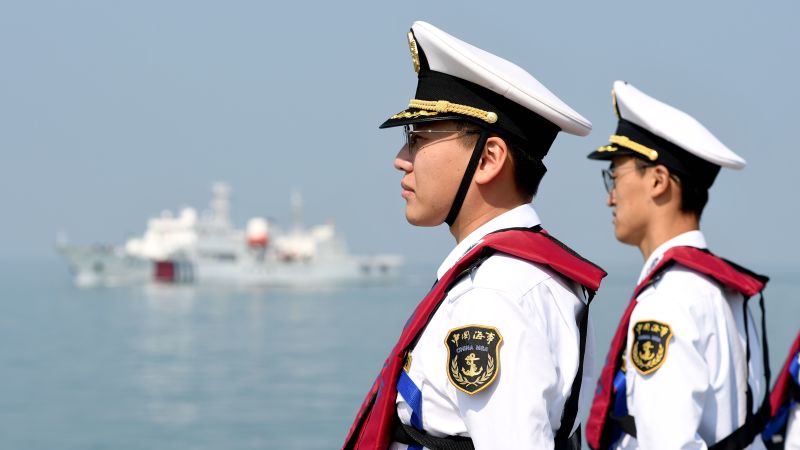
Table of Contents
A New Frontier in Gray-Zone Tactics
For years, the geopolitical tension in the Western Pacific has been defined by the ‘First Island Chain’—a strategic maritime boundary stretching from Japan through Taiwan and the Philippines. While China has long asserted dominance within this perimeter, a recent shift in operational behavior suggests Beijing is attempting to push its jurisdiction further into the open Pacific.
In what analysts are calling the ‘Bashi Breakout,’ ships from China’s Maritime Safety Agency (MSA) have been observed conducting law enforcement and seabed mapping activities in the Bashi Channel and the waters east of Taiwan. This is a significant departure from previous patterns; while the People’s Liberation Army Navy (PLAN) has conducted drills in these areas, the use of the MSA—a civilian law enforcement body—signals an attempt to normalize a permanent administrative presence in contested waters.
The Mechanics of ‘Salami Slicing’
The strategy at play here is known as ‘salami slicing’—the practice of taking small, incremental steps that are individually too minor to trigger a kinetic military response, but which collectively shift the status quo in favor of the aggressor. By deploying MSA vessels rather than warships, Beijing lowers the immediate risk of a military escalation while establishing a ‘new normal’ on the water.
The move follows the 2023 expansion of China’s controversial ‘9-Dash Line’ to a ’10-Dash Line,’ which explicitly included areas east of Taiwan. According to Ray Powell, director of the SeaLight project at Stanford University’s Gordian Knot Center for National Security Innovation, this is an effort to create ‘new facts’ on the water. When China labels these regions as ‘nearshore waters’—a term recently floated by the state-affiliated account Yuyuan Tantian—it is essentially claiming de facto jurisdiction over international shipping lanes.
The Economic Chokehold on Taiwan
The implications for Taiwan are more than just symbolic. Taiwan remains heavily dependent on maritime imports for nearly all of its energy needs, specifically liquid natural gas (LNG). If China successfully establishes itself as the ‘constabulary’ of the sea approaches to Taiwan, it gains the ability to disrupt these critical lifelines without ever firing a shot.
Reports from the Taiwanese coast guard indicate that MSA ships have already begun issuing radio challenges to commercial vessels heading toward the island. Analysts warn that the natural progression of this strategy is the ‘tightening of the boa constrictor’—a scenario where China could force commercial ships into Chinese ports or block energy carriers entirely, effectively starving Taiwan of power and fuel.
Global Repercussions and the First Island Chain
This strategic pivot does not happen in a vacuum. It follows high-level diplomatic exchanges between Beijing and Washington, where Chinese leader Xi Jinping emphasized that Taiwan remains the primary friction point in US-China relations. By breaking the First Island Chain barrier, Beijing is demonstrating that its reach now extends beyond the traditional defensive perimeter that the U.S. and its allies have relied upon to contain Chinese naval expansion.
Carl Schuster, a former director of the US Pacific Command’s Joint Intelligence Center, notes that if these waters are officially designated as sovereign near-shore zones, foreign vessels would theoretically require Chinese permission to enter. This would fundamentally alter the freedom of navigation in one of the world’s most critical trade corridors, turning a transit zone into a gated community controlled by Beijing.