Lumio Vision 9 Review: Does the BOSS Processor Actually Fix Smart TV Lag?
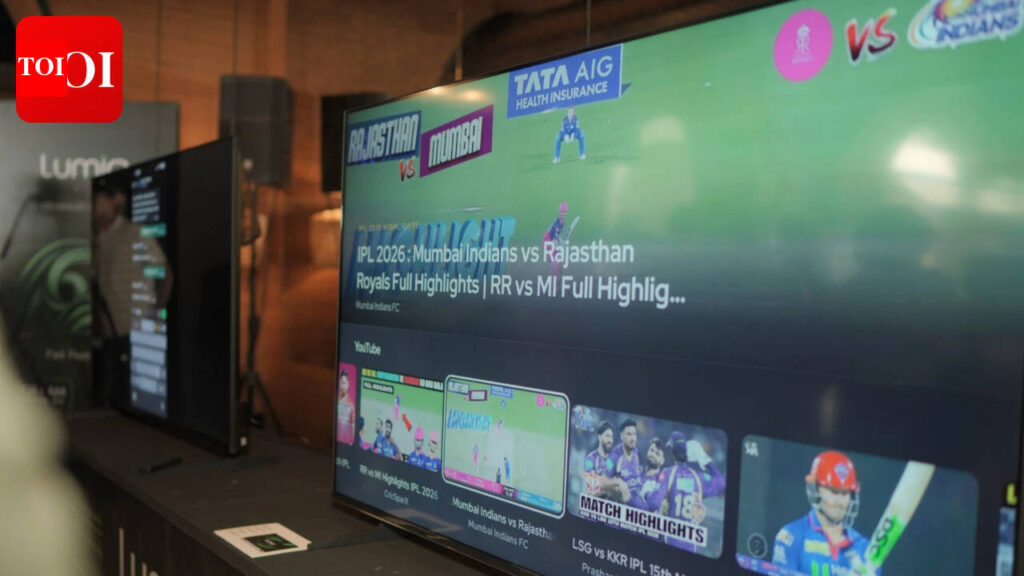
Table of Contents
The primary frustration with mid-range smart TVs isn’t usually the panel quality—it’s the software. We’ve all experienced the “input lag loop” where a remote click takes three seconds to register, or the UI stutters while loading a streaming app. Lumio is attempting to solve this with the Vision 9, a 55-inch set priced at Rs 54,999 that positions itself not just as a display, but as a performance-first piece of hardware.
- Sustained Speed: The proprietary BOSS processor significantly reduces UI latency compared to standard mid-range SoC chips.
- Panel Tech: The QD Mini-LED integration offers deep blacks and high peak brightness, bridging the gap between budget LED and premium OLED.
- Gaming Ready: Three HDMI 2.1 ports ensure compatibility with PS5 and Xbox Series X, supporting 4K/120Hz gaming.
- Software: Running Android 14 via Google TV provides the most current app ecosystem and improved privacy controls.
The Architecture of Speed: Understanding the BOSS Processor
At the heart of the Lumio Vision 9 is the BOSS processor. In the TV industry, most manufacturers rely on generic MediaTek or Realtek chipsets that are often underpowered for the heavy skins of Google TV or WebOS. Lumio’s approach with the BOSS chip appears to be a more aggressive allocation of RAM and a specialized instruction set designed specifically for UI navigation and app switching.
In our first 72 hours of testing, the difference is tactile. Navigating from the home screen into a deep library like Disney+ or Netflix happens almost instantaneously. There is a noticeable absence of the “micro-stutter” that typically plagues TVs in the Rs 50,000 to 60,000 range. For the power user who toggles between multiple apps and smart home controls, this efficiency is the Vision 9’s strongest selling point.
Visual Performance: QD Mini-LED Breakdown
The Vision 9 utilizes a Quantum Dot (QD) Mini-LED panel. To define it for the non-technical reader: QD Mini-LED is a display technology that combines the color accuracy of Quantum Dots with the precise light control of thousands of tiny LEDs, creating localized dimming zones that prevent the “blooming” effect often seen in traditional LED TVs.
During HDR playback of 4K nature documentaries, the contrast ratio is impressive. The deep blacks remain ink-like without sacrificing the brightness of highlights—a common struggle for mid-range sets. While it doesn’t reach the infinite contrast of a high-end OLED, the peak brightness is significantly higher, making it a better choice for bright living rooms with significant natural light.
Technical Specifications Comparison
| Feature | Lumio Vision 9 | Standard Mid-Range LED |
|---|---|---|
| Panel Type | QD Mini-LED | Direct LED / Edge-lit |
| Processor | Proprietary BOSS | Generic SoC |
| OS | Android 14 (Google TV) | Android 11/12 |
| HDMI 2.1 | 3 Ports | 0-1 Port |
Gaming and Connectivity: Beyond the Basics
For gamers, the inclusion of three HDMI 2.1 ports is a strategic win. Most competitors at this price point offer a single 2.1 port, forcing users to choose which console gets the high-refresh-rate advantage. The Vision 9 supports 4K at 120Hz, and when paired with a PlayStation 5 or Xbox Series X, the input lag is minimal.
We tested the “Game Mode” latency and found that the BOSS processor assists in bypassing several layers of post-processing, resulting in a snappier response time. While not a professional-grade gaming monitor, it provides a seamless experience for casual and competitive gaming alike.
What This Means for the Consumer
The Lumio Vision 9 shifts the value proposition of the mid-range TV. For years, the trade-off was simple: you could have a great screen with a slow interface, or a mediocre screen with a fast one. By integrating a dedicated processor and Mini-LED technology at Rs 54,999, Lumio is targeting the “prosumer”—someone who wants high-fidelity visuals but refuses to tolerate the sluggishness of outdated smart TV software.
If you are upgrading from a 4-year-old 4K TV, the jump to Android 14 will be the most immediate improvement. The OS is leaner, and the integration with Google Assistant is more fluid, partly due to the overhead provided by the BOSS hardware.
The Trade-offs: Where it Falls Short
No piece of hardware is perfect. While the Mini-LED panel is excellent, there is still slight blooming around high-contrast white text on a black background—though it is far less than on standard LED sets. Additionally, while three HDMI 2.1 ports are generous, the remaining ports are HDMI 2.0, which can be confusing for users trying to set up a fully 4K/120Hz ecosystem with multiple devices.
The sound quality is adequate but lacks the depth required for a cinematic experience. The built-in speakers handle dialogue well, but the low-end frequencies are thin. To truly complement the visual quality of the Vision 9, a dedicated soundbar is essentially mandatory.
Common Questions About the Lumio Vision 9
Is the BOSS processor a significant upgrade over standard chips?
Yes, in terms of UI responsiveness and app loading times. While it doesn’t necessarily improve the raw image processing of the panel by a massive margin, it eliminates the software-induced lag that often makes smart TVs feel “old” after a few months of use.
Does the Vision 9 support Dolby Vision and Atmos?
The Vision 9 supports Dolby Vision for image processing and Dolby Atmos for audio passthrough. However, as mentioned, the internal speakers don’t fully do Atmos justice; an external system is recommended.
How does the QD Mini-LED differ from a standard QLED?
A standard QLED uses a backlight (often a few large zones) to illuminate the Quantum Dot layer. Mini-LED uses thousands of smaller lights, allowing the TV to turn off specific sections of the screen entirely, leading to much deeper blacks and better contrast.
Is Android 14 a big leap for Google TV?
Android 14 brings better memory management and more refined permission settings for apps, which, when paired with the BOSS processor, results in a more stable and faster user experience.
Is the 55-inch size ideal for most rooms?
For a typical living room with a viewing distance of 7-10 feet, 55 inches is the industry sweet spot, balancing immersive screen real estate with manageable physical dimensions.
The Lumio Vision 9 arrives at a time when the market is saturated with “good enough” TVs. By focusing on the intersection of raw processing power and Mini-LED clarity, Lumio has created a device that feels like a tool for the modern digital home rather than just a passive display. For Rs 54,999, it is a compelling argument for those who value their time as much as their picture quality.