Honor Magic V6 Review: A Masterclass in Hardware Engineering vs. Software Friction
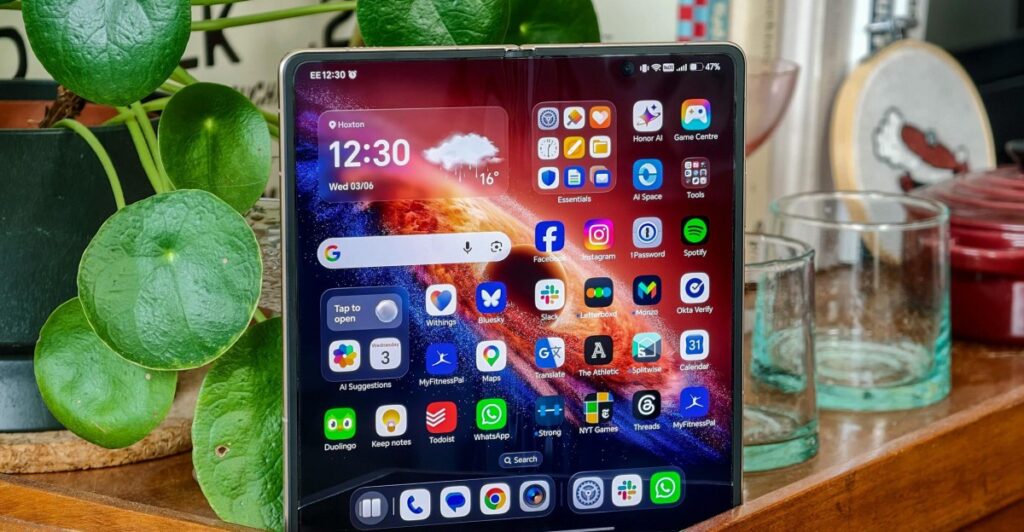
Table of Contents
The Convergence of Foldables and Slab Phones
For years, the trade-off of owning a foldable phone was a calculated gamble. You accepted a bulkier chassis, a shorter battery life, and a fragile screen in exchange for the productivity of a tablet in your pocket. With the global rollout of the Honor Magic V6, that gap is nearly closed. The device arrives not as a radical departure from its predecessor, but as a refinement of an already aggressive design philosophy.
Having spent significant time with the Magic V6 in a professional testing environment, the immediate impression is one of engineering audacity. It manages to be thinner than most flagship ‘slab’ phones while housing a battery that puts traditional smartphones to shame. However, the device highlights a growing tension in the industry: hardware is evolving faster than the software meant to manage it.
- Battery Breakthrough: The jump to 6,660mAh via silicon-carbon tech enables true two-day usage.
- Extreme Durability: The IP69 rating introduces a level of ingress protection previously unseen in foldables.
- Physical Profile: At 8.75mm folded, it effectively eliminates the ‘brick’ feel of early foldables.
- The Software Hurdle: MagicOS remains the primary friction point, lagging behind the intuitiveness of competitors like Oppo.
Breaking the Physics of Foldables: The Hardware Analysis
The Honor Magic V6 focuses on three specific ‘firsts’ that aim to redefine the category. While some are incremental, they represent a broader trend toward making foldables indistinguishable from standard phones in daily carry.
The Thinness Paradox
Measuring in at 8.75mm when folded (specifically the white variant; other colors hit 9mm), the Magic V6 is marginally thinner than the previous generation. To the naked eye, a 0.05mm difference is irrelevant—roughly the thickness of a human hair. However, the engineering required to maintain a 4mm thickness when open while ensuring structural rigidity is substantial. For context, this puts the V6 in direct competition with the iPhone 17 Pro Max’s thickness, meaning users no longer have to sacrifice pocket comfort for screen real estate.
Redefining Ruggedness with IP69
Most flagship foldables, including the Pixel 10 Pro Fold, typically peak at an IPX8 or IP68 rating. The Magic V6 introduces an IP69 rating. In technical terms, while IP68 protects against long-term immersion in water, IP69 protects against high-pressure, high-temperature jet sprays. While the average user is unlikely to subject their phone to industrial power-washing, this rating indicates a significant leap in the sealing of the hinge and display gaskets, addressing the perennial fear of dust ingress in folding mechanisms.
The Silicon-Carbon Battery Leap
The most impactful upgrade is the transition to silicon-carbon battery cells. This technology allows for higher energy density in a smaller physical footprint. The global model features a 6,660mAh capacity, a significant jump from the 5,820mAh found in the Magic V5. In real-world testing, this translates to a reliable two-day battery cycle. For the first time in a high-performance foldable, the ‘battery anxiety’ associated with dual-screen usage has been largely mitigated.
Performance and the ‘Expected’ Flagship Suite
Internally, the Magic V6 is powered by the Qualcomm Snapdragon 8 Elite Gen 5. In benchmarks and daily multitasking, the performance is flawless. With 16GB of RAM and up to 512GB of storage, the device handles memory-intensive apps and heavy split-screen multitasking without thermal throttling. The dual 120Hz OLED displays provide the fluidity expected in 2026, though the screen crease remains slightly more visible than the nearly invisible implementation found in Oppo’s Find N series.
The Camera Compromise
Despite the hardware wins, the camera system illustrates the inherent limitations of the foldable form factor. The triple-camera array is impressive for a foldable, but it cannot compete with a dedicated slab flagship. Because the chassis is so thin, Honor is forced to use smaller sensors. This leads to three specific issues: limited light capture in low-light environments, occasional over-saturation, and inconsistent color processing across the different lenses. It is a ‘good’ camera, but not a ‘great’ one.
| Feature | Honor Magic V6 | Average Foldable (2025) | Slab Flagship (S25/iPhone 17) |
|---|---|---|---|
| Thickness (Folded) | 8.75mm | 10-12mm | 8-9mm |
| Battery Tech | Silicon-Carbon | Li-ion / Li-Po | Li-ion |
| Water Resistance | IP69 | IPX8 / IP68 | IP68 |
| Camera Sensor Size | Medium | Medium | Large/Ultra-Large |
The Software Friction: MagicOS Analysis
Hardware excellence cannot fully mask software deficiency. The Magic V6 runs MagicOS, which continues to be the device’s Achilles’ heel. The user interface is visually noisy and borrows heavily from Apple’s ‘Liquid Glass’ aesthetic without mastering the underlying utility.
Multitasking, while functional, lacks the intuitive flow of Oppo’s software. Honor also persists in bloating the system with redundant first-party apps. While the promise of seven years of OS and security updates is commendable—matching the industry gold standard set by Google and Samsung—the quality of the experience is where the device falters. For a phone at this price point (approximately $1,930 in Singapore/Malaysia), the software should feel as premium as the titanium and glass chassis.
What This Means for the Consumer
The Honor Magic V6 signals that the ‘experimental’ phase of foldables is over. We have reached the point of diminishing returns regarding physical thickness and battery capacity. For the user, this means that the decision to buy a foldable is no longer about whether the hardware can ‘keep up’ with a normal phone—it can.
However, the high price tag remains a barrier. The value proposition shifts from ‘cutting-edge tech’ to ‘premium utility.’ If you prioritize battery life and a slim profile above all else, the V6 is the current market leader. If you prioritize a cohesive software experience or professional-grade photography, the compromises of the foldable form factor are still present.
Practical Implications by User Type
- Power Users: The two-day battery and Snapdragon 8 Elite make this a legitimate laptop replacement for light work.
- Travelers: The IP69 rating and slim profile make it the most durable and portable ‘large screen’ option.
- Photography Enthusiasts: You will likely find the sensors lacking compared to a standard Pro Max or Ultra device.
Frequently Asked Questions
Is the Honor Magic V6 waterproof?
Yes, it carries an IP69 rating, which is superior to the standard IP68. It can withstand high-pressure water jets and is dust-tight, making it one of the most rugged foldables available.
How long does the battery actually last?
Thanks to the 6,660mAh silicon-carbon battery, most users can expect two full days of moderate to heavy use on a single charge.
Does the screen crease affect visibility?
The crease is subtle and barely noticeable during video playback, though it is slightly more prominent than the one found on the Oppo Find N6.
How does the Magic V6 compare to the Samsung Galaxy Z Fold series?
The Magic V6 is significantly thinner and offers a larger battery. However, Samsung generally provides a more robust global repair network and more mature software integration via One UI.
Will it receive updates for a long time?
Honor has committed to seven years of OS and security updates, ensuring the device remains viable through 2033.
What is the price of the Honor Magic V6?
At launch in Malaysia and Singapore, it is priced at approximately RM 7,699 (roughly $1,930), with UK and European pricing expected to be similar.