The Engineering Behind $10 Million F1 Simulators: Why Consumer Sim Racing Isn’t Even Close
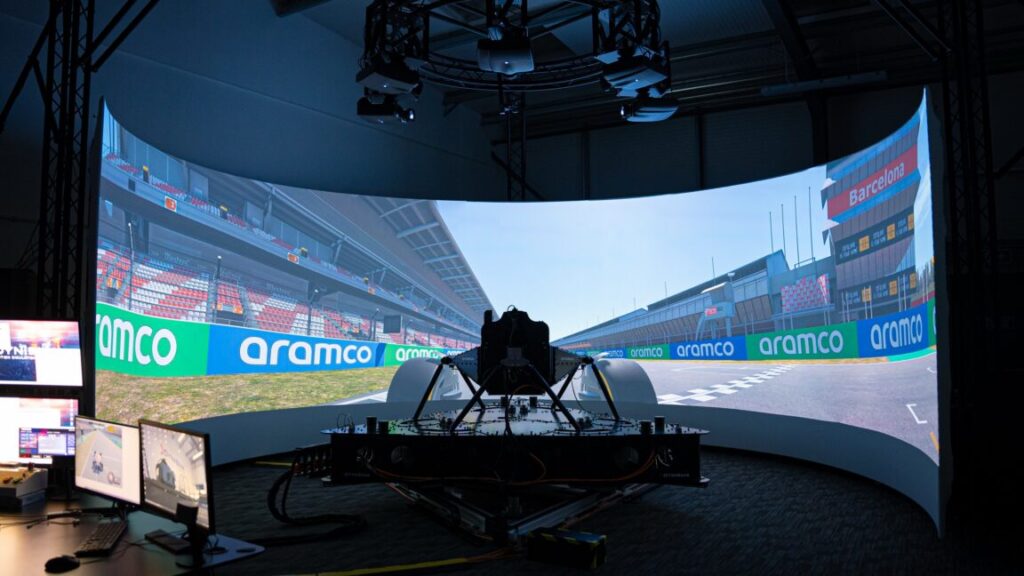
Table of Contents
The Invisible Divide in Virtual Racing
To the casual observer, a high-end home sim racing rig—complete with direct-drive wheels and a hydraulic motion platform—looks remarkably similar to the multimillion-dollar installations found in the secret compounds of Brackley or Maranello. But in the world of Formula 1, the difference between a $50,000 consumer setup and a $10 million Driver-in-the-Loop (DiL) simulator isn’t just a matter of scale; it is a fundamental divergence in physics and electrical engineering.
- Latency is the primary differentiator: Professional F1 sims achieve a 3-5ms response time, an order of magnitude faster than commercial flight or driving simulators.
- High-Frequency Bandwidth: Unlike flight sims that focus on sustained bank angles, F1 rigs must replicate high-frequency vibrations from tires and engine harmonics.
- The Human Factor: World Champion drivers rely on an instinctive “closed loop” of input and response; any lag creates a cognitive disconnect that renders the data useless.
- Tire Modeling: The current frontier of simulation is replicating the exact feeling of tire displacement and energy expenditure to manage overheating during a race.
The adoption of these systems began in the early 2000s, pioneered by teams like McLaren and Ferrari. While consumer gear has improved, the professional tier remains an arms race of low-latency hardware and complex mathematical modeling. The goal is not “immersion” in the gaming sense, but correlation—the degree to which the simulator’s behavior matches the physical car on the tarmac.
Understanding Driver-in-the-Loop (DiL) Technology
Driver-in-the-Loop (DiL) simulation is a specialized testing methodology where a human driver is integrated into a virtual environment to provide real-time subjective feedback on a vehicle’s handling characteristics. Unlike automated simulations, which use algorithms to predict lap times, DiL captures the nuanced, instinctive reactions of a professional athlete.
Ash Warne, founder and CTO of Dynisma, explains that the relationship between a driver and an F1 car is a “dynamic closed loop.” The driver provides an input, the car responds, and the driver reacts to that response in milliseconds. If the simulator introduces a delay—even one barely perceptible to a human—the driver’s brain detects the anomaly, and the correlation with reality breaks.
The War Against Latency
In the context of F1 simulators, latency is the time elapsed from the moment the physics engine calculates a movement (such as the rear end of the car stepping out in yaw) to the moment the driver feels that movement via an accelerometer on the chassis. For Dynisma’s systems, this window is narrowed to 3 to 5 milliseconds.
To put this in perspective, most high-end consumer motion platforms and even advanced commercial flight simulators operate with significantly higher latency. When a car is traveling at 200 mph, a few milliseconds of lag can be the difference between a driver catching a slide and a virtual crash. Warne, who previously worked with McLaren and Ferrari, proved the possibility of this ultra-low latency using basic tools—initially prototyping with Arduino and Raspberry Pi—before scaling to the industrial-grade programmable logic controllers (PLCs) used in current systems.
High-Bandwidth Motion: Beyond the Tilt
Many consumer “motion rigs” rely on simple actuators that tilt the seat forward and backward. However, F1 cars are subjected to immense, high-frequency energy. The challenge for engineers is not just moving the cockpit, but replicating the bandwidth of the vibrations that travel from the road through the suspension and into the driver’s spine.
Flight Simulators vs. Racing Simulators
The technical requirements for a flight simulator are vastly different from those of a race car. Aircraft move relatively slowly in terms of angular change and are interested in sustained bank angles. A race car, conversely, is “stuck to the road” and experiences constant, high-frequency shocks from curb strikes, engine vibrations, and tire scrub.
The Dynisma DMG360XY represents the current apex of this technology. It allows the driver pod to rotate through 360 degrees with 5 meters of travel along the X and Y axes. This level of mobility allows the simulator to replicate not just the centrifugal force of a corner, but the erratic, sharp movements associated with losing grip at high speeds.
The Holy Grail: Tire Physics and Displacement
If you ask a professional sim driver what the hardest thing to replicate is, the answer is almost always the tires. Tires are not static circles of rubber; they are complex, viscoelastic structures that deform under load.
“The biggest thing with simulators has always been the fight to make the tires feel like a tire, even though you don’t have tires,” says Simon Pagenaud, a veteran sim driver for the Cadillac F1 program.
For a driver, the feeling of the tire “moving under the rim” and the displacement of the suspension are critical cues. This subjective feedback allows a driver to sense when a tire is beginning to overheat or when the grip level is dropping. In modern F1, where tire management (thermal degradation) often decides the race, the ability to simulate these forces accurately is a massive competitive advantage.
The Role of the Professional Sim Driver
A common misconception is that sim drivers are simply there to set fast lap times. While speed is necessary, the primary role of a professional simulator driver—like Pagenaud—is to act as a human sensor for the engineers.
Consistency Over Raw Speed
While young drivers use the simulator to prove their raw pace, veteran sim drivers are hired for consistency. Their job is to provide precise, subjective feedback on whether a setup change—such as a minor adjustment to the front wing angle or suspension damping—feels “correct” compared to real-world experience. This helps engineers avoid wasting precious track time during limited practice sessions.
Managing Thermal Energy
Currently, a significant portion of simulator work is dedicated to understanding energy expenditure in the tires. By analyzing how different driving styles affect tire temperature, teams can develop strategies to make the rubber last longer without sacrificing too much grip. This translates directly to pit stop strategy and race results.
What This Means for the Industry
The gap between professional and consumer simulation highlights a critical point in technology: The Law of Diminishing Returns. To get from 90% accuracy to 95% accuracy might cost $10,000 in consumer gear. But to get from 98% to 99.9% accuracy—the level required by an F1 World Champion—requires a $10 million investment in custom motion generators and low-latency electronics.
For the average enthusiast, the aRcade-style motion of a home rig is sufficient for enjoyment and general skill improvement. However, for an F1 team, the simulator is not a game; it is a critical engineering tool. The data derived from these machines informs the physical build of the car, meaning the simulator effectively acts as a wind tunnel for human intuition.
Frequently Asked Questions
Why can’t I buy a Dynisma simulator for my home?
Beyond the $10 million price tag, these systems require industrial-grade power supplies and specialized installation. They are designed as engineering tools for professional drivers and engineers, not as consumer electronics.
Do F1 drivers actually trust the simulators?
Yes, provided the correlation is high. Teams spend thousands of hours comparing simulator data with real-track data. If the simulator says a change will gain 0.1 seconds and the real car does the same, the trust is established.
How does latency affect driving performance?
High latency creates a “disconnect” where the driver’s brain perceives the movement slightly after it happens. This leads to over-correcting and an inability to feel the “limit” of the car, making the simulation feel unnatural and inaccurate.
What is the difference between a motion platform and a motion generator?
A standard platform usually tilts or moves on a few axes. A motion generator, like those from Dynisma, focuses on high-fidelity acceleration and vibration, replicating the actual G-forces and frequencies of a race car.
Does VR improve the experience of F1 simulators?
VR provides better spatial awareness and depth perception, but for professional F1 drivers, the physical haptic feedback (the movement of the chassis) is far more important than the visuals for technical development.