Beyond the Crop: Apple’s Spatial Reframing Attempts to Solve the ‘Wrong Angle’ Problem
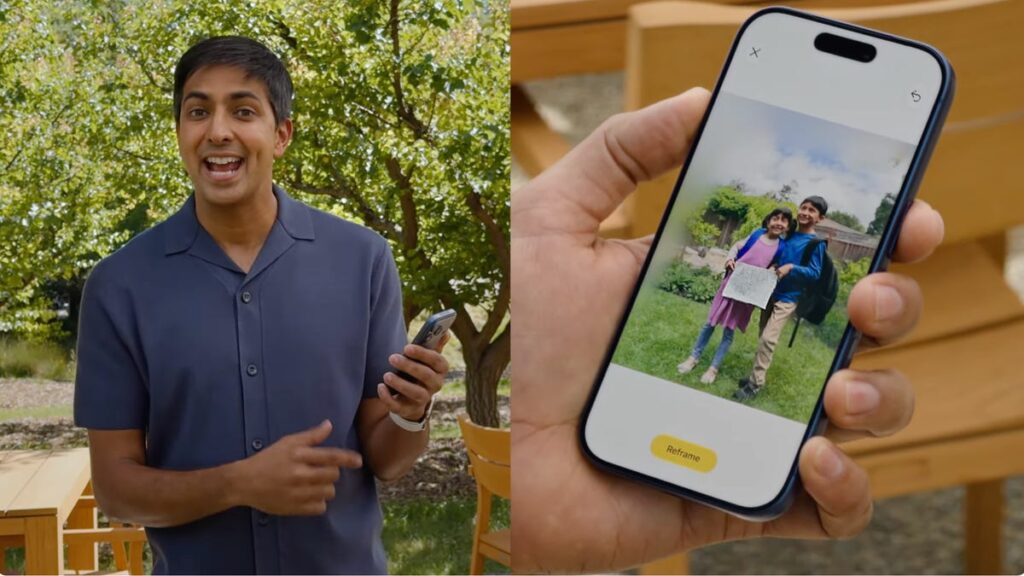
Table of Contents
A New Approach to Composition
For decades, the cardinal rule of photography has been simple: if you don’t like the angle, move your feet. Once the shutter clicks, the perspective is locked in. While software like Adobe Lightroom has long allowed users to tweak the plane of an image or rotate it around a central axis, these adjustments typically result in stretching or distortion that betrays the edit.
Apple is attempting to break this constraint with Spatial Reframing, a feature unveiled during the Worldwide Developers Conference (WWDC) as part of the iOS 27 rollout. Unlike a traditional crop or a perspective warp, Spatial Reframing allows users to virtually shift their position within a scene after the photo has been captured, effectively simulating a physical step to the left or right.
How Spatial Modeling Replaces the Tripod
The technology relies on a sophisticated synthesis of depth mapping and generative filling. Apple uses on-device spatial modeling to analyze the depth of a two-dimensional image, creating a conceptual 3D map of the environment. This is an evolution of the technology found in Apple’s Spatial Photos and the depth-sensing capabilities used for iPhone lock screen effects and Vision Pro integration.
When a user drags the image to adjust the perspective, the system doesn’t just slide the pixels; it recalculates how the subject and background should shift relative to one another. To handle the resulting “holes” in the image created by this shift, Apple integrates generative AI to fill the gaps. According to Alok Deshpande, Apple’s director of Camera and Photos Software, the system is designed to generate only the necessary content to fill these gaps, ensuring the final image remains consistent with the original scene rather than inventing entirely new elements.
The Infrastructure: On-Device vs. Cloud
One of the more critical technical aspects of this feature is how Apple manages the computational load. While the initial spatial modeling happens on-device to maintain privacy and speed, the heavier lifting of generative filling is handled through Apple’s Private Cloud Compute architecture. This hybrid approach allows for higher-fidelity image generation than a mobile chip could realistically handle alone, while attempting to maintain the privacy standards Apple has marketed as a core differentiator from competitors like Google.
This puts Apple in direct competition with Google’s Magic Eraser and the more recent generative AI tools found in the Pixel series. However, where Google has focused heavily on removing objects, Apple is positioning Spatial Reframing as a tool for compositional correction.
The ‘AI Slop’ Dilemma and Photographic Integrity
There is a growing tension in the photography community regarding the rise of “AI slop”—hyper-realistic but fake imagery generated from text prompts. For professional photographers, the line between a “tool” and a “cheat” is often thin. Spatial Reframing sits in a grey area: it is not creating a fake image from scratch, but it is fundamentally altering the truth of the captured moment.
The utility of the tool depends entirely on the quality of the generated pixels. Early iterations of Apple’s Clean Up tool have been hit-or-miss, sometimes leaving smudges or unnatural textures in complex backgrounds. For Spatial Reframing to move beyond a “neat gimmick” and become a legitimate tool for creators, the new imaging models in iOS 27 will need to handle edge-filling with a level of precision that survives a close glance on a high-resolution display.
For the average user, the ability to fix a slightly off-center subject or remove a distracting edge without losing resolution is a significant win. For the purist, it is another step toward a world where the act of taking a photo is merely the first draft, and the final image is an AI-assisted approximation of what we wish we had seen.