Lenovo Floods MWC 2026 With Hardware Experiments: Foldable Legion Go, Modular PCs, and AI Companions
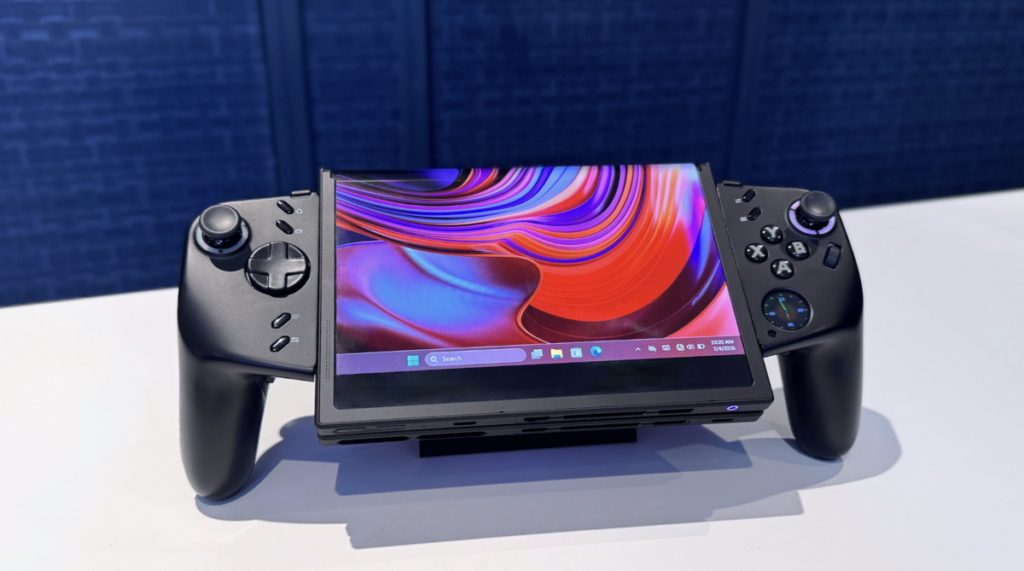
Table of Contents
A Pivot Toward Versatility and Repairability
Following a dominant showing at CES earlier this year, Lenovo has arrived at Mobile World Congress (MWC) 2026 not just with a refreshed product catalog, but with a clear appetite for hardware experimentation. The company’s presence in Barcelona is defined by a shift away from static form factors, leaning heavily into modularity, foldable displays, and a dedicated push toward consumer repairability.
The centerpiece of the show is undoubtedly the Legion Go Fold Concept. While leaks had already hinted at its existence, the official reveal showcases a device that attempts to bridge the gap between a handheld console and a full productivity machine. The prototype features a 7.7-inch POLED screen that unfolds into a massive 11.6-inch canvas. In a move that signals a shift toward more ambitious internals, Lenovo has equipped the Fold Concept with an Intel Lunar Lake chip and 32GB of RAM, paired with a detachable wireless keyboard that transforms the device into a clamshell Windows laptop.
Breaking the Mold with Modular Hardware
While the flashy foldables grab the headlines, the ThinkBook Modular AI PC Concept represents a more fundamental shift in Lenovo’s philosophy. In a direct nod to the design ethos popularized by Framework, this concept allows users to swap ports and modules on the fly. The device features integrated pogo-pin connectors to ensure stable power and data transfer across its detachable components, including a secondary display and keyboard that can be repositioned based on the user’s workflow.
This modular approach aligns with a broader trend within Lenovo’s 2026 roadmap. The company is increasingly prioritizing the right-to-repair, building on the success of the ThinkPad X1 Carbon Gen 14 Aura Edition’s “Space Frame” design. This focus extends to the new T-Series commercial lineup unveiled at MWC, which now features more accessible internal architectures and upgraded 5MP cameras to meet modern enterprise standards.
3D Creativity and High-End Specs
For creators, Lenovo introduced the Yoga Book Pro 3D Concept. This dual-display machine utilizes eye-tracking technology to render 3D objects without the need for glasses. Under the hood, it packs an Intel Core Ultra 7 processor and Nvidia GeForce RTX 5070 graphics—specs that suggest Lenovo is eyeing a production release rather than a mere technical exercise. The device also incorporates unique snap-on pads for the lower touchscreen to trigger contextual menus, further distancing it from traditional laptop layouts.
The AI Desk Presence: Beyond the Chatbot
Lenovo is also attempting to move AI out of the browser and into physical, specialized hardware. The company unveiled two tabletop companions: the AI Work Companion and the AI Workmate.
The Work Companion is designed for the home office, functioning as an inconspicuous desk clock that manages schedules and monitors screen time to prevent burnout. In contrast, the AI Workmate is a more anthropomorphic, business-focused device. Capable of local on-device processing, it can scan physical documents, generate presentations, and project content onto nearby surfaces, all while interacting via voice and gesture.
The Production Line: Yoga 9i and Enterprise Updates
Among the prototypes, the Yoga 9i 2-in-1 Aura Edition is the most immediate win for consumers. Updated with an Intel Core Ultra Series 3 chip and a revised port selection—including the return of the headphone jack—it will hit shelves in May for $1,949. The new model also introduces a magnetic stylus case that triggers a specialized “Canvas mode,” optimizing the software for digital art.
The enterprise segment saw a comprehensive refresh of the ThinkPad and ThinkBook lines, alongside a new rugged ThinkTab and ThinkVision monitor. While specific launch dates for the commercial fleet remain vague, Lenovo confirmed all will arrive within the 2026 calendar year.


