NRO Nominee Roger Mason Outlines AI-Driven Pivot for US Spy Satellite Architecture
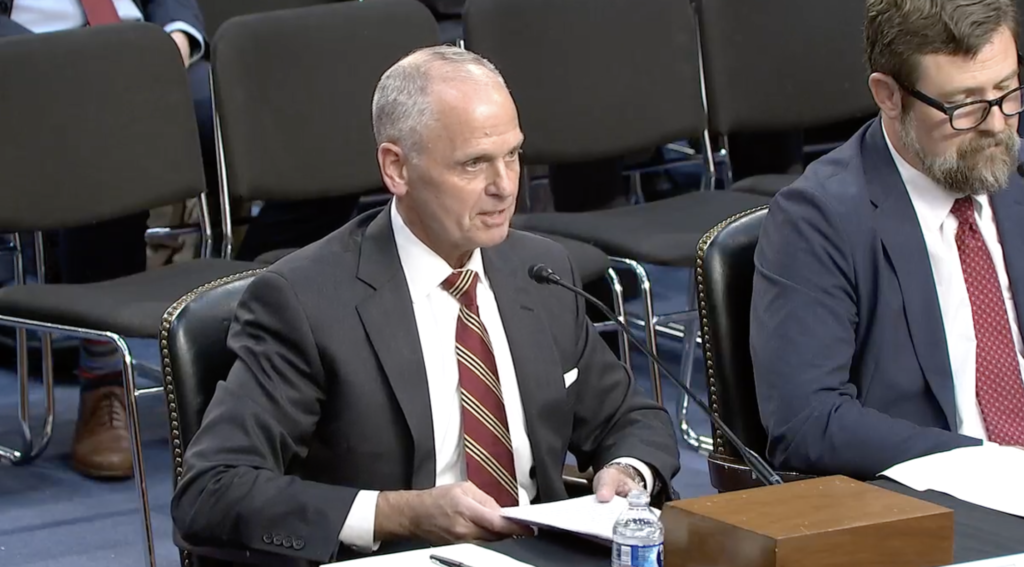
Table of Contents
The Shift Toward a ‘Space Renaissance’
The traditional era of the monolithic, multi-billion dollar spy satellite is giving way to a more fragmented, agile, and commercially integrated model. This transition was the central theme of the confirmation hearing for Roger Mason, President Trump’s nominee to lead the National Reconnaissance Office (NRO). Appearing before the Senate Intelligence Committee on June 2, Mason described the agency as operating within a “space renaissance,” where the speed of private-sector innovation is fundamentally altering how the U.S. conducts space-based intelligence.
Mason, who currently serves as the chief growth officer at V2X Corp., is slated to succeed Christopher Scolese. His testimony suggests a continuation—and likely an acceleration—of the shift toward proliferated low Earth orbit (pLEO) constellations. Rather than relying on a few high-value targets that are vulnerable to adversary attack, the NRO has moved toward a fleet that now exceeds 200 satellites, distributing the risk and increasing the frequency of coverage over specific global targets.
Bridging the Gap Between Government and Startups
A critical friction point in defense procurement has always been the “valley of death”—the gap between a startup’s successful prototype and a government’s long-term contract. Mason addressed this directly, arguing that for the NRO to maintain its edge, it must offer the private sector more than just sporadic contracts; it must offer predictability.
“The things that most well-run companies want is, first of all, predictability in terms of demand,” Mason told senators. He emphasized that industry partners require visibility into government priorities on a five-to-ten-year horizon to justify the massive capital expenditures required for satellite manufacturing and launch.
By broadening opportunities for nontraditional suppliers and startups, Mason intends to decouple the NRO from a reliance on a handful of legacy aerospace primes. This approach allows the agency to integrate emerging sensors and faster launch cadences that the commercial sector has already perfected for internet-providing constellations like SpaceX’s Starlink.
AI as the Operational Backbone
The move toward hundreds of satellites creates a new problem: data deluge. The sheer volume of imagery and signal intelligence generated by a pLEO architecture is beyond the capacity of human analysts to process in real-time. Mason positioned artificial intelligence and machine learning (AI/ML) not as a luxury, but as a necessity for the agency’s survival.
AI is now being tasked with the synchronization of operations—deciding which satellite looks where and when—and the initial triage of data. By automating the identification of patterns or anomalies in imagery, the NRO can distribute actionable intelligence to military commanders on the ground in minutes rather than hours. Mason noted that this operational speed is critical in a contested environment where the window to react to an adversary’s movement is shrinking.
Defending the High Ground
The urgency of this transformation is driven by the evolving threat landscape. The NRO now views space as a “contested environment,” a shift in doctrine reflecting the development of anti-satellite (ASAT) missiles, electronic jamming, and cyber-attack capabilities by rival nations.
The agency’s strategy is moving toward resilience through redundancy. In this model, the loss of a single satellite—whether through a kinetic strike or a technical failure—does not result in a catastrophic intelligence gap. Instead, the distributed nature of the proliferated constellation ensures that coverage remains seamless. This architectural shift, combined with AI-driven orchestration and a deeper integration with commercial launch providers, marks a departure from the Cold War-era philosophy of space superiority based on sheer size and secrecy.