Microsoft Challenges MacBook Pro with NVIDIA-Powered Surface Laptop Ultra
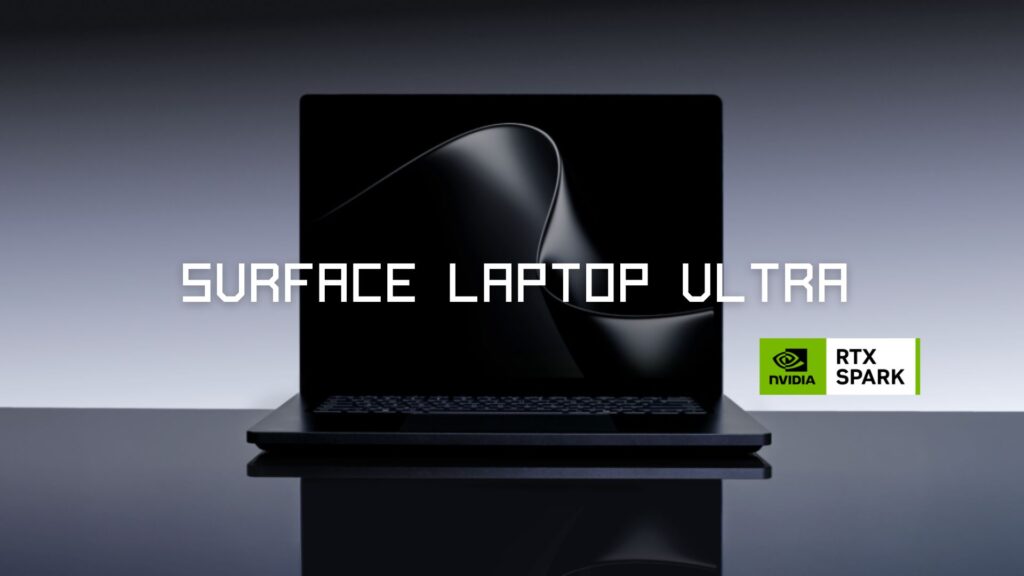
Table of Contents
A Direct Shot at the Pro Ecosystem
At Computex 2026, Microsoft shifted the trajectory of its hardware strategy with the introduction of the Surface Laptop Ultra. For years, the Surface lineup has played the role of the versatile productivity tool—capable, but rarely designed to compete with the raw horsepower of Apple’s M-series Max chips. The Laptop Ultra changes that, positioning itself as a dedicated workstation designed specifically to pull creative professionals away from the MacBook Pro.
The centerpiece of this machine is a deep architectural partnership with NVIDIA, resulting in the RTX Spark platform. By pivoting to a high-performance Arm-based architecture, Microsoft is attempting to solve the thermal and efficiency trade-offs that have long plagued Windows laptops attempting to deliver workstation-class GPU performance in a portable chassis.
The Silicon: NVIDIA RTX Spark and NVLink
Under the hood, the Surface Laptop Ultra departs from standard x86 silicon. It utilizes a 20-core NVIDIA Grace CPU, co-developed with MediaTek, paired with a high-performance Blackwell RTX GPU. This is the consumer realization of the N1X chips that have been circulating in industry leaks over the past several days.
The technical breakthrough here is the use of the NVLink-C2C chip-to-chip interconnect. By linking the CPU and GPU at high speeds, Microsoft has implemented a unified memory architecture supporting up to 128GB of RAM. Unlike traditional discrete GPU setups where data must be copied between system RAM and VRAM, the Laptop Ultra dynamically allocates a shared pool. This allows the device to run 120-billion-parameter AI models entirely locally, delivering one petaflop of AI compute without needing a cloud tether.
Display and Industrial Design
To match the internals, Microsoft has upgraded the chassis to handle the heat. Weighing in at approximately 4.5 pounds, the device utilizes a dual-fan cooling system aimed at mitigating thermal throttling during extended 3D rendering or 12K video exports. It is available in two finishes: Platinum and Nightfall.
The visual centerpiece is a 15-inch mini-LED PixelSense Ultra touchscreen. With a resolution of 2880 x 1920 and a peak HDR brightness of 2,000 nits, it is currently the brightest display Microsoft has ever integrated into a laptop. The input experience is rounded out by a significantly enlarged haptic touchpad, taking advantage of the latest haptic feedback API updates in Windows 11.
Software Optimization and the Prism Layer
Hardware of this magnitude is useless without a compatible software stack. Microsoft has tuned Windows 11 with a new workload profile scheduling system to distribute tasks across the 20 Grace cores more efficiently. To address the perennial “Arm on Windows” problem—app compatibility—Microsoft has optimized its Prism emulation layer. By leveraging AVX and AVX2 instruction set extensions, Prism allows legacy x86 applications to run with minimal performance degradation.
Security for local AI is also a priority. NVIDIA is introducing the OpenShell runtime to Windows, which utilizes Microsoft’s new containment primitives. This essentially sandboxes local AI agents, such as Hermes and OpenClaw, ensuring that experimental LLMs cannot access or modify core system files.
Connectivity and Maintenance
Departing from the trend of port minimalism, the Laptop Ultra is geared toward field work. It includes a full-sized HDMI port, USB-C, USB-A, a dedicated SD card reader, and a 3.5mm headphone jack. Notably, Microsoft is leaning into the “Right to Repair” movement; the device features a replaceable SSD and the company has committed to providing public repair guides and spare parts.
The gaming implications are equally significant. With native anti-cheat support from Epic and BattlEye, and commitments from developers like Riot Games for native versions of League of Legends and Valorant, the RTX Spark platform marks the first time Windows on Arm is a viable target for AAA gaming at 1440p.
The Surface Laptop Ultra is expected to hit shelves in Fall 2026. While pricing has not been officially disclosed, the inclusion of 128GB unified memory and Blackwell silicon suggests a premium price point that will place it in direct competition with the top-tier MacBook Pro configurations.