MSI Debuts MEG Vision X2 AI+: A High-End Desktop With a Holographic AI Companion
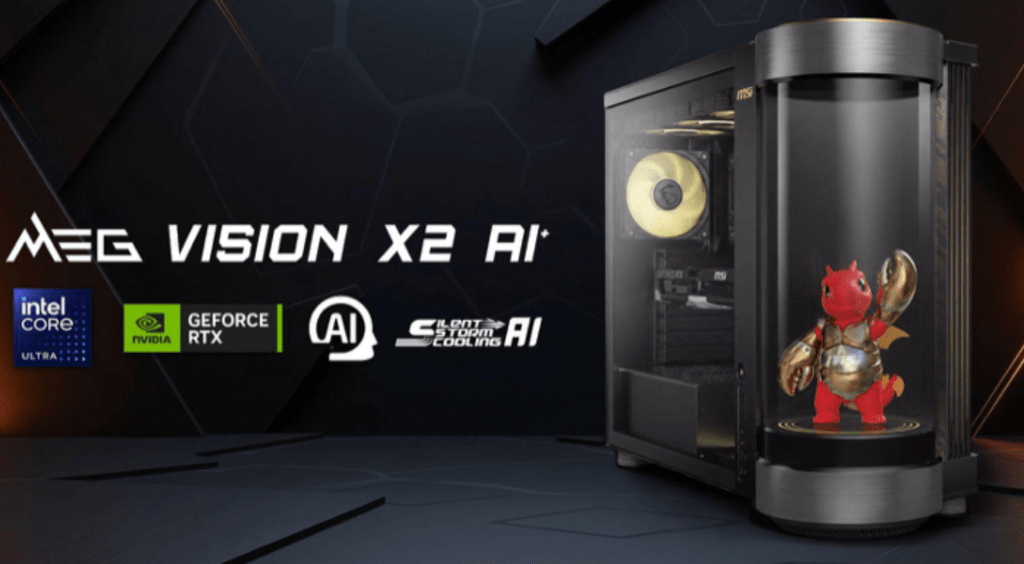
Table of Contents
A Hologram in the Chassis
At this year’s Computex, MSI leaned heavily into the industry’s current obsession with agentic AI, unveiling the MEG Vision X2 AI+. While the machine promises high-end performance, the headline feature is an integrated “AI Holostage” display. This isn’t just another small OLED monitoring screen; it is a holographic jar housing “LuckyClaw,” an animated dragon that serves as the system’s AI companion.
The integration of LuckyClaw represents a shift toward voice-driven system management. According to MSI, the avatar is designed to provide seamless, hands-free control over the desktop’s most granular settings. This includes switching performance profiles on the fly, adjusting MSI monitor calibrations, and managing complex RGB lighting schemes—tasks that typically require digging through multiple layers of software menus like MSI Center.
Beyond the branded dragon, the Holostage is designed as an open platform. MSI has stated the display is compatible with third-party digital companions, desktop pets, and custom AI avatars. This suggests a move toward a more personalized “digital twin” or virtual assistant experience, allowing users to replace the corporate mascot with their own custom-generated characters.
The Utility vs. Novelty Gap
Technically, the holographic implementation is an impressive piece of visual engineering, but it raises questions about actual utility for the target audience. For the performance-minded gamer or workstation user, the appeal of voice-controlling a monitor’s refresh rate or color profile is debatable. Most power users prefer the precision of a mouse click or a dedicated hardware button over the unpredictability of an AI voice agent.
There is also the question of resource overhead. While MSI has not released a full hardware specification sheet, the machine is confirmed to utilize Intel and Nvidia components. It remains unclear whether the rendering of the holographic avatar and the processing of the AI agent are offloaded to a dedicated NPU (Neural Processing Unit) or if they consume GPU cycles that would otherwise be dedicated to gaming or productivity tasks. If the AI requires a persistent cloud connection or a subscription model for “skill updates,” it may face pushback from a community that prizes local control and zero-latency performance.
Expanding the AI+ Ecosystem
While the MEG Vision X2 AI+ captures the spotlight with its eccentricity, MSI is also diversifying its more traditional hardware lines. The company introduced new aesthetic variants of the Prestige 14 Flip AI+ laptop, featuring lids adorned with Van Gogh’s “Starry Night” and “Starry Night Over the Rhône.” These aren’t mere stickers but integrated designs on the 14-inch aluminum chassis, paired with a matching blue finish.
Under the hood, the Prestige 14 Flip AI+ is positioned as a productivity workhorse. It features Intel Core Ultra processors, an OLED panel, and a claimed battery life of up to 30 hours, targeting a demographic that prioritizes mobility and display quality over raw gaming power. The laptops currently start around $1,500, though pricing for the Van Gogh special editions has not yet been disclosed.
The MEG Vision X2 AI+ does not have a confirmed release date or price point, though industry analysts expect a late 2024 or early 2025 rollout. Given the specialized nature of the holographic display and the “AI+” branding, it will likely carry a significant premium over MSI’s standard MEG series desktops.


