Viltrox Slices Premium 35mm Lens in Half to Prove Optical Resilience at Beijing Trade Show
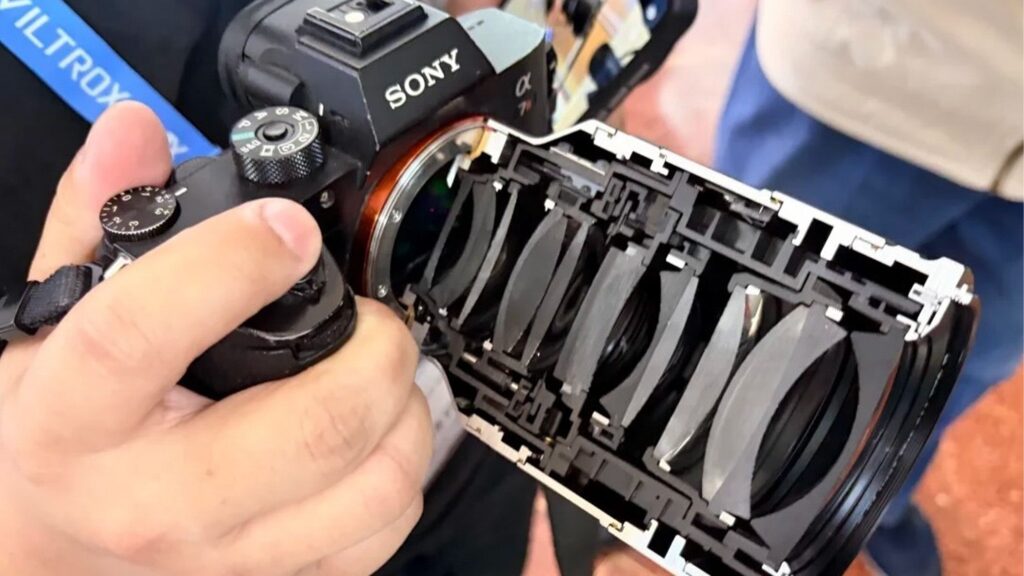
Table of Contents
A Destructive Demonstration of Optical Physics
In an industry where lens manufacturers typically obsess over microns of alignment and the pristine purity of glass, Viltrox decided to take a more visceral approach to showcasing its hardware. At the recent China P&E trade show in Beijing, the company drew crowds by performing what looked like a hardware nightmare: they took one of their premium AF 35mm f/1.2 LAB lenses and sliced it clean down the middle, lengthwise.
The stunt wasn’t an accident or a failure of quality control, but a calculated exhibition of optical resilience. By removing half of the glass elements and the barrel structure, Viltrox wanted to demonstrate the fundamental way light interacts with a lens system. The result was a series of photographs that, while technically compromised, remained strikingly coherent, proving that a lens doesn’t need to be whole to form a complete image.
How the ‘Half-Lens’ Effect Actually Works
To the casual observer, slicing a lens in half seems like it should result in a photo where half the frame is missing. However, the physics of light doesn’t work like a curtain. When you look through a lens, you aren’t seeing a 1:1 map of the glass to the sensor; rather, the lens collects light rays from the entire scene and bends them toward a single focal point.
Because an infinite number of light rays bounce off a subject and travel toward the camera, the remaining half of the Viltrox lens was still capable of capturing rays from every part of the frame. The image didn’t split; instead, the amount of light reaching the sensor was drastically reduced. In practical terms, this means that while the composition remains intact, the image suffers from a significant loss of light, often resulting in increased noise or a requirement for longer exposure times to maintain a usable image.
The Trade-off: Ethereal Artifacts and Light Loss
The images produced by the bisected AF 35mm f/1.2 LAB exhibit a distinct, almost surreal aesthetic. While the subjects are clearly rendered, there is a noticeable presence of unusual distortion and soft-edge fringing. This is largely due to the loss of symmetry in the lens’s optical path. In a standard lens, elements are designed to cancel out aberrations through symmetrical pairing; by removing half of the equation, Viltrox introduced a level of optical imbalance that created a dreamy, ethereal look.
From a technical standpoint, the LAB series is designed for high-end professional work, emphasizing sharpness and wide apertures. By destroying the physical integrity of the lens, Viltrox effectively turned a precision tool into a creative filter. The stunt serves as a high-impact visual metaphor for the robustness of their lens construction, suggesting that the optical design is so well-executed that it can withstand extreme physical degradation and still produce a recognizable image.
Marketing Through Mayhem
This move follows a broader trend of ‘destructive testing’ used by tech brands to signal confidence. While it serves no practical purpose for the end-user—who should obviously avoid sawing their gear in half—it positions Viltrox as a bold player in the competitive prime lens market. It also highlights the brand’s willingness to experiment at a time when they are aggressively expanding their Evo range of prime lenses.
For photographers, the experiment is a reminder that the ‘magic’ of a lens is often a result of complex mathematics. When those mathematics are physically altered, the result isn’t always a black screen, but sometimes a new, unexpected way of seeing the world.