The El Niño Effect: Why an Active Pacific Means a Quieter Atlantic Hurricane Season
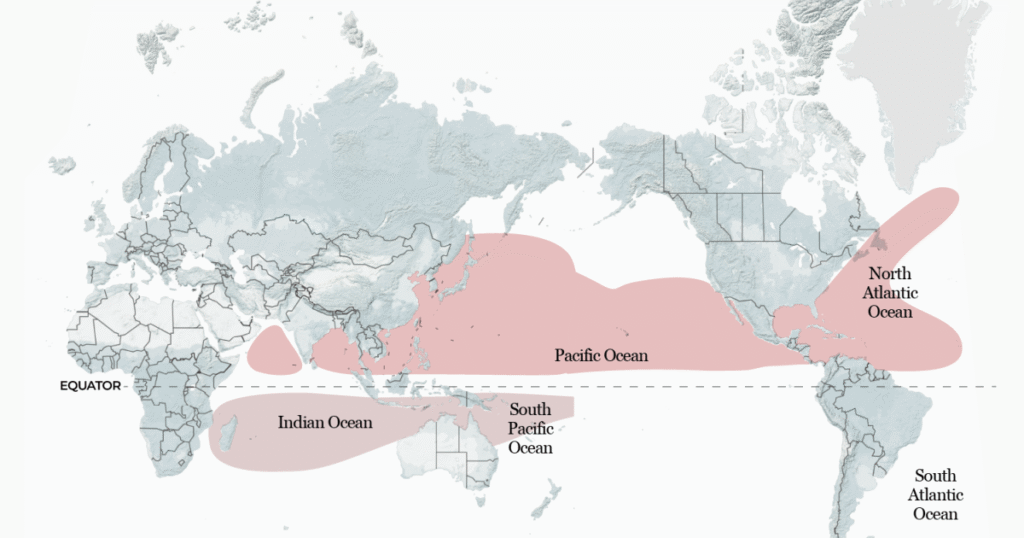
Table of Contents
The Pacific Pivot
As the Atlantic hurricane season enters its critical window, the global meteorological community is closely watching a temperature shift thousands of miles away in the central and eastern tropical Pacific. The National Oceanic and Atmospheric Administration (NOAA) has projected a quieter-than-average season for the Atlantic, citing the influence of El Niño—a periodic warming of surface sea temperatures that effectively rewrites the atmospheric playbook for tropical storm development.
According to NOAA forecasters, there is a 55 percent probability of below-normal activity this year. While the data suggests a reprieve for the Caribbean and the U.S. Gulf Coast, the phenomenon isn’t eliminating storm energy; it is simply redistributing it. In the complex choreography of the El Niño-Southern Oscillation (ENSO), what is lost in the Atlantic is often gained in the Pacific.
The Mechanics of Suppression
To understand why a warm Pacific leads to a dormant Atlantic, one must look at the trade winds. Under neutral conditions, these equatorial winds push warm surface water away from the Americas toward Asia. However, during an El Niño phase, these winds weaken or even reverse. This allows a massive surge of warm water to migrate east toward the Americas, altering the atmospheric pressure gradients globally.
For the Atlantic basin, this shift typically manifests as increased vertical wind shear. Wind shear—the change in wind speed and direction at different altitudes—acts as a mechanical disruptor for developing storms. When shear is high, it effectively “rips apart” the organized convection required for a tropical depression to intensify into a hurricane. Historically, El Niño phases have been linked to a 60 percent reduction in hurricane days and a marked decrease in overall system intensity.
A Global Shift in Storm Geography
While the U.S. East Coast may see fewer landfalls, other regions face an elevated risk. Tropical storms are essentially heat engines, fueled by warm ocean waters. By shifting the pool of warmest water eastward in the Pacific, El Niño moves the “birthplace” of storms.
In the Northwest Pacific, the total volume of typhoons remains relatively stable, but their point of origin shifts. Fewer systems form near the Asian coastline, while more develop further east toward the international dateline. A similar pattern emerges in the South Pacific; Australia typically sees a decrease in coastline storms, while activity spikes near the dateline. Hawaii, in particular, often sees an increase in storm frequency during and immediately following an El Niño event.
The High Cost of ‘Quiet’ Seasons
Despite the optimistic percentages, meteorologists warn against complacency. Ken Graham, Director of the National Weather Service, emphasized in a recent release that the statistical probability of a quiet season does not guarantee safety. “It only takes one storm to make for a very bad season,” Graham noted, reminding coastal residents that intensity is not always linear with frequency.
The economic stakes are staggering. From 1980 to 2024, hurricanes have caused approximately $1.55 trillion in economic losses in the U.S. alone, with an average of 160 deaths per year. High-impact events like Hurricane Katrina, Maria, and Helene demonstrate that a single Category 4 or 5 storm can outweigh a decade of “below-normal” activity in terms of human and financial devastation.
Defining the Storms: Hurricanes, Typhoons, and Cyclones
While the media often uses these terms interchangeably, the distinction is purely geographical, based on where the storm reaches the critical wind threshold of 119 km/h (74 mph).
- Hurricanes: Form in the North Atlantic and Northeast Pacific, impacting the U.S. and Caribbean.
- Typhoons: Originate in the Northwest Pacific, frequently striking Japan and the Philippines.
- Cyclones: Develop in the South Pacific and Indian Ocean, affecting regions from Australia to Mozambique.
As the climate continues to fluctuate, the interplay between El Niño and La Niña (its cooler counterpart) remains the primary driver of global weather volatility, dictating everything from drought in the Americas to flooding in Southeast Asia.