HoverAir Aqua Attempts to Solve the ‘Dreaded Dunk’ for Water Sports Enthusiasts
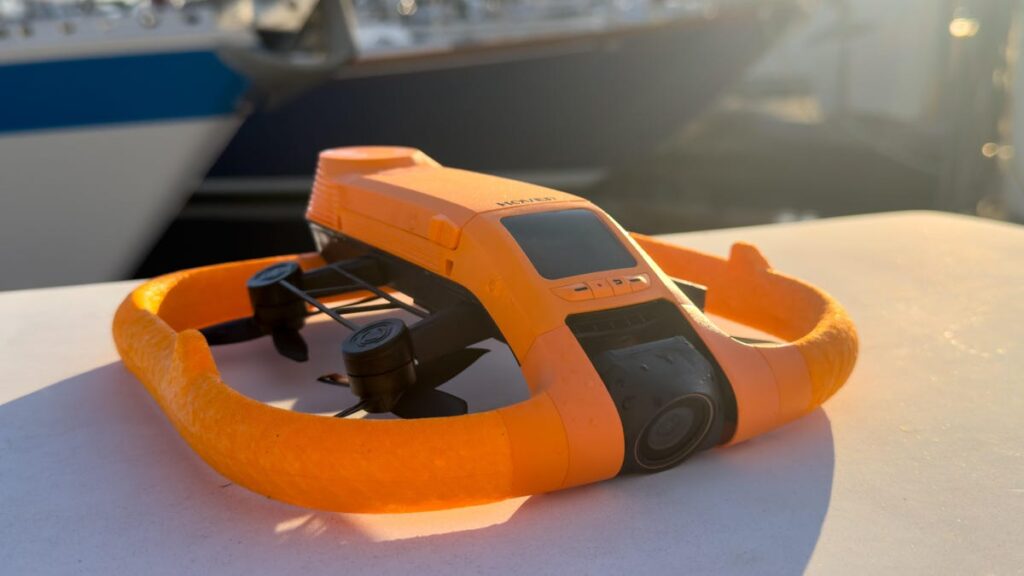
Table of Contents
The Anxiety of the First Splash
Every drone pilot knows the visceral spike of adrenaline that occurs when a quadcopter gets too close to a body of water. For years, the relationship between consumer drones and liquid has been one of mutual exclusivity; a single wrong move or a gust of wind usually results in an expensive piece of hardware becoming a permanent reef fixture. The HoverAir Aqua is designed specifically to erase that anxiety.
Positioned as a companion for surfers, kayakers, and paddleboarders, the Aqua isn’t just water-resistant—it is designed to exist in the water. While it doesn’t dive like a submarine, it treats the surface of a lake or ocean as a launchpad and a safety net, bridging the gap between a traditional flying camera and a floating action cam.
Hardware Built for Buoyancy
The system departs from the traditional controller-and-drone setup. Instead, it utilizes a two-part ecosystem: the 249g drone itself and the ‘Lighthouse,’ a chunky, orange wearable transmitter. By keeping the weight under the 250g threshold, HoverAir is strategically targeting the regulatory sweet spot that often exempts users from rigorous FAA registration in various jurisdictions, though the device faces a curious rollout. Despite its global availability in 50 countries, the Aqua is currently unavailable in the U.S. due to what the company describes as “administrative and regulatory complexities.”
Physical durability is central to the design. The drone features foam guards on each side that double as flotation devices. A 1.6-inch AMOLED screen integrated into the chassis allows for mode selection and footage review without needing to boot up a smartphone app immediately. To maintain its IP67 rating, the unit relies on a secure silicon plug for the charging port and a locked battery latch—critical failure points if neglected before a session.
The Lighthouse Ecosystem
The Lighthouse beacon is where the intelligence of the system resides for the user. Rather than toggling joysticks, the wearer uses the beacon to signal the drone. A primary button launches the craft, while a second brings it home. For those who want more granular control, four directional buttons allow the pilot to nudge the drone’s altitude or rotation while it is airborne.
In practical application—specifically during kayaking tests in the Pacific Northwest—the synergy between the beacon and the drone is impressively seamless. Once the ‘OmniTerrain’ mode (the specific flight profile for water) is engaged, the drone locks onto the Lighthouse. The takeoff is loud and sputtery as the rotors fight through the surface tension of the water, but the transition to flight is rapid.
Solving the ‘Upside-Down’ Problem
One of the more technical triumphs of the Aqua is the ‘Turtle Flip.’ In a typical drone crash, landing upside down in water is a death sentence for the motors or, at the very least, requires the user to physically retrieve the device. The Aqua can automatically right itself if it ends up inverted on the surface, a feature that is indispensable in choppy surf or turbulent currents where a drone might be knocked over by a wave.
The autonomous modes are tailored to specific aquatic disciplines. ‘Kayak mode’ maintains a consistent trailing distance, while ‘Orbit Follow’ and ‘Spiral’ provide the cinematic sweeps usually reserved for professional camera crews. The drone can hit speeds up to 34 mph (55 km/h), making it viable for faster-moving water sports, though its true value lies in the ‘set and forget’ nature of the follow-me logic.
Water-Surface Videography
Interestingly, the Aqua offers a perspective that traditional drones cannot. Because the camera can rotate 90 degrees to face downward, the drone can record underwater footage while bobbing on the surface. This effectively turns the drone into a floating GoPro before it ever leaves the water, capturing the environment beneath the surface before transitioning into aerial cinematography.


