Lenovo’s CES 2026 Rollables: Pushing OLED Beyond the Fold
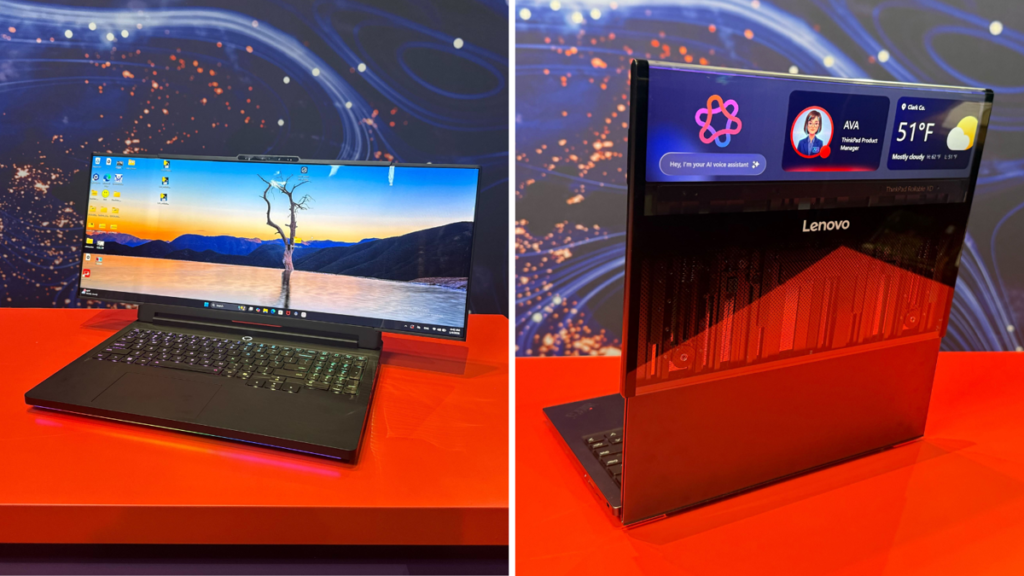
Table of Contents
The End of the Static Screen
For years, the industry’s answer to more screen real estate has been the fold—a mechanical hinge that creates a crease and a fixed aspect ratio. At CES 2026, Lenovo is betting that the future isn’t folded, but rolled. The company has unveiled two distinct prototypes: the business-centric ThinkPad Rollable XD and the gaming-focused Legion Pro Rollable, both of which utilize flexible OLED panels to fundamentally alter the laptop’s footprint on the fly.
These devices arrive shortly after the commercial release of the ThinkBook Plus Gen 6 Rollable AI, signaling that Lenovo is moving past mere experimentation and into the realm of refining specific use cases for expanding displays. While these remain concepts, the level of polish suggests a roadmap aimed at consumer availability within the next few product cycles.
ThinkPad Rollable XD: Vertical Expansion and ‘World-Facing’ Glass
The ThinkPad Rollable XD targets the productivity market with a display that expands vertically. The screen grows from a standard 13.3-inch height to nearly 16 inches, representing a 50% increase in vertical workspace. This shift is particularly useful for coders or researchers who typically struggle with the limited verticality of traditional 16:9 or 16:10 panels.
What distinguishes the XD from previous iterations is its 180-degree wrap-around OLED panel. The display curves over the top edge of the lid, creating a secondary, world-facing screen on the back of the device. To protect this exposed curve, Lenovo collaborated with Corning to develop a specialized transparent glass cover. This design choice serves a dual purpose: it protects the delicate OLED substrate and allows a glimpse into the internal fiber cables and motors that drive the rolling mechanism.
Interaction with the display is handled via physical buttons or intuitive swipes along the lid’s edge. While the voice and gesture controls seen in earlier prototypes are absent here, the hardware integration—specifically moving the rolling mechanism into the lid rather than the base—indicates a significant engineering pivot toward a sleeker, more balanced chassis.
Legion Pro Rollable: A 21-Inch Gaming Behemoth
If the ThinkPad is about efficiency, the Legion Pro Rollable is about sheer spectacle. Moving away from vertical expansion, the Legion model expands horizontally from both sides. It operates in three distinct stages: a 16-inch ‘Focus Mode,’ a 21.5-inch ‘Tactical Mode,’ and a massive ‘Arena Mode’ that pushes the total width to two feet.
This effectively gives a gamer a portable 21-inch monitor without the need for external peripherals. The panel supports a 240Hz refresh rate, critical for competitive gaming, though the prototype shows slight creasing where the OLED retreats into its housing. Lenovo claims the mechanism is rated for 25,000 roll cycles, but the build quality still requires the ‘market-readiness’ polishing typical of CES showcases.
Under the hood, the Legion Pro Rollable is designed to mirror the specs of the top-tier Legion Pro 7i. This means it is built to house an Nvidia GeForce RTX 5090 GPU and high-end Intel Core processors. However, that power comes with a cost. During demonstrations, the device emitted significant heat and noise even during idle states, highlighting the thermal challenges of packing high-TDP components into a chassis that must also accommodate rolling motors and flexible screens.
The Engineering Trade-off
The aesthetic of the Legion Pro is unapologetically loud, featuring heavy RGB accent lighting and rainbow LED strips along the rear vents. Yet, the real story is the engineering struggle between portability and power. The sheer heft of the device, combined with the heat generated by the RTX 5090, suggests that a production version may require an entirely new cooling solution to avoid throttling during ‘Arena Mode’ sessions.
From Prototype to Price Tag
The transition from concept to consumer is often where these devices die, but Lenovo has a track record here. The original rollable concept took two years to hit shelves. If the company follows a similar trajectory, these expanded versions could arrive by 2028. However, prospective buyers should be prepared for a premium. With the ThinkBook Plus Gen 6 retailing around $3,499.99, it is likely that the Legion Pro Rollable—with its RTX 5090 and massive OLED assembly—will push well into the $4,000 to $5,000 range.


