Lenovo’s CES 2026 Rollables: From the ‘World-Facing’ ThinkPad to a 21-Inch Gaming Behemoth
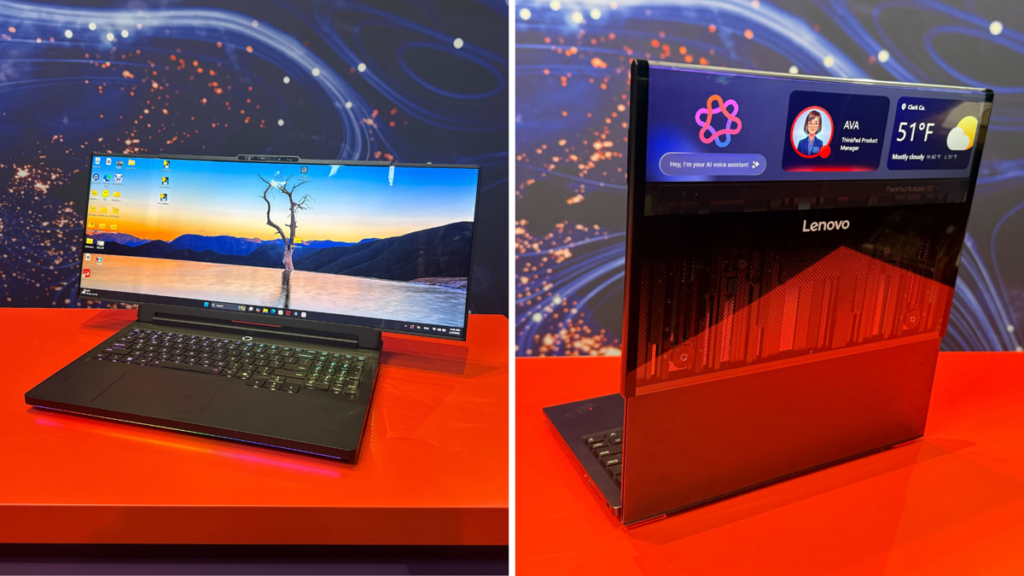
Table of Contents
Beyond the Fold: Lenovo’s New Bet on Rollable Glass
Six months after successfully transitioning its first rollable laptop from a laboratory curiosity to a commercial product, Lenovo has returned to CES 2026 with two new prototypes that push the boundaries of flexible silicon. The company unveiled the ThinkPad Rollable XD Concept and the Legion Pro Rollable Concept, both of which signal a strategic shift away from the ‘fold’ and toward a seamless ‘roll’ mechanism.
The underlying tech relies on ultra-thin, flexible OLED panels. While the industry has largely settled on the crease-prone fold of the Samsung-style display, Lenovo is doubling down on a motorized retraction system. These devices are still prototypes—Lenovo staff were quick to warn that they are delicate—but the level of polish suggests these aren’t just design studies; they are blueprints for future SKUs.
The ThinkPad Rollable XD: Verticality and Transparency
The ThinkPad Rollable XD is designed for the productivity power user. Its primary party trick is a vertical expansion that allows the display to grow from a compact 13.3 inches to nearly 16 inches in height. This isn’t just about size; it’s a 50 percent increase in vertical real estate that transforms the device from a standard ultrabook into a portable workstation without increasing the device’s footprint.
More intriguing is the 180-degree wrap. The OLED panel curves over the top edge of the lid, creating a secondary, world-facing display on the back of the laptop. To achieve this, Lenovo collaborated with Corning to develop a specialized transparent glass cover that protects the curved section of the panel. In a move that feels like an engineering flex, the glass allows users to see the internal fiber cables and motors that drive the rolling mechanism—all housed within the lid rather than the base.
Interaction is handled via a physical button or a capacitive swipe across the edge of the lid, as the entire frame is touchscreen-enabled. While it lacks the voice and gesture controls seen in previous iterations, the tactile response of the motorized roll is remarkably fluid.
Legion Pro Rollable: A 21-Inch Tactical Setup
If the ThinkPad is about efficiency, the Legion Pro Rollable is about raw scale. This machine moves away from vertical growth in favor of a massive horizontal expansion. In ‘Focus Mode,’ it operates as a standard 16-inch 240Hz OLED laptop. However, by triggering ‘Tactical Mode,’ the screen expands to 21.5 inches. For those pushing the device to its limit, ‘Arena Mode’ extends the display a full two feet, effectively generating a high-end external monitor out of thin air.
This approach solves a long-standing friction point for gamers who want more screen real estate but find dual-screen solutions, like the Asus ROG Zephyrus Duo, too cumbersome or restrictive in their layout. The screen is seamless, though some superficial marking and slight creasing were visible during our demo—typical for a prototype rated for 25,000 roll cycles.
Under the hood, the Legion Pro Rollable is built for peak performance, mirroring the specs of the Legion Pro 7i. It features top-tier Intel Core processors and the latest Nvidia GeForce RTX 5090 GPU. However, this power comes with a cost: the device is substantial in weight and runs hot. During our time with the unit, the rear fans were working overtime to expel heat even before a demanding game was launched.
The Path to Production
The aesthetic is unapologetically ‘gamer,’ featuring an RGB keyboard and dynamic rainbow LED strips lining the chunky rear vents. It is a stark contrast to the utilitarian black of the ThinkPad, but both share the same core challenge: durability. Rollable screens are inherently more complex than static ones, requiring a level of mechanical precision that typically drives prices into the stratosphere.
Given that the previous ThinkBook Plus Gen 6 Rollable AI launched at a premium $3,499.99, these new concepts will likely occupy the same luxury bracket. While Lenovo hasn’t provided a hard release date, the trajectory from the 2023 concepts to the 2024 retail launch suggests that these ‘prototypes’ may be closer to a store shelf than they first appear.


