HoverAir Aqua Attempts to Solve the ‘Water Anxiety’ of Consumer Drones
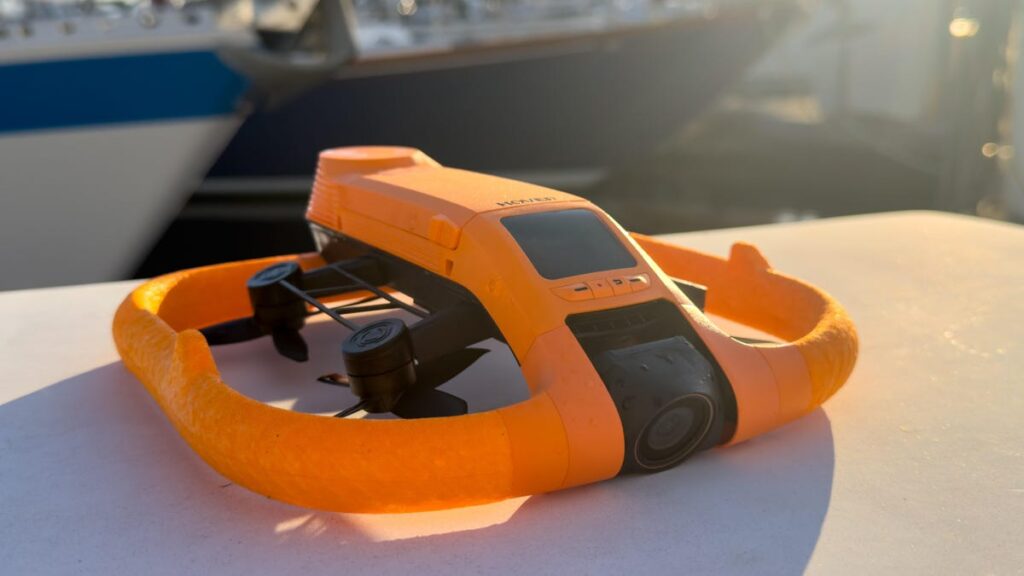
Table of Contents
Tackling the Fear of the Dunk
For most drone pilots, water is the ultimate enemy. Whether it is a sudden gust of wind or a momentary lapse in depth perception, the prospect of a high-end quadcopter sinking into a lake or ocean is a recurring nightmare that keeps many pilots far from the shoreline. HoverAir is attempting to erase that anxiety with the Aqua, a drone specifically engineered to treat water not as a hazard, but as a launchpad.
The HoverAir Aqua isn’t designed for underwater exploration—it doesn’t submerge for cinematic reef shots—but it is built to survive the chaos of the surface. With an IP67 rating, the device is fully sealed against dust and water immersion. In practice, this means the drone can bob on the surface of a marina or survive a direct plunge into the surf without short-circuiting. To maintain this seal, users must ensure the silicon plug on the bottom charging port is secure and the battery is properly latched, a critical manual check before any aquatic deployment.
A Specialized Hardware Ecosystem
Unlike traditional drones that rely heavily on a smartphone app for every movement, the Aqua utilizes a two-part hardware system: the 249g quadcopter and the “Lighthouse.” The latter is a chunky, orange wearable transmitter that functions as both a physical target for the drone’s sensors and a remote control. By wearing the Lighthouse on an arm or leg, the user creates a persistent wireless tether, allowing the drone to lock onto the subject with higher precision than visual tracking alone would allow.
The drone itself is remarkably lightweight, staying just under the 250g threshold that typically triggers mandatory FAA registration in the US. It features a 1.6-inch AMOLED screen on the chassis for quick mode selection and footage review, reducing the need to constantly fumble with a phone while wearing wet gear. For buoyancy, the unit is equipped with foam guards on each side, ensuring it floats reliably when not in flight.
Autonomous Action and the ‘Turtle Flip’
The real utility of the Aqua lies in its autonomy. Rather than requiring a dedicated pilot to manage the sticks, the drone uses a suite of modes tailored for specific activities. In Kayak mode, for instance, the drone maintains a consistent trailing distance, allowing the paddler to focus on the water while the camera captures the action from behind. Other options like Orbit Follow and Spiral offer more cinematic movement, while Dolly and Angle tracks provide traditional cinematography tools.
One of the most pragmatic additions is the “Turtle Flip.” In a real-world water environment—especially in surf or choppy currents—it is common for a lightweight drone to land upside down. Instead of requiring the user to swim back and manually flip the device, the Aqua can autonomously right itself, a feature that significantly reduces the risk of battery drain or motor overheating while stuck in a flipped position.
Regulatory Hurdles and Market Reach
Despite the technical capabilities, the Aqua faces a significant hurdle in the world’s largest consumer electronics market. At a price point of $1,299, the drone is positioned as a premium tool for adventurers, yet it is currently unavailable in the United States. HoverAir has attributed this to “current US administrative and regulatory complexities,” leaving US-based enthusiasts to watch from the sidelines while the device ships to 50 other countries.
For those in supported regions, the system arrives with a comprehensive kit, including three batteries and waterproof dry-bags to keep spares safe in a life vest. While it can still be operated via the Hover app for more granular control, the core appeal is the removal of the interface. By shifting the control to the Lighthouse wearable and the onboard AI, HoverAir has created a tool that behaves less like a remote-controlled aircraft and more like a floating, flying cameraman.