Russian Drone Strike in Romania Sparks NATO Alarm Over Airspace Violations
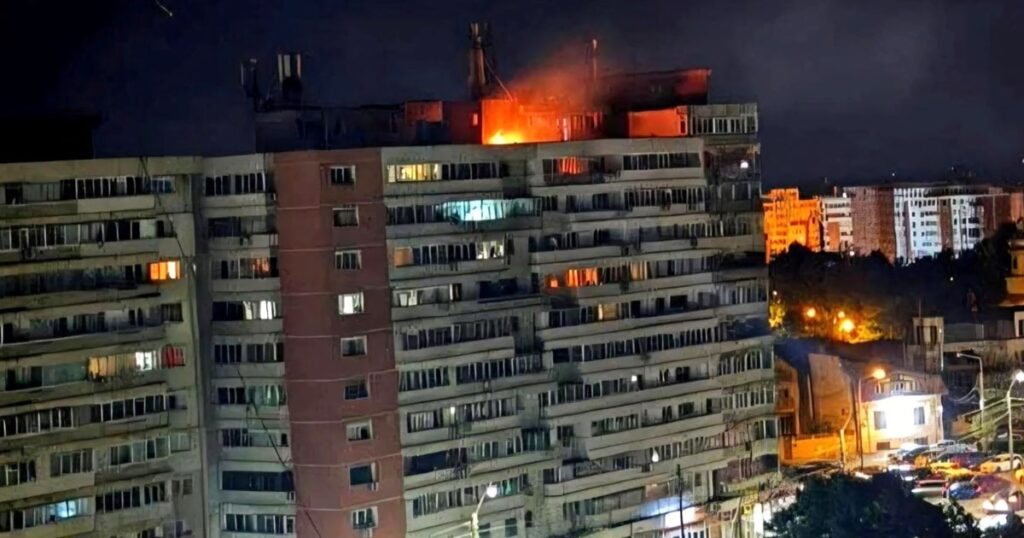
Table of Contents
Collateral Damage or Calculated Risk?
In the early hours of Friday, the kinetic reality of the war in Ukraine spilled over the border into Romania when a Russian drone struck an apartment complex in Galați. The impact ignited a roof fire and left two residents injured, transforming a neighborhood on the banks of the Danube into a flashpoint for international diplomacy and military tension.
The strike occurred during a massive aerial assault by Russia against Ukraine’s critical infrastructure. According to Ukrainian military officials, the wave consisted of 232 drones and one Iskander-M/S-400 ballistic missile. While Ukraine managed to intercept 217 of the drones, the remaining aircraft and the missile penetrated deeper into Ukrainian territory—and in at least one instance, crossed into NATO airspace.
The Breach at Galați
The Romanian Ministry of National Defense confirmed that radar systems detected multiple drones entering their airspace during the attack. In a rapid response, Romania scrambled two F-16 fighter jets and a helicopter at 1:19 a.m., granting the pilots authority to neutralize the intruders. Despite these efforts, one drone successfully hit the roof of a residential building in Galați, a strategic river port town that sits in close proximity to the Ukrainian border.
The incident highlights a growing technical and tactical challenge for NATO: the difficulty of intercepting low-flying, small-radar-signature drones that may deviate from their course due to electronic warfare, technical failure, or intentional redirection. For Romania, the breach is not merely a technical failure but a violation of national sovereignty.
Diplomatic Fallout and the Article 5 Dilemma
The reaction from European leadership was immediate and severe. Romanian Foreign Affairs Minister Oana-Silvia Țoiu described the event as a “serious and irresponsible escalation,” noting that the government has already summoned the Russian ambassador to demand accountability. This sentiment was echoed by EU President Ursula von der Leyen, who stated that Russia’s aggression has “crossed yet another line.”
At the heart of the tension is the ambiguity surrounding NATO’s Article 5, the cornerstone of the alliance’s mutual defense pact. While Article 5 mandates that an attack on one member is an attack on all, the alliance has historically been cautious about triggering a full-scale military response to “stray” munitions or accidental incursions. However, as the frequency of these spillover events increases, the threshold for what constitutes a “deliberate attack” becomes dangerously blurred.
A Pattern of Airspace Erosion
This event follows a series of similar incursions across Eastern Europe, where Russian missiles and drones have frequently entered the airspace of Poland and Latvia. Lithuanian Prime Minister Inga Ruginienė warned that these violations must not become a “new reality” that the West simply grows accustomed to.
From a technical standpoint, the use of Iranian-designed drones—referenced by U.S. Representative Joe Wilson in his condemnation of the strike—shows a shift toward asymmetric attrition. These drones are often used to saturate air defenses, creating gaps that allow more lethal ballistic missiles to reach their targets. When these systems fail or drift, the risk shifts from military targets to civilian populations in non-combatant nations.
As of Friday morning, the Kremlin has not issued a formal comment on the Galați strike. Meanwhile, NATO spokeswoman Allison Hart emphasized that the alliance will continue to strengthen defenses against drone threats, suggesting a move toward more integrated and aggressive air-defense umbrellas across the eastern flank.


