Lenovo’s ThinkStation P4 Targets the ‘Prosumer’ Gap with a Compact, High-Performance Workstation
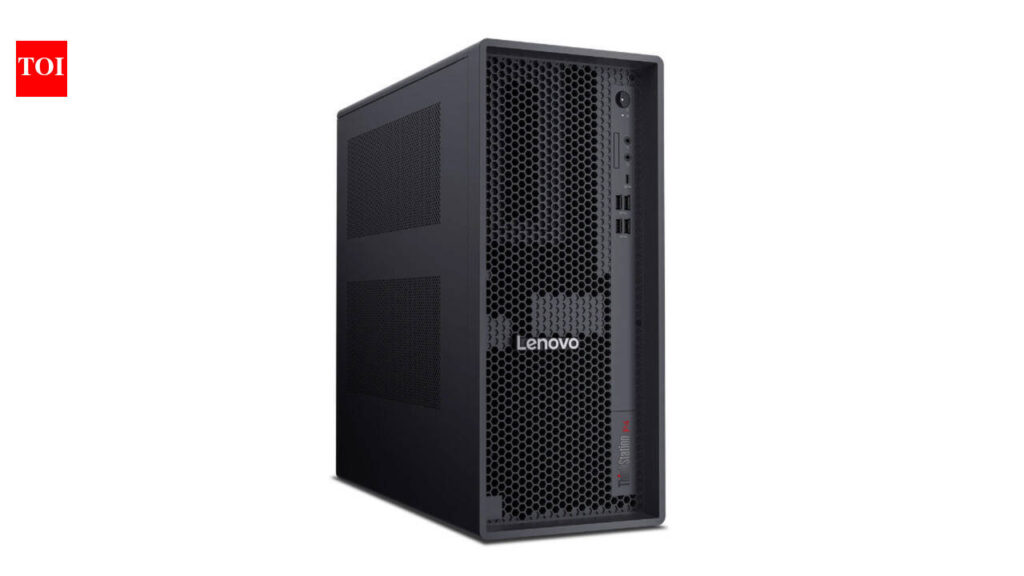
Table of Contents
Breaking the Monolith
For years, the professional workstation market has been defined by a stark binary: massive, noisy towers that can handle heavy renders, or compact mini-PCs that struggle under sustained thermal loads. Lenovo is attempting to blur that line with the launch of the ThinkStation P4, a machine designed specifically for the “prosumer”—the engineer, data scientist, or 3D artist who needs certification-grade reliability without occupying an entire desk.
The P4 isn’t just a shrunk-down version of the P-series flagship; it represents a strategic shift in how Lenovo handles thermal management in small form factor (SFF) chassis. While the company hasn’t released every granular detail regarding the internal airflow, the P4 utilizes a redesigned chassis that emphasizes modularity and airflow over the cramped interior layouts seen in previous entry-level workstations.
Hardware Architecture and Scalability
Under the hood, the ThinkStation P4 leverages the latest Intel Xeon W-series processors, providing the multi-threaded performance necessary for CAD software and complex simulations. By opting for Xeon over consumer-grade Core i9s, Lenovo ensures the P4 supports ECC (Error Correction Code) memory, a non-negotiable requirement for professionals running simulations that might take days to complete and cannot afford a single bit-flip crash.
On the graphics front, Lenovo has partnered with NVIDIA to integrate the RTX Ada Generation GPUs. These cards are tailored for professional workflows, offering specialized drivers that are ISV (Independent Software Vendor) certified. This means users of software like Autodesk Maya, SolidWorks, and Adobe Premiere Pro can expect a level of stability and optimization that consumer GeForce cards simply cannot guarantee.
Addressing the AI Workload
The timing of the P4 launch coincides with the explosion of local AI development. Many developers are moving away from expensive cloud instances to local “edge” workstations for prototyping Large Language Models (LLMs) and training small-scale neural networks. The P4’s ability to house a professional GPU and expand its RAM capacity makes it a viable entry point for AI researchers who need a dedicated Linux or Windows environment without the footprint of a rack-mounted server.
We are seeing a broader trend across the industry—similar to movements by Dell with the Precision line—where the distinction between a “powerful PC” and a “workstation” is now defined less by raw speed and more by sustained performance. The P4 is built to run at 100% CPU load for hours without thermal throttling, a feat that typical gaming desktops often struggle with due to suboptimal chassis airflow.
Market Positioning and Accessibility
The ThinkStation P4 enters a crowded market, but its value proposition lies in its balance. It is more powerful than the ThinkCentre line but significantly more affordable and compact than the P6 or P9 beasts. For boutique architecture firms or freelance industrial designers, this is the “sweet spot” of hardware.
While Lenovo has not yet provided a comprehensive global pricing tier, industry analysts expect the P4 to start at a competitive mid-range price point, scaling upward based on the specific GPU and RAM configurations chosen. The inclusion of a robust warranty and professional support services further separates this from the consumer market, positioning it as a business tool rather than a gadget.


