Lenovo Floods MWC 2026 With Foldable Gaming Handhelds and Modular AI PC Concepts
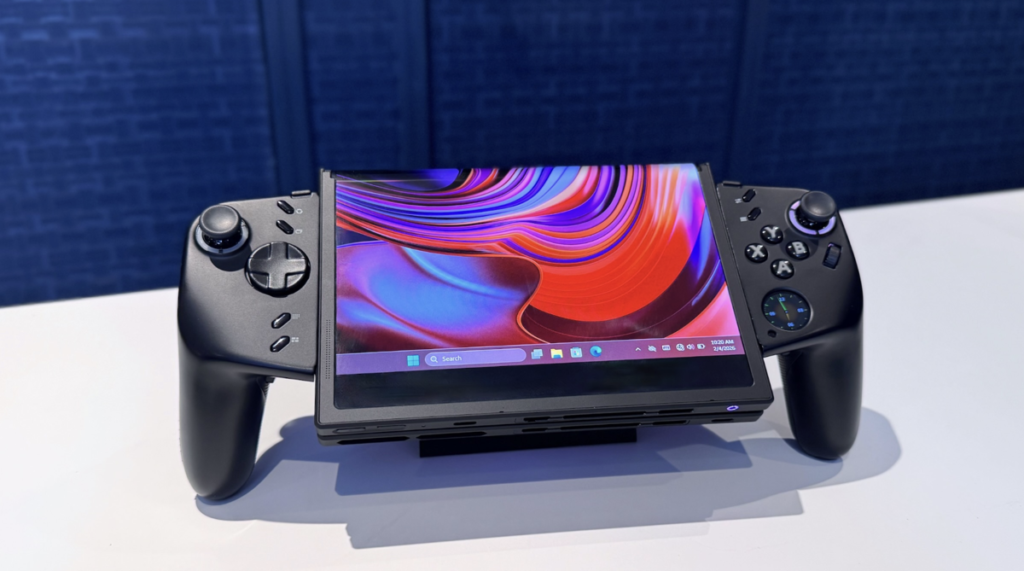
Table of Contents
Beyond the Slab: Lenovo’s Bet on Flexible Hardware
Lenovo arrived at Mobile World Congress 2026 not just to refresh its catalog, but to signal a fundamental shift in how it views the PC. While the company continues to dominate the volume market with standard clamshells, its showcase in Barcelona is dominated by a series of aggressive experiments in modularity and foldable displays, suggesting the world’s largest PC maker is feeling the pressure to innovate beyond the traditional laptop chassis.
The center of attention is undoubtedly the Legion Go Fold Concept. Following a series of leaks last week, Lenovo officially confirmed the handheld, which attempts to bridge the gap between a portable gaming console and a full-fledged productivity machine. The device features a 7.7-inch POLED display that unfolds into a massive 11.6-inch canvas. Unlike previous foldable attempts, this unit includes a detachable wireless keyboard and a controller that doubles as a vertical mouse, effectively turning the handheld into a Windows laptop on the fly.
Technical specifications for the prototype provide a glimpse into its viability; it is powered by Intel’s Lunar Lake architecture with 32GB of RAM. While Lenovo frames this as a “concept,” the inclusion of specific hardware targets suggests this isn’t merely a design exercise, but a blueprint for a potential 2027 product launch.
The Modular Pivot and the Right-to-Repair
Perhaps more significant from an industry perspective is the ThinkBook Modular AI PC Concept. In a move that mirrors the philosophy of Framework, Lenovo is experimenting with user-swappable ports and a detachable secondary display and keyboard system. The modularity is handled via integrated pogo-pin connectors, allowing users to reorganize their workspace or upgrade specific components without replacing the entire motherboard.
This push toward longevity is a recurring theme for Lenovo in 2026. Earlier this year, the company garnered attention with the ThinkPad X1 Carbon Gen 14 Aura Edition’s “Space Frame” design, which simplified internal access for repairs. That trajectory continues at MWC, where the T-Series enterprise laptops have been redesigned for easier servicing, accompanied by hardware upgrades like larger speakers and 5MP cameras.
3D Visualization and Desk-Bound AI
For the creative market, the Yoga Book Pro 3D Concept aims to move glasses-free 3D technology out of the niche and into a professional workflow. The dual-OLED setup utilizes eye-tracking to render depth, powered by an Intel Core Ultra 7 and an Nvidia GeForce RTX 5070. The addition of snap-on physical pads for the lower touchscreen indicates Lenovo is thinking about how 3D interfaces can actually be manipulated, rather than just viewed.
Rounding out the announcements is a foray into “ambient AI.” Lenovo introduced two tabletop companions: the AI Work Companion, a discreet, clock-like device meant to manage burnout and schedules, and the AI Workmate. The latter is a more anthropomorphic, lamp-like device capable of local on-device AI processing. It can scan physical documents and project content onto nearby surfaces, moving the AI experience away from a chat box and into the physical environment of the office.
The Production Line: Yoga and ThinkPad
While the concepts steal the headlines, the commercial heart of the event is the Yoga 9i 2-in-1 Aura Edition. This flagship consumer device sees the return of the headphone jack—a nod to professional users—and an Intel Core Ultra Series 3 chip. The new magnetically attached Yoga Pen Gen 2 enables a specific “Canvas mode,” positioning the device as a serious tool for digital artists. It hits the market in May with a price tag of $1,949.
The enterprise side sees a broader rollout of updated ThinkPad and ThinkBook models, alongside a rugged ThinkTab and new ThinkVision monitors. While official launch dates for the business line remain vague, Lenovo confirmed they will all be available within the 2026 calendar year. Together with the rollout of the Qira AI agent to over 20 devices in the coming weeks, Lenovo is attempting to weave a cohesive ecosystem where the hardware is as adaptable as the software running on it.


