Decoding the ‘Dead Test’: The Secret Font and Hidden Easter Egg of the Commodore 64’s Most Famous Diagnostic Tool
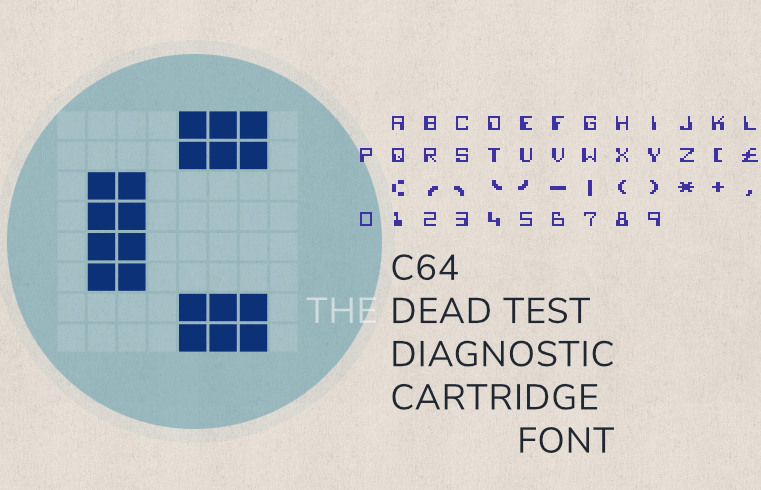
Table of Contents
The Ghost in the Machine
For enthusiasts of the Commodore 64, few pieces of hardware are as legendary—or as intimidating—as the Dead Test diagnostic cartridge. Designed for field technicians to troubleshoot bricks and failing boards, the Rev. 718220 (Commodore part 31419-03) is a standalone miracle of engineering. It doesn’t just test the machine; it bypasses it. By embedding its own character set and logic within the ROM, the cartridge can output data even when the C64’s internal ROMs are completely non-functional.
However, for decades, a specific detail of this hardware has remained largely undocumented: the iconic, boxy font that defines the Dead Test user interface. While the standard C64 font is ubiquitous in retro computing, the Dead Test typeface is a rare breed, appearing only in this specific diagnostic tool and a few advanced successors like the Rev. 586200 and the SX64’s Rev. 588220.
A Minimalist Approach to Diagnostics
The Dead Test font is a study in efficiency. Unlike the full character set of the C64, the cartridge implements only 58 characters, covering screen codes $00 to $39. It eschews lower-case letters and reverse video characters entirely, focusing instead on upper-case letters, digits, and a handful of mathematical operators.
The implementation is precise. While characters like parentheses and periods are borrowed from the standard C64 set, the cartridge replaces the traditional “at” symbol (@) at position $00 with an extra blank space—a logical choice for a diagnostic tool where screen real estate and clarity are paramount. More interestingly, the range typically reserved for symbols like #, $, and % is repurposed for box-border characters, allowing the cartridge to draw clean frames around test results.
The MICR Connection and a Hidden Easter Egg
Visually, the font departs from the C64’s soft curves, opting for a rigid, blocky aesthetic characterized by rectangular lumps. This isn’t an arbitrary design choice. The typography is a direct homage to the MICR (Magnetic Ink Character Recognition) E-13B standard, the specialized font used globally by banks to process checks.
The digits in the Dead Test font almost perfectly mirror the E-13B set, save for a slightly more squared-off number 3. This design language served a practical purpose: the high-contrast, blocky shapes were designed to remain legible on professional monitors used by service technicians, even if they looked somewhat harsh on a consumer-grade CRT television.
The most fascinating discovery, however, lies at screen code $21. In a standard C64 environment, this would be an exclamation mark. In the Dead Test ROM, it is a mysterious, C-shaped glyph. After analyzing the ROM’s data sections, it becomes clear that this character is never actually called by the code; it is an unused asset. Further investigation reveals it is the “transit symbol” from the MICR set, used as a delimiter for bank routing codes. It is a pure Easter egg—a subtle nod by Commodore’s engineers to the world of financial computing, hidden in a diagnostic tool where it would never be seen by the end user.
Two Machines, One Port
The existence of this standalone font is made possible by the C64’s unique relationship with the Commodore Max. The C64 is essentially two machines in one: the standard home computer we know and a compatibility mode for the ill-fated Commodore Max (released in 1982). The Max relied entirely on cartridge ROMs rather than internal chips.
When the C64 detects specific signals via the _GAME and _XROM pins on the expansion port, it enters “Ultimax mode.” In this state, the machine’s internal ROMs, including the character ROM, are banked out of the memory map. By mimicking this behavior, the Dead Test cartridge can seize control of the system, utilizing its own embedded character ROM to report failures in the very hardware that would normally be required to display text.