JWST reveals ‘morning clouds’ on a scorching gas giant 700 light-years away
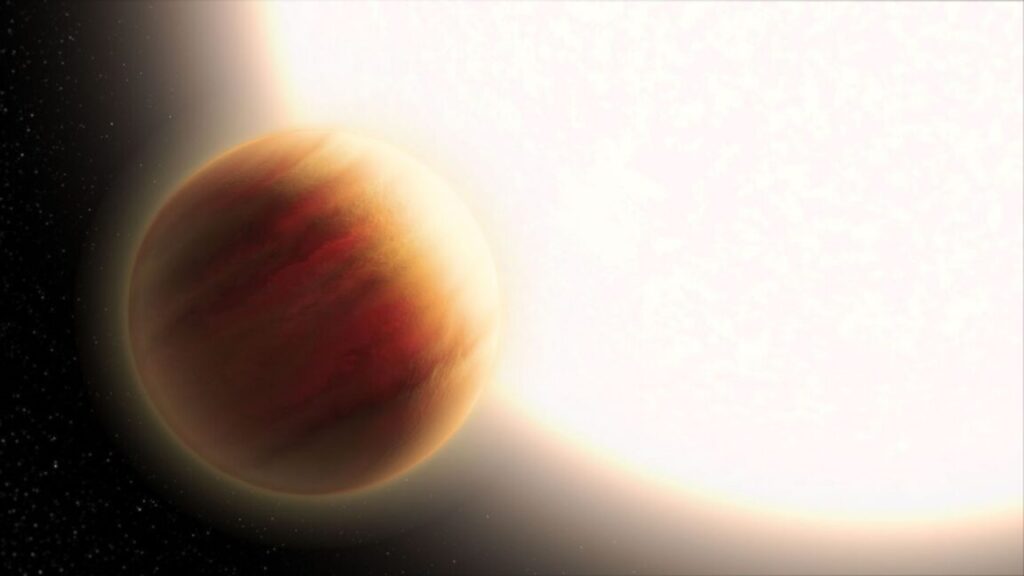
Table of Contents
The problem with ‘averaging’ an alien world
For years, astronomers studying exoplanets have relied on a method called transmission spectroscopy. It’s a clever trick: as a planet passes in front of its host star, scientists analyze the light filtering through the planet’s atmosphere to determine what chemicals are present. The problem, however, is that this method treats the planet’s atmosphere as one giant, homogenous ball of gas. It averages everything out.
For tidally locked planets—worlds where one side permanently faces the star and the other remains in eternal darkness—this oversimplification is a critical flaw. On these worlds, the temperature swings are so violent that the atmosphere behaves less like a uniform sphere and more like a chaotic weather engine.
In a new study published in Science, astrophysicist Sagnick Mukherjee and his team at Johns Hopkins University used the James Webb Space Telescope (JWST) to prove that treating these worlds as a single average leads to fundamentally wrong conclusions about their chemistry.
Decoding the ‘Morning’ and ‘Evening’ limbs
The subject of the study is WASP-94A b, a low-density gas giant roughly 690 light-years from Earth. While it has less than half the mass of Jupiter, it is significantly wider, meaning its atmosphere extends further into space and is easier for JWST to probe.
To get a clearer picture, Mukherjee’s team employed a technique called limb-resolved spectroscopy. Because a planet doesn’t snap instantly in front of a star, the telescope sees the “morning limb” (the leading edge rotating from the cold night side into the day side) slightly before it sees the “evening limb” (the trailing edge crossing back into darkness).
Using the telescope’s Near Infrared Imager and Slitless Spectrograph (NIRISS), the team split the signal. The results were jarringly different. The morning limb showed a sloped spectrum, indicating high-altitude aerosols—essentially a thick layer of dust and cloud particles blocking the light. The evening limb, by contrast, was clear, revealing distinct spikes of gaseous water vapor and potentially carbon dioxide.
A planetary conveyor belt of mineral clouds
The temperature on WASP-94A b is brutal, averaging over 1,500 Kelvin. The data revealed that the evening side is roughly 450 Kelvin hotter than the morning side. This temperature gradient drives a phenomenon known as equatorial super-rotation, where fierce winds at the equator blow eastward faster than the planet itself rotates.
This creates a global weather cycle. On the permanent night side, the atmosphere cools enough for minerals to condense into droplets, forming thick clouds. These clouds are then dragged by the equatorial jet streams toward the morning side. As they hit the blistering heat of the day side, the droplets begin to evaporate. By the time the winds reach the evening limb, the clouds have vanished, leaving a clear sky.
The team specifically identified these as clouds rather than photochemical hazes (the kind of smog caused by UV radiation). If they were hazes, they would form on the day side and be pushed toward the evening limb, which is the exact opposite of what JWST observed.
Why this changes exoplanet science
The most significant finding for the broader scientific community came when the team ran a control experiment. They took the precise JWST data and re-analyzed it using the traditional “averaged” model that most astronomers use.
The results were alarming. By blending the thick morning clouds with the clear evening air, the averaged model completely distorted the perceived chemical composition of the planet. This suggests that many exoplanets previously categorized by scientists may have had their atmospheric chemistry fundamentally misunderstood because the observers failed to account for the distinct differences between the day and night hemispheres.