Russia Escalates Air Campaign with Massive Combined Strike on Kyiv Infrastructure
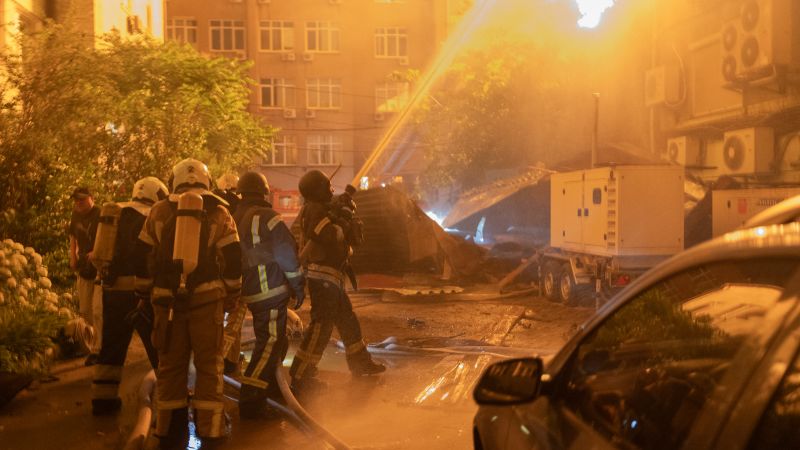
Table of Contents
A New Scale of Aerial Attrition
In what marks one of the most intense aerial engagements since the full-scale invasion began, Russian forces launched a massive “combined strike” on Kyiv and surrounding regions on July 2, 2026. The operation, which the Ukrainian air force reports involved nearly 500 drones and dozens of missiles, was designed to overwhelm air defenses through sheer volume and simultaneous vectors of attack.
The human cost was immediate. President Volodymyr Zelensky confirmed at least 13 deaths and over 90 injuries, with rescue operations still active as crews dig through the ruins of residential complexes. While Ukraine’s integrated air defense systems intercepted the majority of the incoming projectiles, 33 managed to penetrate the shield, striking targets across the capital. The result was not just tactical damage but profound civilian devastation.
The Geography of Destruction
The most severe damage was concentrated in the Darnytskyi district, southeast of the city center. Mayor Vitaliy Klitschko described the scene as catastrophic, noting that portions of a residential building were “literally blown away.” Beyond the housing blocks, the strikes hit a research institute, an ambulance station, and a hotel, suggesting a strategy aimed at degrading the city’s functional capacity and psychological resilience.
The strike lasted roughly 11 hours, forcing thousands of Kyiv residents into metro stations and bomb shelters—a grimly familiar routine that has become a permanent fixture of urban life in Ukraine over the last four years. This specific wave of attacks followed a direct warning from President Zelensky on Wednesday, who urged citizens to be “especially careful” as intelligence suggested Vladimir Putin had been orchestrating a massive strike for some time.
Retaliation and the Drone Arms Race
Moscow’s Ministry of Defence framed the assault as a retaliatory measure. The Russian government claims the use of “high-precision, long-range weapons” was a direct response to Ukraine’s increasingly aggressive drone campaign against Russian energy and industrial sites. In recent weeks, Ukraine has pivoted toward a strategy of systemic economic attrition, targeting oil refineries and logistics hubs deep within Russian territory.
Just hours before the Kyiv strikes, Ukrainian forces targeted one of Russia’s largest oil refineries in Kstovo, located hundreds of miles east of Moscow. They also claimed strikes on a critical railway bridge over the Donets River and a command post in Kharkiv. This “tit-for-tat” escalation demonstrates a shift in the war’s operational logic: Ukraine is utilizing low-cost, long-range drone technology to bring the war to the Russian interior, while Russia responds with high-yield missile strikes on urban centers.
The Technical Asymmetry of Modern Air War
The scale of this engagement—with Russia claiming to have intercepted 327 Ukrainian drones in a separate window—highlights the evolving nature of electronic warfare and air defense. The use of nearly 500 drones in a single wave against Kyiv suggests a “saturation attack” strategy, intended to exhaust the magazine capacity of surface-to-air missile (SAM) batteries and confuse radar operators through noise and decoys.
Despite the interceptions, the persistence of these strikes remains a critical vulnerability for Ukraine. The recent damage to the UNESCO-listed Kyiv Pechersk Lavra monastery in June underscored that even the most culturally significant sites are no longer off-limits. As the conflict enters this phase of sustained, high-volume aerial combat, Foreign Minister Andriy Sybiha has called for more than just “words of condemnation,” urging the international community for concrete air defense reinforcements to prevent further civilian casualties.