Sony’s Xperia 1 VIII is a Brutalist Masterpiece with a Performance Problem
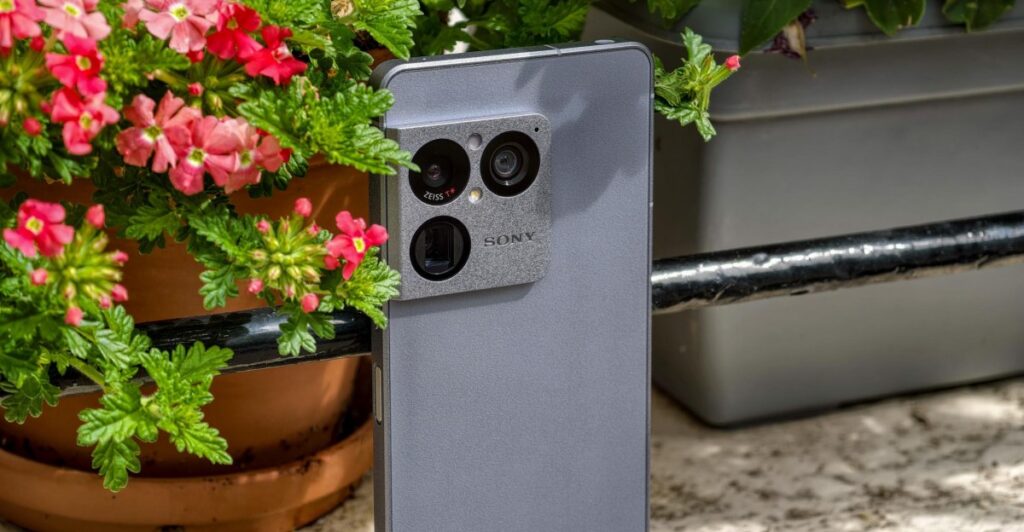
Table of Contents
A Departure from the Sony Blueprint
For years, Sony’s flagship Xperia 1 series adhered to a rigid design philosophy: a towering 21:9 aspect ratio, a 4K display, and a minimalist aesthetic that felt more like a professional tool than a consumer gadget. With the Xperia 1 VIII, Sony has finally broken that cycle. The new handset marks a significant aesthetic pivot, trading its familiar slim profile for a blocky, brutalist camera island and a textured finish that feels less like a typical glass slab and more like high-end industrial equipment.
The chassis is wrapped in Gorilla Glass Victus 2 on the front and Victus on the rear, but the real story is the tactile experience. Sony has introduced a fine, nail-file-like texture that varies between the back and the frame. It is a deliberate move to justify the phone’s eye-watering price point—starting at £1,399 / €1,499 in Europe and climbing to €1,999 for the 1TB model. While the US market remains neglected, the global positioning is clear: this is a luxury item for a niche audience.
Despite the visual overhaul, Sony has clung to the features that make the Xperia a sanctuary for enthusiasts. The 3.5mm headphone jack and the microSD card slot remain, a rarity in the flagship space. However, the commitment to legacy hardware extends to the fingerprint sensor, which remains side-mounted and recessed. In testing, this sensor is frustratingly inconsistent, failing to unlock roughly a third of the time.
The Hardware Trade-off
The shift in design extends to the display. Sony has long since abandoned the 4K, 21:9 panels of the past, opting instead for a 6.5-inch, 120Hz OLED. While the brightness is commendable, the resolution is capped at 1080p—a spec that feels underwhelming when compared to the pixel density of rivals like the Xiaomi 17 Ultra. The screen is entirely uninterrupted by a punch-hole or notch, but the cost is a thick top and bottom bezel to house the stereo speakers and front camera.
Under the hood, the 1 VIII runs the Qualcomm Snapdragon 8 Elite Gen 5, paired with up to 16GB of RAM. On paper, it is a powerhouse. In practice, the optimization feels incomplete. During a recent press event, using the device for real-time AI transcription caused the chassis to become worryingly hot to the touch within 30 minutes. This thermal inefficiency manifests as intermittent stuttering and lag when switching between apps or launching the camera, suggesting that Sony is struggling to tame the heat of the latest silicon.
Battery life is equally disappointing. Despite the 5,000mAh cell, the device rarely lasts a full day under moderate use. Worse still is the 30W charging speed. In an era where competitors offer 100W+ fast charging, the Xperia 1 VIII feels glacial, with only Google’s Pixel 10 Pro offering a similarly sluggish charging experience.
The New Optical Strategy
The most pivotal change is the camera. Sony has abandoned the continuous optical zoom that defined the last four generations of Xperia flagships. In a surprising reversal, they have pivoted toward the strategy used by Chinese OEMs: maximizing sensor size over mechanical versatility.
The new 2.9x (70mm-equivalent) telephoto lens utilizes a massive 48-megapixel, 1/1.56-inch-type sensor. This is nearly as large as the primary 1/1.35-inch-type main sensor, and it produces a level of detail and low-light performance that the previous continuous zoom lenses couldn’t match. By sacrificing the flexibility of a variable focal length, Sony has gained raw image quality. While it is a cruel irony that Xiaomi adopted continuous zoom just as Sony abandoned it, the 1 VIII is undeniably Sony’s most capable photographic tool to date.
However, the software experience is marred by the ‘AI Camera Assistant,’ which feels intrusive and often fails to deliver the intended enhancements. For those who prefer the manual control of the Pro apps, the return of the knurled two-stage shutter button is a welcome touch, providing a tactile connection to the act of photography that no other modern smartphone offers.