The Saturation Strategy: How Ukraine is Systematically Dismantling Russia’s Air Defense Grid
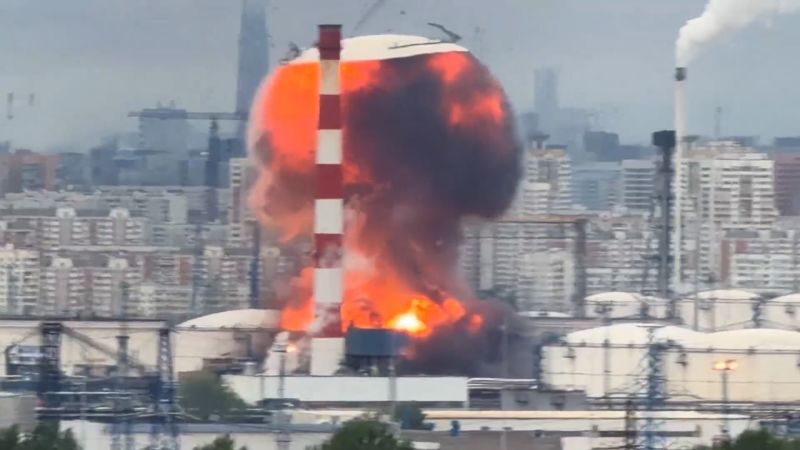
Table of Contents
Chaos on the Highway: A Symptom of Systemic Failure
Recent footage emerging from Moscow captures a scene that contradicts the image of a fortified superpower: Russian soldiers firing shoulder-mounted air-defense systems (MANPADS) from the shoulder of a busy highway, while civilian traffic continues to flow cautiously around them. The images, verified by CNN, show a reactive, almost ad-hoc response to a massive barrage of Ukrainian drones descending on the Russian capital. In one instance, a Russian interceptor missile missed its target entirely, instead striking an oil storage tank on the city’s outskirts, resulting in a massive explosion that experts from the Stockholm International Peace Research Institute (SIPRI) described as a ‘Russian own-goal.’
This lack of coordination is not merely a local tactical failure but a reflection of a broader strategic crisis within Russia’s integrated air defense network. The deployment of military hardware in close proximity to civilian commuters suggests a breakdown in organized traffic and security control, signaling a state of desperation as the war’s kinetic reality reaches the heart of the Kremlin.
The Mathematics of Saturation
Ukraine’s current strategy relies on the principle of saturation. By launching swarms of over 100 drones in a single wave, Kyiv is effectively ‘mathing out’ the Russian defense grid. Even if Russia possesses a high intercept rate, the sheer volume of targets exceeds the processing capacity of their command-and-control systems. According to Robert Brovdi, commander of Ukraine’s Unmanned Systems Forces, Moscow maintained a significant arsenal as of mid-May, including over 100 launchers and 50 Pantsir mobile systems. However, quantity of hardware does not equate to effectiveness in the face of a swarm.
The technical gap lies in the difference between detection and a ‘quality track.’ As Thomas Withington, a military sciences fellow at the Royal United Services Institute (RUSI), explains, drones are significantly harder to track than traditional cruise missiles or aircraft. While they may appear as blips on radar, maintaining a consistent lock on hundreds of small, low-flying targets coming from multiple vectors requires a level of coordination that the Russian system is currently failing to execute.
Hardware Not Fit for Purpose
A fundamental issue is that Russia’s primary air defense architecture was designed for a different era of warfare. These systems were built to engage high-altitude ballistic missiles and conventional military jets—not low-cost, slow-moving autonomous drones. This mismatch means that Russia is often using expensive, limited-stock missiles to shoot down cheap plastic drones, a trade-off that is economically and logistically unsustainable.
Furthermore, the impact of international sanctions has created a technological bottleneck. The precision components and semiconductors required to redesign these systems for drone interception are increasingly difficult for Moscow to acquire. This has left the Kremlin in a paradox: they can ramp up production of existing missiles, but those missiles are fundamentally unfit for the specific threat they are meant to neutralize.
Strategic Attrition and the ‘Threadbare Tapestry’
Beyond the technical failures, Ukraine has engaged in a deliberate campaign of attrition. By targeting air-defense launchers and radar stations across a wide geographic area—from St. Petersburg to the occupied eastern territories—Kyiv has forced Russia to redistribute its assets. This has stretched the defense network thin, creating what can be described as a ‘threadbare tapestry’ of coverage.
The Ukrainian Armed Forces report a devastating toll on Russian hardware, claiming the destruction of 166 anti-air elements this year alone, adding to a total of over 1,432 since 2022. By systematically removing the ‘eyes’ (radar) and the ‘teeth’ (launchers) of the defense grid, Ukraine has opened corridors for its long-range strikes to hit critical oil refineries and military hubs deep within Russian territory.
The Political Cost of Technical Failure
The insecurity has already permeated the highest levels of Russian state ceremony. The scale of the drone threat forced the Kremlin to strip military hardware from its Victory Day parade in Red Square this May, citing the ‘current operational situation.’ When the state cannot guarantee the safety of its most prestigious military display in its own capital, it serves as a powerful admission of the vulnerability of its airspace.