Ukraine’s Moscow Drone Offensive: How Low-Cost Asymmetric Warfare is Piercing Russian Air Defenses
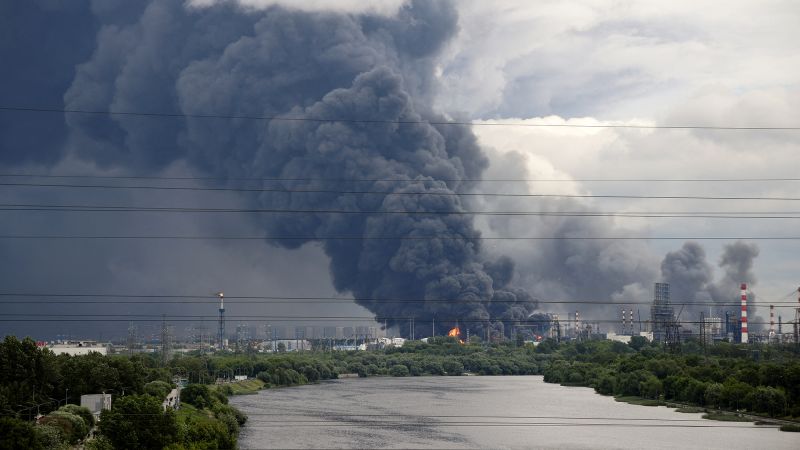
Table of Contents
The Breach of the Capital’s Perimeter
On Thursday, the skyline of Moscow was transformed by thick plumes of black smoke and the rhythmic thunder of explosions. In what has been described by the Russian state-run news agency TASS as the largest drone offensive on the capital in two years, Ukrainian forces successfully penetrated the city’s sophisticated air defense layers to strike critical infrastructure, specifically targeting oil refineries located roughly 10 miles from the Kremlin.
This operation represents more than just a tactical success; it is a demonstration of the evolving nature of asymmetric warfare. By utilizing mass-produced, low-cost Unmanned Aerial Vehicles (UAVs), Ukraine has effectively shifted the cost-benefit analysis of modern air defense. When a drone costing a few thousand dollars necessitates the use of a million-dollar interceptor missile, the economic attrition begins to favor the attacker.
- Strategic Disruption: The strikes targeted fuel production, threatening the logistics of both the civilian population and the military machine.
- Psychological Impact: Bringing the war to the doorstep of the Russian elite shatters the narrative of a localized conflict.
- Technical Failure: The breach of Moscow’s triple-ring air defense suggests critical gaps in radar detection and interception capabilities.
Technical Breakdown: How the Breach Occurred
Moscow is theoretically protected by one of the most dense air-defense networks in the world, consisting of S-400 and Pantsir-S1 systems. However, the recent offensive reveals a recurring vulnerability to “swarm” tactics and low-altitude penetration.
The Challenge of Low-RCS Targets
Modern radar systems are designed to track high-speed, high-altitude jets and missiles. Ukrainian drones often utilize carbon-fiber frames and small electronic signatures, resulting in a low Radar Cross Section (RCS). This allows them to fly “under the radar,” literally hugging the terrain to avoid detection until they are within the inner perimeter of the city.
Swarm Tactics and System Saturation
The TASS report indicates that drones arrived in waves. In electronic warfare, this is known as saturation. By launching a high volume of drones simultaneously, the attackers force the air defense systems to prioritize targets. If the number of incoming projectiles exceeds the number of available interceptor missiles or the processing speed of the tracking radar, some drones will inevitably slip through.
The Role of Electronic Warfare (EW)
Russia has heavily invested in GPS jamming and spoofing. However, the success of this attack suggests that Ukraine is utilizing inertial navigation or optical terrain matching, which do not rely on satellite signals. This technical pivot allows drones to maintain a course even when the signal is lost, rendering traditional electronic jamming ineffective.
Economic Attrition: The Refinery Strategy
The decision to target refineries is a calculated move to hit Russia’s primary economic engine. The energy sector provides the hard currency required to fund the military effort. When a refinery lid is blown off or a distillation column is compromised, the result is two-fold: immediate loss of production and long-term structural damage that requires specialized parts—many of which are currently under Western sanctions.
| Impact Metric | Short-Term Effect | Long-Term Strategic Implication |
|---|---|---|
| Fuel Supply | Local gas station queues in Moscow | Reduced fuel availability for frontline logistics |
| Environmental | Black rain and air toxicity | Erosion of public trust in state safety |
| Infrastructure | Fire and structural collapse | Dependency on sanctioned high-tech imports for repair |
The Political Dimension: A Crack in the Shell
For years, President Vladimir Putin has operated from a position of perceived insulation, both physically and informationally. However, the visual evidence of these attacks—captured in countless videos posted by Moscow residents—cannot be scrubbed from the public consciousness. The sight of black rain falling on luxury cars in the capital creates a visceral link between the Kremlin’s decisions and the domestic reality.
This atmospheric shift is coinciding with reports of widening discontent. The inability of the state to prevent drones from reaching the heart of the capital undermines the image of the “strongman” and the reliability of the Russian military-industrial complex. When the state can no longer guarantee the security of its own seat of power, the political risk for the leadership increases exponentially.
The Geopolitical Shift and the G7 Context
The timing of the offensive follows President Volodymyr Zelensky’s engagement at the G7 meeting in Evian. While the geopolitical landscape remains volatile—marked by Donald Trump’s vacillating stance on Ukrainian aid—Zelensky has emerged with a strategic objective: the ability to mass-produce Western air defense systems under license within Ukraine.
This proposal marks a shift from a donation-based model to an industrial-partnership model. If Ukraine can manufacture missiles and interceptors locally, it eliminates the bottleneck of slow Western shipping and political hesitation in Washington or Brussels. It transforms Ukraine into a hub for defense technology, creating a permanent deterrent against future aggression.
What This Means for Global Security
The success of these strikes signals a paradigm shift in how urban centers are defended. For decades, the “Iron Dome” or S-400 approach focused on high-altitude intercepts. The Moscow offensive proves that low-cost, high-volume UAVs can effectively bypass these systems.
For other nations, this means the necessity of investing in Counter-UAS (C-UAS) technology, such as high-energy lasers, microwave weapons, and AI-driven acoustic detection, rather than relying solely on expensive missile batteries. The era of the “impenetrable shield” is over; the era of the “adaptive mesh” of defenses has begun.
Impact on Civilian Infrastructure
The environmental fallout from refinery fires—specifically the “black rain” mentioned in reports—introduces a new layer of urban warfare. The chemical runoff from burning petroleum products creates immediate health hazards and long-term ecological damage, which can be used as a psychological tool to heighten civilian anxiety within the aggressor’s territory.
Frequently Asked Questions
How do cheap drones get past expensive S-400 missiles?
Cheap drones use low-altitude flight paths and materials that reduce their radar signature. Furthermore, by attacking in “swarms,” they can saturate the air defense system, forcing it to use its limited number of interceptors on decoys while others slip through.
Why are oil refineries the primary target?
Refineries are critical nodes in Russia’s economy. Destroying them reduces the fuel available for the military and cuts off the export revenue the Kremlin uses to fund the war effort. They are also highly flammable, meaning a small drone can cause massive, visible damage.
What is the “black rain” mentioned in Moscow?
Black rain is the result of soot and particulate matter from large industrial fires (like refinery blazes) mixing with precipitation. It is a visual indicator of severe environmental contamination and serves as a potent symbol of the war’s arrival in the capital.
Can Russia simply build more air defenses?
While Russia can produce more systems, the precision components—such as advanced microchips and sensors—are often subject to international sanctions. Replacing a destroyed S-400 battery is significantly more expensive and time-consuming than building a thousand Ukrainian drones.
Does this mean the war is moving into a new phase?
Yes. We are seeing a transition from a frontline war of attrition to a war of strategic depth, where the objective is to make the cost of continuing the war unbearable for the Russian domestic population and leadership.