The Orbit Race: How Low-Latency Satellite Imagery is Redefining European Border Security
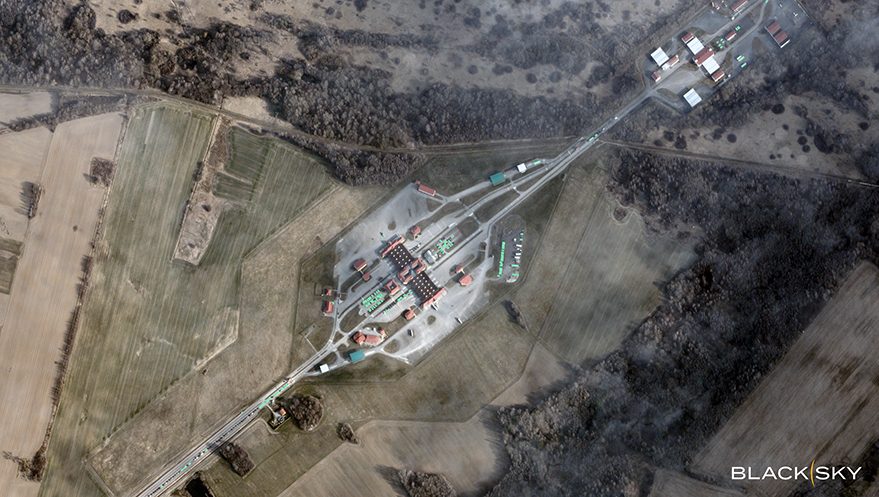
Table of Contents
The End of the Static Border
For decades, border security was defined by the ‘line’—a physical perimeter monitored by patrols, cameras, and intermittent aerial reconnaissance. But across Europe, that perimeter has become a fluid, high-tempo environment. From shifting maritime routes in the Mediterranean to the rapid dispersal of staging areas in land corridors, the nature of border activity now changes in hours, not days.
The primary challenge for ministries of interior and national security agencies is no longer a lack of data, but a lack of tempo. In the time it takes for a traditional satellite image to be captured, processed, and delivered to a command center, the target—be it a convoy of vehicles or a small maritime vessel—has often already moved. This lag creates a ‘decision gap’ that organized facilitation networks exploit to evade detection.
Enter the era of high-frequency, low-latency orbital intelligence. Companies like BlackSky are pivoting away from the traditional model of ‘snapshots’ and toward a model of persistent monitoring, treating the earth’s surface more like a live feed than a photo album.
Compressing the Decision Cycle
At the tactical level, the objective is simple: situational awareness in real-time. When a security agency identifies a suspected staging area, the critical metric is the ‘revisit rate’—how often a satellite can pass over the exact same coordinates. While traditional providers might offer a glimpse every few days, the new generation of SmallSat constellations allows for hourly or daily revisits.
This frequency allows analysts to distinguish between a random gathering of vehicles and a coordinated logistics node. By layering AI-enabled analytics over these images, the system can automatically flag anomalies—such as a sudden concentration of aircraft in a non-transit corridor—without requiring a human analyst to manually scan thousands of square kilometers of imagery.
This shift moves the operation from a reactive posture to a proactive one. Instead of deploying assets based on a report from twelve hours ago, commanders can redirect interceptors or patrols based on activity detected within the last sixty minutes. In an environment where organized networks are highly adaptive, this compression of the decision cycle is the only way to maintain a strategic advantage.
From Tactical Snapshots to Pattern-of-Life Analysis
Beyond immediate detection, the accumulation of high-frequency data enables what intelligence officers call ‘pattern-of-life’ analysis. By observing a specific region over weeks or months, security agencies can identify the invisible infrastructure of border crossings: the recurring transportation hubs, the predictable cycles of movement, and the evolution of smuggling routes.
This longitudinal data provides a strategic layer that traditional patrols cannot. It reveals whether a shift in activity is a one-off event or a systemic change in how a network operates. When planners can see a pressure point developing in a specific sector before it peaks, they can reallocate resources across a region, preventing any single point of entry from becoming overwhelmed.
The Integration of AI and Orbit
The technical hurdle has always been the volume of data. High-resolution imagery is cumbersome; processing it manually is slow. The integration of automated object detection—specifically designed to classify vessels, vehicles, and aircraft—is what makes high-frequency monitoring operationally actionable.
By automating the ‘detection’ phase, the human analyst is moved to the ‘interpretation’ phase. They are no longer looking for the needle in the haystack; they are analyzing why the needle is there and where it is likely to go next. This synergy between BlackSky’s low-latency constellation and AI-driven classification is transforming the border from a line to be guarded into a dynamic system to be managed.
As European borders continue to face complex mobility challenges, the reliance on commercial space-based intelligence is likely to grow. The strategic necessity is clear: in a world of rapid adaptation, the side that sees the fastest, decides the fastest, and moves the fastest wins.