Taiwan Deploys HIMARS in First Live-Fire Drills Facing the Mainland
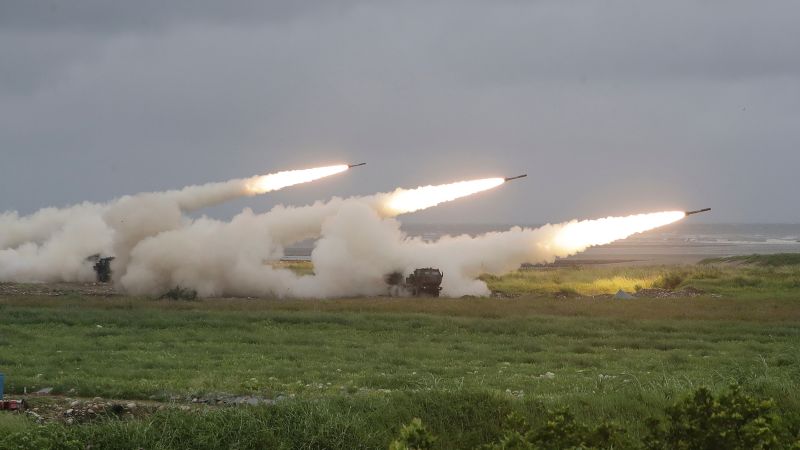
Table of Contents
Precision over Power: The Shift to Asymmetric Defense
Taiwan’s military has shifted its tactical focus toward high-mobility, precision strikes, culminating in a series of live-fire exercises on Wednesday. For the first time, the army deployed the US-supplied High Mobility Artillery Rocket System (HIMARS), firing rockets directly into the waters of the Taiwan Strait. While the system has undergone previous testing, the decision to orient the launches toward the mainland is a pointed demonstration of the island’s defensive readiness.
The drills, centered in Taichung, were not merely a test of hardware but a rehearsal of a specific strategic philosophy: asymmetric warfare. Rather than attempting to match China’s massive naval and aerial tonnage—a feat virtually impossible for a smaller island nation—Taiwan is increasingly relying on “shoot-and-scoot” tactics. This approach prioritizes agility and stealth, using truck-mounted rocket pods that can emerge from concealed positions, launch a precision volley, and relocate before the enemy can coordinate a counter-strike.
The Mechanics of ‘Shoot-and-Scoot’
During the exercise, the HIMARS units demonstrated the rapid deployment cycles necessary for survival in a modern conflict environment. Upon receiving firing orders, the vehicles maneuvered into position and launched rockets within a three-minute window. This speed is critical; in a scenario involving satellite surveillance and drone spotting, any stationary launcher is a target.
To manage safety and political sensitivities, the military utilized reduced-range practice rockets. These munitions are designed to simulate the trajectory and launch sequence of combat rounds but fall into the water shortly after leaving the coast. Despite the reduced range, the operational intent was clear. When questioned by CNN’s Jim Sciutto, Alexander Yui, Taiwan’s representative to the US, framed the geography as a simple binary: “We’re an island; we can only shoot east or west, so they chose west.”
Integrating the 155mm Howitzer
The HIMARS were not the only systems tested during the two-day operation on the west coast. The drills also integrated 155mm howitzers, blending long-range rocket precision with traditional heavy artillery. This layered approach is intended to create a “denial zone” along the coast, making any amphibious landing operation prohibitively costly for an invading force.
The integration of these systems reflects a broader US-encouraged transition in Taiwan’s procurement strategy. The shift moves away from “big-ticket” platforms—like massive naval vessels or expensive fighter jets that are vulnerable to first-strike attacks—toward a distributed network of mobile, lethal, and hard-to-detect assets.
The Geopolitical Friction of Arms Sales
The timing of these drills coincides with a complex period of diplomacy. In December, the United States announced plans to sell an additional 82 HIMARS systems to Taiwan. However, this arms package has faced headwinds, appearing to be put on hold following high-level meetings between President Donald Trump and Chinese leader Xi Jinping in Beijing last month.
This tension underscores the delicate balance the US maintains: opposing any forced change to Taiwan’s status while managing the strategic relationship with China. For Taiwan, the delay in additional hardware makes the mastery of existing systems—like the HIMARS—even more vital. As China continues to increase the frequency of warships and aircraft entering the skies and waters near the island, Taiwan’s military is betting that mobility and precision will be its most effective deterrent.